
Seeing the TrojanDropper:Win32/Sirefef detection means that your PC is in big danger. This computer virus can correctly be identified as ransomware – type of malware which ciphers your files and forces you to pay for their decryption. Removing it requires some specific steps that must be taken as soon as possible.
TrojanDropper:Win32/Sirefef detection is a virus detection you can spectate in your computer. It frequently appears after the preliminary procedures on your PC – opening the suspicious email, clicking the advertisement in the Internet or setting up the program from unreliable sources. From the moment it shows up, you have a short time to act until it begins its destructive activity. And be sure – it is far better not to await these harmful things.
What is TrojanDropper:Win32/Sirefef virus?
TrojanDropper:Win32/Sirefef Summary
In summary, TrojanDropper:Win32/Sirefef ransomware activities in the infected PC are next:
- Behavioural detection: Executable code extraction – unpacking;
- Sample contains Overlay data;
- Uses Windows utilities for basic functionality;
- Reads data out of its own binary image;
- CAPE extracted potentially suspicious content;
- Authenticode signature is invalid;
- Uses Windows utilities to create a scheduled task;
- Behavioural detection: Injection (Process Hollowing);
- Behavioural detection: Injection (inter-process);
- Attempts to modify browser security settings;
- Creates a copy of itself;
- Attempts to disable browser security warnings;
- Anomalous binary characteristics;
- Uses suspicious command line tools or Windows utilities;
- Yara detections observed in process dumps, payloads or dropped files;
- Ciphering the documents located on the target’s disk — so the victim cannot use these files;
- Blocking the launching of .exe files of anti-virus apps
- Blocking the launching of installation files of anti-virus apps
Ransomware has been a horror story for the last 4 years. It is difficult to realize a more damaging virus for both individuals and companies. The algorithms utilized in TrojanDropper:Win32/Sirefef (generally, RHA-1028 or AES-256) are not hackable – with minor exclusions. To hack it with a brute force, you need more time than our galaxy currently exists, and possibly will exist. However, that virus does not do all these unpleasant things instantly – it may take up to a few hours to cipher all of your documents. Therefore, seeing the TrojanDropper:Win32/Sirefef detection is a clear signal that you must start the elimination procedure.
Where did I get the TrojanDropper:Win32/Sirefef?
Ordinary methods of TrojanDropper:Win32/Sirefef injection are usual for all other ransomware examples. Those are one-day landing websites where users are offered to download the free software, so-called bait e-mails and hacktools. Bait emails are a relatively modern method in malware distribution – you get the email that simulates some normal notifications about deliveries or bank service conditions shifts. Inside of the email, there is an infected MS Office file, or a web link which opens the exploit landing site.
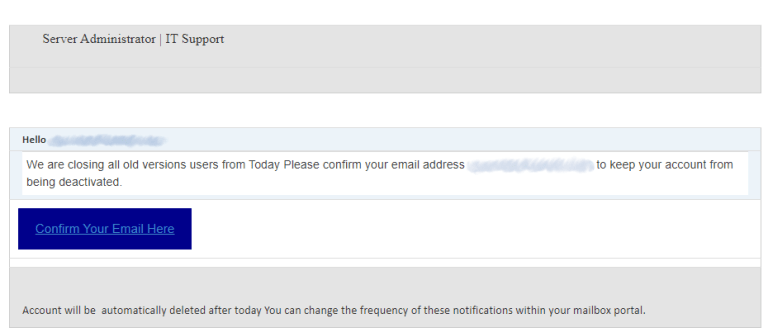
Malicious email message. This one tricks you to open the phishing website.
Avoiding it looks fairly uncomplicated, but still needs a lot of focus. Malware can hide in different spots, and it is far better to stop it even before it gets into your system than to rely upon an anti-malware program. General cybersecurity awareness is just an important thing in the modern world, even if your relationship with a computer stays on YouTube videos. That may keep you a lot of money and time which you would spend while searching for a solution.
TrojanDropper:Win32/Sirefef malware technical details
File Info:
name: DEF69F039626979D185C.mlwpath: /opt/CAPEv2/storage/binaries/f4c60f9cd48a8567dc68e2ee604f55bc3d5a67230459e787d71c2e615cb7c69dcrc32: 2EAA7AB4md5: def69f039626979d185c4cab463fdda6sha1: dc78ef6ec312df44c03b2f56db3f503c84cc694esha256: f4c60f9cd48a8567dc68e2ee604f55bc3d5a67230459e787d71c2e615cb7c69dsha512: 5fcadff5a9fb245876e40254917bbb8d7e2f2bd4bce98d7dde108eaaa657961b2a2081a856c1a6bbdf10fdb3adb7b7ae7e58014283705e419c36bfb13e72f6b3ssdeep: 6144:S/ZGI9E4wZX4mzfr0Ix/l//v/itjybQUMQ:SbPyZzfIIx/l/H/itj0/MQtype: PE32 executable (GUI) Intel 80386, for MS Windowstlsh: T1E544BF6BB544A0E6F177C4F87454F18BA91DEC3262A14C17B6C61B0A75B9382FEA031Fsha3_384: 0f31b4843d21858b9a289d3b959f7869c69164d992c264c111fca7c05f4b19eae3e5757aa367e9959ad19ad799d0eae1ep_bytes: 686c2b4000e8f0ffffff000000000000timestamp: 2013-09-25 18:33:56Version Info:
Translation: 0x0409 0x04b0CompanyName: MaliopersLichersProductName: SaloperdosMuchosFileVersion: 1.00ProductVersion: 1.00InternalName: KilogrammOriginalFilename: Kilogramm.exe
TrojanDropper:Win32/Sirefef also known as:
| Bkav | W32.AIDetectMalware |
| Lionic | Trojan.Win32.Blocker.V!c |
| Elastic | malicious (high confidence) |
| MicroWorld-eScan | Gen:Variant.Jaik.32980 |
| FireEye | Generic.mg.def69f039626979d |
| CAT-QuickHeal | Worm.Gamarue.I3 |
| Skyhigh | BehavesLike.Win32.Generic.dc |
| McAfee | PWS-Zbot.gen.oj |
| Malwarebytes | Generic.Malware/Suspicious |
| Zillya | Trojan.Blocker.Win32.11032 |
| Sangfor | Suspicious.Win32.Save.vb |
| K7AntiVirus | Trojan ( 0055e3991 ) |
| Alibaba | Ransom:Win32/Blocker.aa71c2af |
| K7GW | Trojan ( 0055e3991 ) |
| CrowdStrike | win/malicious_confidence_100% (W) |
| VirIT | Trojan.Win32.Generic.CNRE |
| Symantec | ML.Attribute.HighConfidence |
| ESET-NOD32 | a variant of Win32/Injector.ANKL |
| APEX | Malicious |
| TrendMicro-HouseCall | TROJ_SPNR.1AJ213 |
| Kaspersky | Trojan-Ransom.Win32.Blocker.cjpf |
| BitDefender | Gen:Variant.Jaik.32980 |
| NANO-Antivirus | Trojan.Win32.Blocker.crkzch |
| Avast | Win32:Emotet-AQ [Trj] |
| Tencent | Trojan-ransom.Win32.Blocker.cjpf |
| Emsisoft | Gen:Variant.Jaik.32980 (B) |
| F-Secure | Backdoor.BDS/Androm.atao |
| DrWeb | Trojan.Winlock.10061 |
| VIPRE | Gen:Variant.Jaik.32980 |
| TrendMicro | TROJ_SPNR.1AJ213 |
| Trapmine | suspicious.low.ml.score |
| Sophos | Mal/Generic-S |
| SentinelOne | Static AI – Malicious PE |
| MAX | malware (ai score=100) |
| Jiangmin | Trojan/Blocker.grc |
| Detected | |
| Avira | BDS/Androm.atao |
| Varist | W32/VBInject.ER.gen!Eldorado |
| Antiy-AVL | Trojan[Ransom]/Win32.Blocker |
| Kingsoft | malware.kb.a.1000 |
| Microsoft | TrojanDropper:Win32/Sirefef |
| Xcitium | TrojWare.Win32.Injector.ANJM@52gqk7 |
| Arcabit | Trojan.Jaik.D80D4 |
| ZoneAlarm | Trojan-Ransom.Win32.Blocker.cjpf |
| GData | Gen:Variant.Jaik.32980 |
| Cynet | Malicious (score: 100) |
| AhnLab-V3 | Trojan/Win32.Agent.R83144 |
| BitDefenderTheta | Gen:NN.ZevbaF.36802.pm3@aql6oZc |
| ALYac | Gen:Variant.Jaik.32980 |
| VBA32 | Hoax.Blocker |
| Cylance | unsafe |
| Panda | Trj/Genetic.gen |
| Rising | Dropper.Sirefef!8.525 (TFE:3:ahzkoURDhaF) |
| Yandex | Trojan.GenAsa!cX5IU/a6vhg |
| Ikarus | Trojan-Downloader.Win32.Obvod |
| MaxSecure | Trojan.Malware.6453065.susgen |
| Fortinet | W32/Injector.ALXK!tr |
| AVG | Win32:Emotet-AQ [Trj] |
| Cybereason | malicious.396269 |
| DeepInstinct | MALICIOUS |
| alibabacloud | Ransomware:Win/Blocker.cjpf |


Leave a Comment