
If you spectate the alert of Trojan:Win32/LnkPhish.A detection, it looks like that your system has a problem. All malicious programs are dangerous, without any deviations. LnkPhish.A is a malicious software that aims at exposing your computer to further malware injection. The majority of the modern malware examples are complex, and can inject various other viruses. Getting the Trojan:Win32/LnkPhish.A virus often equals to getting a malicious thing which can act like spyware or stealer, downloader, and a backdoor. Spectating this detection means that you must to perform the removal as fast as you can.
What does the pop-up with Trojan:Win32/LnkPhish.A detection mean?
The Trojan:Win32/LnkPhish.A detection you can see in the lower right corner is shown to you by Microsoft Defender. That anti-malware software is good at scanning, however, prone to be mainly unstable. It is defenseless to malware attacks, it has a glitchy user interface and problematic malware removal features. Hence, the pop-up which states about the LnkPhish.A is just a notification that Defender has actually found it. To remove it, you will likely need to make use of another anti-malware program.
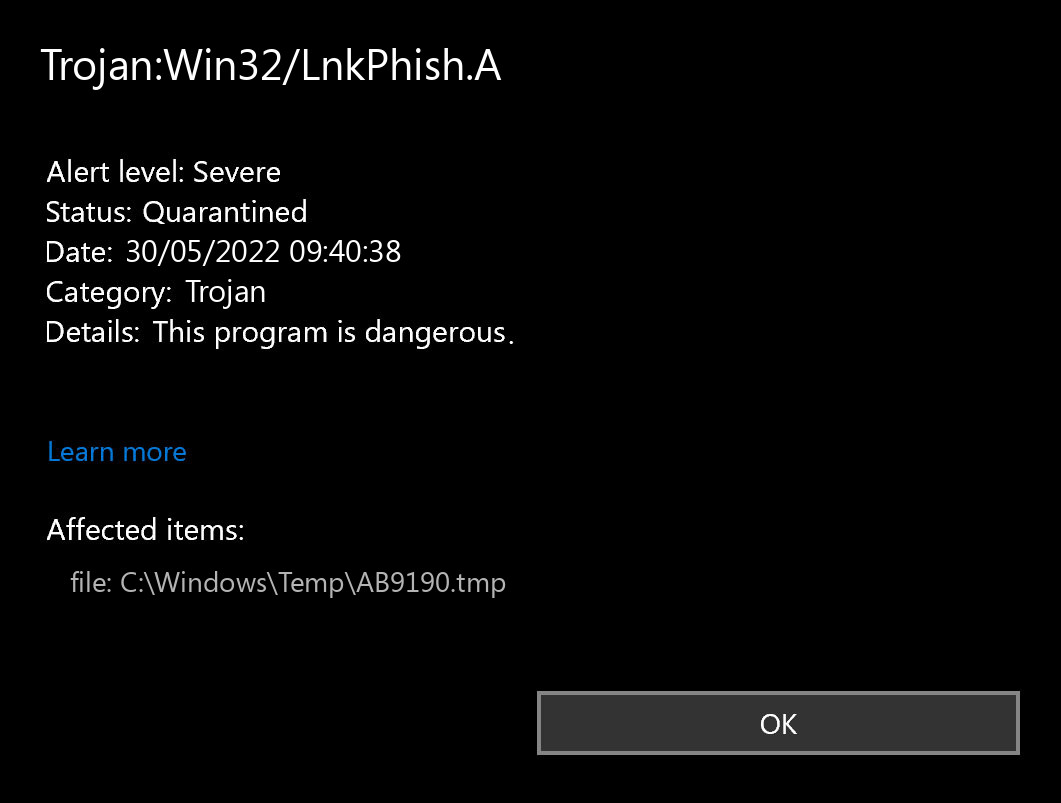
Microsoft Defender: “Trojan:Win32/LnkPhish.A”
The exact Trojan:Win32/LnkPhish.A virus is a very nasty thing. It digs inside of your PC disguised as a part of something normal, or as a part of the app you downloaded from a forum. After that, it makes all possible steps to make your system weaker. At the end of this “party”, it injects other malicious things – ones which are choosen by crooks who control this virus. Hence, it is impossible to predict the effects from LnkPhish.A actions. And the unpredictability is one of the most unwanted things when we are talking about malware. That’s why it is rather not to choose at all, and don’t let the malware to complete its task.
Threat Summary:
| Name | LnkPhish.A Trojan |
| Detection | Trojan:Win32/LnkPhish.A |
| Details | LnkPhish.A tool that looks legitimate but can take control of your computer. |
Is Trojan:Win32/LnkPhish.A dangerous?
As I have actually stated , non-harmful malware does not exist. And Trojan:Win32/LnkPhish.A is not an exception. This virus alters the system configurations, modifies the Group Policies and Windows registry. All of these components are critical for correct system functioning, even in case when we are not talking about system safety. Therefore, the virus which LnkPhish.A contains, or which it will download later, will try to get maximum profit from you. Cyber burglars can steal your personal information, and then push it on the Darknet. Using adware and browser hijacker functionality, embedded in Trojan:Win32/LnkPhish.A malware, they can make money by showing you the ads. Each view gives them a penny, but 100 views per day = $1. 1000 victims who watch 100 banners per day – $1000. Easy math, but sad conclusions. It is a bad choice to be a donkey for crooks.
How did I get this virus?
It is not easy to line the origins of malware on your PC. Nowadays, things are mixed, and distribution ways used by adware 5 years ago may be used by spyware nowadays. But if we abstract from the exact spreading way and will think of why it has success, the answer will be really simple – low level of cybersecurity awareness. People press on ads on weird websites, click the pop-ups they receive in their browsers, call the “Microsoft tech support” thinking that the odd banner that states about malware is true. It is necessary to understand what is legit – to avoid misconceptions when attempting to figure out a virus.
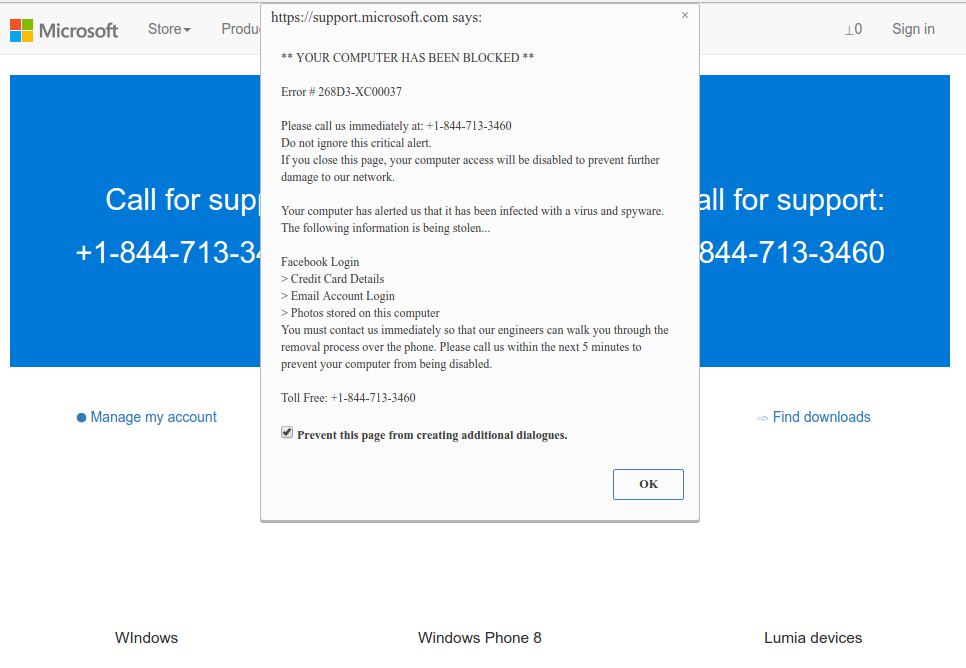
Microsoft Tech Support Scam
Nowadays, there are two of the most extensive ways of malware distribution – bait e-mails and injection into a hacked program. While the first one is not so easy to avoid – you need to know a lot to recognize a counterfeit – the 2nd one is very easy to handle: just do not use cracked applications. Torrent-trackers and various other providers of “totally free” applications (which are, exactly, paid, but with a disabled license checking) are just a giveaway place of malware. And Trojan:Win32/LnkPhish.A is simply amongst them.


Leave a Comment