
Spectating the Trojan-Ransom.Win32.Blocker.uajp malware detection usually means that your system is in big danger. This virus can correctly be named as ransomware – sort of malware which ciphers your files and asks you to pay for their decryption. Deleteing it requires some unusual steps that must be taken as soon as possible.
Trojan-Ransom.Win32.Blocker.uajp detection is a malware detection you can spectate in your system. It often shows up after the preliminary procedures on your PC – opening the untrustworthy email messages, clicking the banner in the Internet or setting up the program from unreliable sources. From the moment it shows up, you have a short time to do something about it until it begins its destructive activity. And be sure – it is much better not to wait for these malicious effects.
What is Trojan-Ransom.Win32.Blocker.uajp virus?
Trojan-Ransom.Win32.Blocker.uajp Summary
In summary, Trojan-Ransom.Win32.Blocker.uajp ransomware activities in the infected computer are next:
- Behavioural detection: Executable code extraction – unpacking;
- SetUnhandledExceptionFilter detected (possible anti-debug);
- Creates RWX memory;
- Possible date expiration check, exits too soon after checking local time;
- Anomalous file deletion behavior detected (10+);
- Dynamic (imported) function loading detected;
- Enumerates running processes;
- Reads data out of its own binary image;
- The binary contains an unknown PE section name indicative of packing;
- Authenticode signature is invalid;
- Tries to suspend Cuckoo threads to prevent logging of malicious activity;
- Behavioural detection: Injection (inter-process);
- Creates or sets a registry key to a long series of bytes, possibly to store a binary or malware config;
- Installs itself for autorun at Windows startup;
- Anomalous binary characteristics;
- Encrypting the documents kept on the victim’s disk drives — so the victim cannot check these documents;
- Blocking the launching of .exe files of anti-virus programs
- Blocking the launching of installation files of anti-malware programs
Ransomware has actually been a nightmare for the last 4 years. It is hard to picture a more dangerous virus for both individuals and organizations. The algorithms used in Trojan-Ransom.Win32.Blocker.uajp (generally, RHA-1028 or AES-256) are not hackable – with minor exclusions. To hack it with a brute force, you need to have a lot more time than our galaxy already exists, and possibly will exist. But that virus does not do all these unpleasant things immediately – it can require up to a few hours to cipher all of your files. Therefore, seeing the Trojan-Ransom.Win32.Blocker.uajp detection is a clear signal that you should begin the removal process.
Where did I get the Trojan-Ransom.Win32.Blocker.uajp?
Common ways of Trojan-Ransom.Win32.Blocker.uajp injection are usual for all other ransomware variants. Those are one-day landing sites where victims are offered to download and install the free program, so-called bait emails and hacktools. Bait e-mails are a pretty new tactic in malware distribution – you get the email that imitates some regular notifications about deliveries or bank service conditions changes. Inside of the email, there is a malicious MS Office file, or a link which opens the exploit landing site.
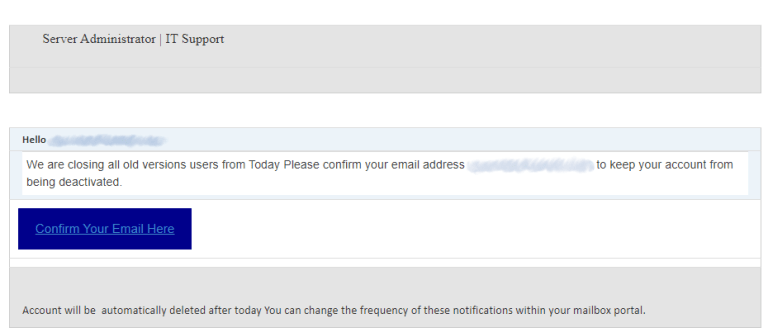
Malicious email message. This one tricks you to open the phishing website.
Avoiding it looks pretty uncomplicated, but still demands a lot of awareness. Malware can hide in various spots, and it is far better to stop it even before it goes into your PC than to rely upon an anti-malware program. Basic cybersecurity awareness is just an important thing in the modern world, even if your relationship with a PC stays on YouTube videos. That may save you a great deal of time and money which you would spend while searching for a fix guide.
Trojan-Ransom.Win32.Blocker.uajp malware technical details
File Info:
name: 162E5787B28208EB47C0.mlwpath: /opt/CAPEv2/storage/binaries/7f1cc6211bca7f57b7248b5ccfc55c202347b7d4446b14d45a6869bcf9f83b43crc32: BA448BF9md5: 162e5787b28208eb47c024893f696247sha1: 2501bf3345d2b92c2f0a03a4dd0b05d425ccac74sha256: 7f1cc6211bca7f57b7248b5ccfc55c202347b7d4446b14d45a6869bcf9f83b43sha512: 1eb1d30d0a37a0c5d3283e6439e12976b8ec4c72a132c4cf2c464a24441c61f297333fbdc8627f65a670551530dc355b8286ca7414a093f9a5c407225950690assdeep: 196608:SI+4s1L8hAqib1xpnQyPJJo6dB8G4LPaMkjufDT:SIBaGQBxpQyhJonzPkKntype: PE32 executable (GUI) Intel 80386, for MS Windowstlsh: T1BA76334264E6E1BAE150F671261E44140EB7FD8968F09CE97CAEB884BF77972DC0025Fsha3_384: f325f1e015543c71db86355ead139af95e35f6509d58a3b5bffeffc71128f4cb0195ce5f36a2567db5b57f959b22d4bdep_bytes: 558bec83c4c453565733c08945f08945timestamp: 1992-06-19 22:22:17Version Info:
Comments: This installation was built with Inno Setup.CompanyName: LRepacks FileDescription: ScreenHunter Pro Setup FileVersion: 7.0.1261.0 LegalCopyright: Copyright 2007-2021 LRepacks ProductName: ScreenHunter Pro ProductVersion: 7.0.1261 Translation: 0x0000 0x04b0
Trojan-Ransom.Win32.Blocker.uajp also known as:
| Cylance | Unsafe |
| Zillya | Trojan.Blocker.Win32.61637 |
| Sangfor | Trojan.Win32.Gen.MBT |
| K7AntiVirus | Unwanted-Program ( 005727961 ) |
| K7GW | Unwanted-Program ( 005727961 ) |
| Symantec | Trojan.Gen.MBT |
| ESET-NOD32 | a variant of Win32/HackTool.Crack.KN potentially unsafe |
| Paloalto | generic.ml |
| Kaspersky | Trojan-Ransom.Win32.Blocker.uajp |
| Avast | FileRepMalware |
| Sophos | DownWare (PUA) |
| McAfee-GW-Edition | BehavesLike.Win32.BadFile.wc |
| Jiangmin | Trojan.Blocker.ubc |
| Microsoft | PUA:Win32/Puamson.A!ml |
| McAfee | Artemis!162E5787B282 |
| VBA32 | TrojanRansom.Blocker |
| Malwarebytes | Generic.Malware/Suspicious |
| Yandex | Trojan.Blocker!8i3FPPxXXj4 |
| Fortinet | Riskware/Crack |
| AVG | FileRepMalware |
| Panda | Trj/CI.A |


Leave a Comment