
Seeing the Troj/Blind-A malware detection usually means that your PC is in big danger. This malware can correctly be identified as ransomware – sort of malware which encrypts your files and forces you to pay for their decryption. Stopping it requires some specific steps that must be done as soon as possible.
Troj/Blind-A detection is a malware detection you can spectate in your computer. It often shows up after the preliminary actions on your PC – opening the suspicious email, clicking the advertisement in the Web or setting up the program from unreliable sources. From the instance it appears, you have a short time to act until it begins its harmful activity. And be sure – it is much better not to await these destructive effects.
What is Troj/Blind-A virus?
Troj/Blind-A Summary
In total, Troj/Blind-A malware actions in the infected computer are next:
- SetUnhandledExceptionFilter detected (possible anti-debug);
- Dynamic (imported) function loading detected;
- Yara rule detections observed from a process memory dump/dropped files/CAPE;
- Enumerates running processes;
- Manipulates data from or to the Recycle Bin;
- Authenticode signature is invalid;
- Uses Windows utilities for basic functionality;
- Attempts to delete or modify volume shadow copies;
- Writes a potential ransom message to disk;
- Modifies boot configuration settings;
- Exhibits possible ransomware file modification behavior;
- Likely virus infection of existing system binary;
- Creates a known Estemani ransomware decryption instruction / key file.;
- Uses suspicious command line tools or Windows utilities;
- Encrypting the documents kept on the victim’s disks — so the victim cannot use these files;
- Blocking the launching of .exe files of anti-virus apps
- Blocking the launching of installation files of anti-malware programs
Ransomware has been a headache for the last 4 years. It is hard to picture a more harmful malware for both individuals and organizations. The algorithms used in Troj/Blind-A (usually, RHA-1028 or AES-256) are not hackable – with minor exclusions. To hack it with a brute force, you need a lot more time than our galaxy currently exists, and possibly will exist. But that malware does not do all these bad things instantly – it may require up to several hours to cipher all of your files. Therefore, seeing the Troj/Blind-A detection is a clear signal that you should begin the elimination process.
Where did I get the Troj/Blind-A?
Common ways of Troj/Blind-A distribution are usual for all other ransomware examples. Those are one-day landing web pages where users are offered to download and install the free program, so-called bait e-mails and hacktools. Bait e-mails are a pretty new strategy in malware spreading – you receive the email that imitates some regular notifications about shippings or bank service conditions updates. Inside of the email, there is a malicious MS Office file, or a link which opens the exploit landing site.
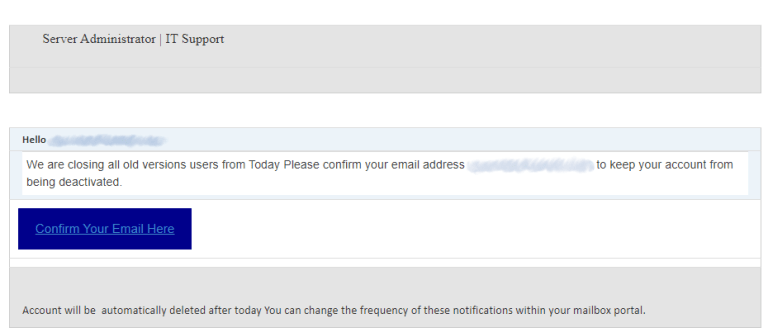
Malicious email message. This one tricks you to open the phishing website.
Avoiding it looks pretty simple, however, still needs a lot of recognition. Malware can hide in different places, and it is far better to stop it even before it gets into your system than to depend on an anti-malware program. Basic cybersecurity knowledge is just an essential item in the modern world, even if your relationship with a computer remains on YouTube videos. That can save you a great deal of money and time which you would certainly spend while looking for a solution.
Troj/Blind-A malware technical details
File Info:
name: CF210898BDFD3CC88171.mlwpath: /opt/CAPEv2/storage/binaries/4ef1d3ae0c97521e4249fcd7950c10c2e0cd22b031edf567e91476343f67ff54crc32: AFD0CD42md5: cf210898bdfd3cc88171a4650c753725sha1: 8442cf03bc61b4489519dc67aa3ff1bcc5d7e7bfsha256: 4ef1d3ae0c97521e4249fcd7950c10c2e0cd22b031edf567e91476343f67ff54sha512: 6d9b9d5c83b77471deeab5242fd143cf005f64f75b2aa7feed61d1b22d70d85ce18931deb15db7bdf3458c45baed7dd7f96a163b45004bf831759bd2b155971bssdeep: 12288:eP5k4IOwA7+OeO+OeNhBBhhBBcvRe3525djsUTpStRuiJMWte5uAnIsyRdstwVAw:0k4IOwAvReM55sdxzteBRgFAQhIrGdN/type: PE32 executable (GUI) Intel 80386, for MS Windowstlsh: T12FE48E22BA93E0B2C5BA11B10D2CF70D63BFB85549759B7F77E80B1D1FB01809A196D2sha3_384: b3bbe884678d3588bf639f186c826ba34f947cb3574f684496bf6a7647818c31ce98358e7a66c5e3799a4e4967d66765ep_bytes: e890e50000e97ffeffff558bec83ec20timestamp: 2017-11-26 22:29:54Version Info:
0: [No Data]
Troj/Blind-A also known as:
| Bkav | W32.AIDetect.malware2 |
| Elastic | malicious (high confidence) |
| MicroWorld-eScan | Gen:Heur.Ransom.REntS.Gen.1 |
| FireEye | Generic.mg.cf210898bdfd3cc8 |
| McAfee | Artemis!CF210898BDFD |
| Cybereason | malicious.8bdfd3 |
| BitDefenderTheta | Gen:NN.ZexaF.34182.PuW@aKTzA0li |
| Cyren | W32/Trojan.HVUY-3084 |
| Symantec | ML.Attribute.HighConfidence |
| ESET-NOD32 | a variant of Win32/Filecoder.NNZ |
| BitDefender | Gen:Heur.Ransom.REntS.Gen.1 |
| Ad-Aware | Gen:Heur.Ransom.REntS.Gen.1 |
| Sophos | Troj/Blind-A |
| McAfee-GW-Edition | BehavesLike.Win32.Multiplug.jh |
| SentinelOne | Static AI – Suspicious PE |
| Emsisoft | Gen:Heur.Ransom.REntS.Gen.1 (B) |
| Jiangmin | Trojan.Gen.ou |
| MaxSecure | Trojan.Malware.300983.susgen |
| Avira | ADWARE/Amonetize.Gen7 |
| Microsoft | Trojan:Script/Phonzy.C!ml |
| GData | Gen:Heur.Ransom.REntS.Gen.1 |
| Cynet | Malicious (score: 100) |
| AhnLab-V3 | Trojan/Win32.Gen |
| ALYac | Gen:Heur.Ransom.REntS.Gen.1 |
| APEX | Malicious |
| Rising | Malware.Heuristic!ET#90% (RDMK:cmRtazrAa6T8XGQCoueWZhOEYgxO) |
| Yandex | Trojan.GenAsa!g08EJTuTBrQ |
| MAX | malware (ai score=80) |
| eGambit | Unsafe.AI_Score_99% |
| Fortinet | W32/Filecoder.NNZ!tr |
| Panda | Trj/GdSda.A |


Leave a Comment