
Seeing the Ransom:Win32/Yanluow.STA malware detection means that your system is in big danger. This virus can correctly be identified as ransomware – type of malware which ciphers your files and asks you to pay for their decryption. Deleteing it requires some peculiar steps that must be done as soon as possible.
Ransom:Win32/Yanluow.STA detection is a virus detection you can spectate in your system. It usually appears after the preliminary actions on your computer – opening the dubious email, clicking the banner in the Web or setting up the program from unreliable sources. From the instance it shows up, you have a short time to take action until it starts its malicious action. And be sure – it is far better not to await these harmful effects.
What is Ransom:Win32/Yanluow.STA virus?
Ransom:Win32/Yanluow.STA Summary
Summarizingly, Ransom:Win32/Yanluow.STA ransomware activities in the infected PC are next:
- SetUnhandledExceptionFilter detected (possible anti-debug);
- Presents an Authenticode digital signature;
- Dynamic (imported) function loading detected;
- Authenticode signature is invalid;
- Ciphering the files kept on the target’s disk — so the victim cannot use these files;
- Blocking the launching of .exe files of anti-malware apps
- Blocking the launching of installation files of anti-virus programs
Ransomware has actually been a nightmare for the last 4 years. It is hard to realize a more dangerous malware for both individual users and corporations. The algorithms used in Ransom:Win32/Yanluow.STA (usually, RHA-1028 or AES-256) are not hackable – with minor exclusions. To hack it with a brute force, you need to have more time than our galaxy currently exists, and possibly will exist. But that malware does not do all these bad things without delay – it can require up to several hours to cipher all of your documents. Therefore, seeing the Ransom:Win32/Yanluow.STA detection is a clear signal that you have to begin the clearing procedure.
Where did I get the Ransom:Win32/Yanluow.STA?
General methods of Ransom:Win32/Yanluow.STA distribution are usual for all other ransomware variants. Those are one-day landing websites where users are offered to download the free program, so-called bait e-mails and hacktools. Bait e-mails are a quite modern strategy in malware distribution – you get the e-mail that imitates some normal notifications about deliveries or bank service conditions changes. Inside of the e-mail, there is an infected MS Office file, or a link which leads to the exploit landing page.
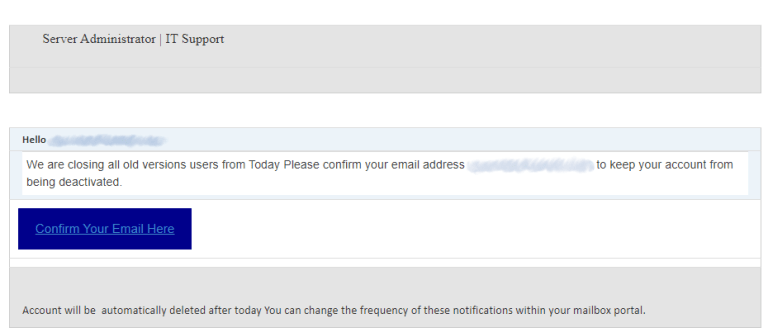
Malicious email message. This one tricks you to open the phishing website.
Preventing it looks quite uncomplicated, but still needs a lot of attention. Malware can hide in different places, and it is better to stop it even before it goes into your computer than to trust in an anti-malware program. Standard cybersecurity knowledge is just an important thing in the modern world, even if your relationship with a computer remains on YouTube videos. That can keep you a great deal of time and money which you would certainly spend while trying to find a solution.
Ransom:Win32/Yanluow.STA malware technical details
File Info:
name: AFAF2D4EBB6DC47E79A9.mlwpath: /opt/CAPEv2/storage/binaries/d11793433065633b84567de403c1989640a07c9a399dd2753aaf118891ce791ccrc32: 7392B74Dmd5: afaf2d4ebb6dc47e79a955df5ad1fc8asha1: c418ce055d97928f94ba06b5de8124a601d8f632sha256: d11793433065633b84567de403c1989640a07c9a399dd2753aaf118891ce791csha512: 321424ac21ebdb7f759a84236cb95c533b3000b3143099e1697f4a1f534c11782dafa68e5fa9e662b973b9669c1177b69c2fd0b83455625e57aa123385f581e6ssdeep: 12288:EfaLQyGK6kAa2XgsA1RUa+jE6S3qRTjO0:EwIHnXp/O0type: PE32 executable (console) Intel 80386, for MS Windowstlsh: T176948D60F543F472D46248F44E38EA66B92DEC191B745AEB73D83A3A8D740D01A33FA5sha3_384: e7849f16ed08daa8b3595ef3da96269186c94e55dab5e5a93eb5d9ea551b468dca8a35190a58569cb8272d4dacef624bep_bytes: e8ae0a0000e974feffff8b4df464890dtimestamp: 2021-09-18 02:54:03Version Info:
0: [No Data]
Ransom:Win32/Yanluow.STA also known as:
| Lionic | Trojan.Win32.Agent.j!c |
| Elastic | malicious (moderate confidence) |
| DrWeb | Trojan.Encoder.34762 |
| MicroWorld-eScan | Trojan.GenericKD.47564204 |
| FireEye | Trojan.GenericKD.47564204 |
| CAT-QuickHeal | Ransom.Yanluowang.S25607602 |
| ALYac | Trojan.Ransom.Yanluowang |
| Cylance | Unsafe |
| K7AntiVirus | Riskware ( 0040eff71 ) |
| Alibaba | Ransom:Win32/Yanluow.3b77c770 |
| K7GW | Riskware ( 0040eff71 ) |
| CrowdStrike | win/malicious_confidence_100% (W) |
| Cyren | W32/ABRisk.XUCT-2855 |
| ESET-NOD32 | a variant of Win32/Filecoder.OJO |
| TrendMicro-HouseCall | Ransom.Win32.YANLUOWANG.THLOCBA |
| Paloalto | generic.ml |
| ClamAV | Win.Ransomware.Yanluowang-9902913-1 |
| Kaspersky | HEUR:Trojan-Ransom.Win32.Agent.gen |
| BitDefender | Trojan.GenericKD.47564204 |
| Tencent | Malware.Win32.Gencirc.11de89cb |
| Ad-Aware | Trojan.GenericKD.47564204 |
| Emsisoft | Trojan.GenericKD.47564204 (B) |
| Zillya | Trojan.Agent.Win32.2587905 |
| TrendMicro | Ransom.Win32.YANLUOWANG.THLOCBA |
| McAfee-GW-Edition | Artemis!Trojan |
| Sophos | Mal/Generic-R + Troj/Yanluow-A |
| Ikarus | Trojan.Crypter |
| Jiangmin | Trojan.Agent.dsqn |
| Webroot | W32.Malware.Gen |
| Avira | TR/Redcap.utgfq |
| Microsoft | Ransom:Win32/Yanluow.STA |
| GData | Trojan.GenericKD.47564204 |
| Cynet | Malicious (score: 99) |
| AhnLab-V3 | Ransomware/Win.YANLUOWANG.C4861686 |
| McAfee | Artemis!AFAF2D4EBB6D |
| VBA32 | TrojanRansom.Agent |
| Malwarebytes | Malware.AI.4278623743 |
| Panda | Trj/CI.A |
| Rising | Ransom.Yanluowang!1.DD67 (CLASSIC) |
| Yandex | Trojan.Filecoder!ldH3dZD/4sY |
| Fortinet | W32/Ylwransom.A!tr.ransom |
| AVG | Win32:Malware-gen |
| Avast | Win32:Malware-gen |


Leave a Comment