
Spectating the Ransom:Win32/WannaCrypt.F!dha malware detection means that your PC is in big danger. This malware can correctly be identified as ransomware – type of malware which ciphers your files and forces you to pay for their decryption. Removing it requires some peculiar steps that must be done as soon as possible.
Ransom:Win32/WannaCrypt.F!dha detection is a virus detection you can spectate in your system. It usually shows up after the provoking actions on your PC – opening the suspicious email, clicking the banner in the Web or installing the program from dubious resources. From the second it appears, you have a short time to act before it begins its destructive activity. And be sure – it is better not to await these harmful actions.
What is Ransom:Win32/WannaCrypt.F!dha virus?
Ransom:Win32/WannaCrypt.F!dha Summary
In total, Ransom:Win32/WannaCrypt.F!dha ransomware activities in the infected PC are next:
- Authenticode signature is invalid;
- Encrypting the files kept on the victim’s drive — so the victim cannot check these documents;
- Blocking the launching of .exe files of anti-malware programs
- Blocking the launching of installation files of anti-virus programs
Ransomware has actually been a horror story for the last 4 years. It is challenging to realize a more damaging virus for both individuals and organizations. The algorithms utilized in Ransom:Win32/WannaCrypt.F!dha (typically, RHA-1028 or AES-256) are not hackable – with minor exclusions. To hack it with a brute force, you need more time than our galaxy actually exists, and possibly will exist. However, that malware does not do all these bad things without delay – it may require up to a few hours to cipher all of your documents. Thus, seeing the Ransom:Win32/WannaCrypt.F!dha detection is a clear signal that you have to start the clearing procedure.
Where did I get the Ransom:Win32/WannaCrypt.F!dha?
Usual methods of Ransom:Win32/WannaCrypt.F!dha distribution are basic for all other ransomware variants. Those are one-day landing websites where victims are offered to download and install the free software, so-called bait e-mails and hacktools. Bait emails are a relatively new strategy in malware distribution – you get the email that mimics some regular notifications about shippings or bank service conditions changes. Within the email, there is a malicious MS Office file, or a web link which leads to the exploit landing site.
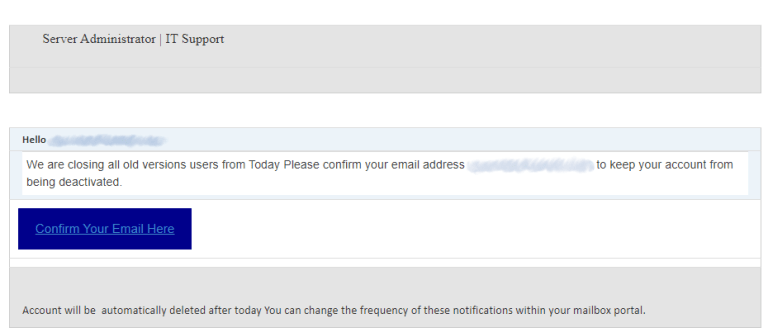
Malicious email message. This one tricks you to open the phishing website.
Avoiding it looks quite uncomplicated, but still needs a lot of awareness. Malware can hide in different places, and it is better to stop it even before it goes into your computer than to rely on an anti-malware program. Common cybersecurity awareness is just an essential item in the modern-day world, even if your interaction with a PC remains on YouTube videos. That can keep you a lot of time and money which you would spend while searching for a fix guide.
Ransom:Win32/WannaCrypt.F!dha malware technical details
File Info:
name: 447DF60943DB0D15AC58.mlwpath: /opt/CAPEv2/storage/binaries/76ff9d9e25aebdd318618cd3f4430a1217ba8e8faa1d04295c700defa2d7f691crc32: 39ABFA63md5: 447df60943db0d15ac588c4b1d566365sha1: 75e3f0c7cd3788f837fe2c49d0a7524c73d1302bsha256: 76ff9d9e25aebdd318618cd3f4430a1217ba8e8faa1d04295c700defa2d7f691sha512: b4c02126203673c5630613e20f64ac7a86e168bf40232e1245058695e8f1e89303641dd6c56ef083a76440c73168786230b7bc926dc43786a1eff230345b576dssdeep: 3072:p9pAawCOa8cK+tsUf/ildx0dFJtkoeV0XXPILEVTCW5DgSglPJTcMXaDuV+LydV6:nIagQildktM0XXPIYVTH5DgSgNakEDtype: PE32 executable (GUI) Intel 80386, for MS Windowstlsh: T1C514D096329CC0B8C0215174D8BB5F25F7B6FC6A1239864F73948B691F237D2BB25722sha3_384: a4525563c5c93210574b15c283ba68d2f07820b02ddf0a086a00d024dd644ab9b151c6dd8da4c15f365ef8f30e8f9beeep_bytes: 00000000000000000000000000000000timestamp: 2015-09-20 19:44:01Version Info:
0: [No Data]
Ransom:Win32/WannaCrypt.F!dha also known as:
| Bkav | W32.AIDetect.malware1 |
| Lionic | Worm.Win32.Generic.o!c |
| MicroWorld-eScan | DeepScan:Generic.Malware.W!wre!X.83F70098 |
| FireEye | Generic.mg.447df60943db0d15 |
| CAT-QuickHeal | Worm.Generic |
| ALYac | DeepScan:Generic.Malware.W!wre!X.83F70098 |
| Malwarebytes | Malware.AI.217352255 |
| K7AntiVirus | Riskware ( 0040eff71 ) |
| BitDefender | DeepScan:Generic.Malware.W!wre!X.83F70098 |
| K7GW | Riskware ( 0040eff71 ) |
| CrowdStrike | win/malicious_confidence_60% (W) |
| Symantec | ML.Attribute.HighConfidence |
| ESET-NOD32 | a variant of Generik.GNCVZME |
| APEX | Malicious |
| Paloalto | generic.ml |
| ClamAV | BC.Win.Exploit.Exe_With_CVE_2017_0147-6316126-2 |
| Kaspersky | HEUR:Worm.Win32.Generic |
| Alibaba | Ransom:Win32/WannaCrypt.8b770e6f |
| Rising | Exploit.EternalBlue!1.AAED (CLASSIC) |
| Ad-Aware | DeepScan:Generic.Malware.W!wre!X.83F70098 |
| Emsisoft | DeepScan:Generic.Malware.W!wre!X.83F70098 (B) |
| DrWeb | Trojan.Encoder.11432 |
| McAfee-GW-Edition | Artemis!Trojan |
| Sophos | Mal/Generic-S |
| Ikarus | Trojan-Ransom.WannaCrypt |
| Avira | TR/AD.DPulsarShellcode.jainw |
| MAX | malware (ai score=83) |
| Microsoft | Ransom:Win32/WannaCrypt.F!dha |
| Arcabit | DeepScan:Generic.Malware.W!wre!X.83F70098 |
| Cynet | Malicious (score: 100) |
| McAfee | Artemis!447DF60943DB |
| VBA32 | TrojanRansom.Wanna |
| Cylance | Unsafe |
| Panda | Trj/CI.A |
| TrendMicro-HouseCall | Ransom_WannaCrypt.R002C0DKP21 |
| Tencent | Trojan.Win32.BitCoinMiner.la |
| SentinelOne | Static AI – Suspicious PE |
| eGambit | Trojan.Generic |
| Fortinet | W32/PossibleThreat |
| AVG | Sf:WNCryLdr-A [Trj] |
| Cybereason | malicious.943db0 |


Leave a Comment