
Seeing the Ransom:Win32/StopCrypt.SLC!MTB malware detection usually means that your system is in big danger. This malware can correctly be named as ransomware – type of malware which ciphers your files and asks you to pay for their decryption. Stopping it requires some peculiar steps that must be taken as soon as possible.
Ransom:Win32/StopCrypt.SLC!MTB detection is a virus detection you can spectate in your system. It frequently shows up after the preliminary procedures on your PC – opening the dubious e-mail messages, clicking the banner in the Web or mounting the program from dubious sources. From the second it appears, you have a short time to do something about it before it begins its harmful activity. And be sure – it is far better not to wait for these harmful effects.
What is Ransom:Win32/StopCrypt.SLC!MTB virus?
Ransom:Win32/StopCrypt.SLC!MTB Summary
In summary, Ransom:Win32/StopCrypt.SLC!MTB malware actions in the infected system are next:
- Sample contains Overlay data;
- The binary likely contains encrypted or compressed data.;
- Authenticode signature is invalid;
- Anomalous binary characteristics;
- Encrypting the documents located on the victim’s disk drives — so the victim cannot use these files;
- Blocking the launching of .exe files of anti-virus programs
- Blocking the launching of installation files of anti-malware apps
Ransomware has been a nightmare for the last 4 years. It is challenging to realize a more hazardous virus for both individual users and companies. The algorithms utilized in Ransom:Win32/StopCrypt.SLC!MTB (typically, RHA-1028 or AES-256) are not hackable – with minor exclusions. To hack it with a brute force, you need a lot more time than our galaxy actually exists, and possibly will exist. But that virus does not do all these bad things instantly – it may take up to a few hours to cipher all of your documents. Hence, seeing the Ransom:Win32/StopCrypt.SLC!MTB detection is a clear signal that you need to start the clearing process.
Where did I get the Ransom:Win32/StopCrypt.SLC!MTB?
Routine tactics of Ransom:Win32/StopCrypt.SLC!MTB injection are basic for all other ransomware variants. Those are one-day landing web pages where users are offered to download the free program, so-called bait emails and hacktools. Bait emails are a pretty new method in malware distribution – you get the email that imitates some regular notifications about deliveries or bank service conditions changes. Inside of the e-mail, there is a malicious MS Office file, or a web link which leads to the exploit landing page.
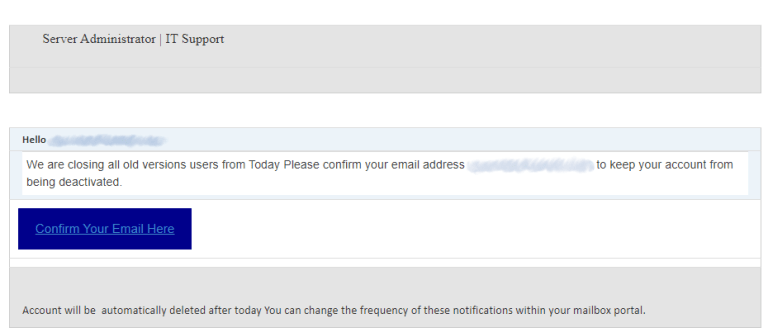
Malicious email message. This one tricks you to open the phishing website.
Preventing it looks pretty simple, however, still requires a lot of awareness. Malware can hide in various spots, and it is far better to stop it even before it invades your computer than to trust in an anti-malware program. Basic cybersecurity knowledge is just an important item in the modern world, even if your relationship with a computer stays on YouTube videos. That can keep you a great deal of time and money which you would spend while trying to find a solution.
Ransom:Win32/StopCrypt.SLC!MTB malware technical details
File Info:
name: ED4C053FF28FB9B5910E.mlwpath: /opt/CAPEv2/storage/binaries/9285dfe89769aefb54220765e9a340f2ff6e689916090e2a8b428ec2ebc072e1crc32: C791220Cmd5: ed4c053ff28fb9b5910e295100b7b7e7sha1: b494be70c5cd004499a1807a6023e4e0d1f9af3fsha256: 9285dfe89769aefb54220765e9a340f2ff6e689916090e2a8b428ec2ebc072e1sha512: e8d3b5bba0003795c988620d5c1dd6b61c61c65ecbcecfc41a9ce111e40c61f967f48639e66a1c4559204a89fb3589c8c92751bbecac92dbd073af5d59df7d8assdeep: 6144:tjqSBPy2QLA0Mnd1WEBC94P40DV9Le82jaf:tjnPy2oVMnd1WtSgd4type: PE32 executable (GUI) Intel 80386, for MS Windowstlsh: T11A440225F3A0C576D0D22D3054A1DAE259BD75222278D99B6BA80E3D6F303C0DB7939Fsha3_384: ffaf9a4401e3d4e781927f92044caed80a1d2f7cbe9ae373732d49961824129e6d29307a8cc1d367b29f84839ea6bdbdep_bytes: e8964f0000e989feffff8bff558bec83timestamp: 2021-08-28 21:46:35Version Info:
0: [No Data]
Ransom:Win32/StopCrypt.SLC!MTB also known as:
| Bkav | W32.AIDetect.malware2 |
| MicroWorld-eScan | Trojan.GenericKDZ.91244 |
| FireEye | Generic.mg.ed4c053ff28fb9b5 |
| Sangfor | Trojan.Win32.Save.a |
| Alibaba | Trojan:Application/Kryptik.af093ee2 |
| Cybereason | malicious.0c5cd0 |
| Symantec | Trojan.Gen.2 |
| Elastic | malicious (high confidence) |
| ESET-NOD32 | a variant of Win32/Kryptik.HQNV |
| APEX | Malicious |
| BitDefender | Trojan.GenericKDZ.91244 |
| Emsisoft | Trojan.GenericKDZ.91244 (B) |
| McAfee-GW-Edition | BehavesLike.Win32.Dropper.dc |
| Trapmine | malicious.high.ml.score |
| Sophos | ML/PE-A |
| SentinelOne | Static AI – Malicious PE |
| GData | Trojan.GenericKDZ.91244 |
| Microsoft | Ransom:Win32/StopCrypt.SLC!MTB |
| Cynet | Malicious (score: 100) |
| AhnLab-V3 | Packed/Win.GEE.R512324 |
| McAfee | Artemis!ED4C053FF28F |
| MAX | malware (ai score=87) |
| Malwarebytes | Malware.AI.15583812 |
| Rising | [email protected] (RDML:ArWb2UYW+O/nUxK7+dgKWw) |
| CrowdStrike | win/malicious_confidence_100% (W) |


Leave a Comment