
Spectating the Ransom:Win32/StopCrypt.PC!MTB detection name means that your system is in big danger. This malware can correctly be identified as ransomware – sort of malware which encrypts your files and asks you to pay for their decryption. Removing it requires some specific steps that must be done as soon as possible.
Ransom:Win32/StopCrypt.PC!MTB detection is a virus detection you can spectate in your system. It frequently appears after the preliminary actions on your computer – opening the dubious email messages, clicking the advertisement in the Internet or installing the program from dubious resources. From the moment it shows up, you have a short time to take action until it begins its destructive action. And be sure – it is far better not to wait for these destructive actions.
What is Ransom:Win32/StopCrypt.PC!MTB virus?
Ransom:Win32/StopCrypt.PC!MTB Summary
In summary, Ransom:Win32/StopCrypt.PC!MTB ransomware actions in the infected computer are next:
- SetUnhandledExceptionFilter detected (possible anti-debug);
- Behavioural detection: Executable code extraction – unpacking;
- Yara rule detections observed from a process memory dump/dropped files/CAPE;
- Presents an Authenticode digital signature;
- Creates RWX memory;
- Dynamic (imported) function loading detected;
- Enumerates the modules from a process (may be used to locate base addresses in process injection);
- CAPE extracted potentially suspicious content;
- Unconventionial language used in binary resources: Arabic (Libya);
- The binary likely contains encrypted or compressed data.;
- Authenticode signature is invalid;
- CAPE detected the RedLine malware family;
- Anomalous binary characteristics;
- Encrypting the documents kept on the victim’s disk drives — so the victim cannot use these files;
- Blocking the launching of .exe files of anti-malware programs
- Blocking the launching of installation files of anti-malware apps
Ransomware has been a horror story for the last 4 years. It is challenging to picture a more damaging virus for both individual users and corporations. The algorithms utilized in Ransom:Win32/StopCrypt.PC!MTB (typically, RHA-1028 or AES-256) are not hackable – with minor exclusions. To hack it with a brute force, you need more time than our galaxy currently exists, and possibly will exist. However, that virus does not do all these unpleasant things immediately – it may require up to a few hours to cipher all of your documents. Hence, seeing the Ransom:Win32/StopCrypt.PC!MTB detection is a clear signal that you have to start the elimination process.
Where did I get the Ransom:Win32/StopCrypt.PC!MTB?
General tactics of Ransom:Win32/StopCrypt.PC!MTB distribution are typical for all other ransomware examples. Those are one-day landing sites where victims are offered to download the free program, so-called bait e-mails and hacktools. Bait e-mails are a relatively new tactic in malware spreading – you get the email that simulates some routine notifications about shippings or bank service conditions shifts. Within the email, there is an infected MS Office file, or a web link which leads to the exploit landing page.
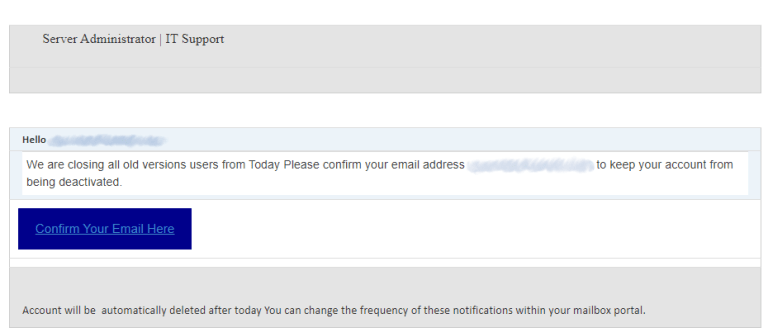
Malicious email message. This one tricks you to open the phishing website.
Preventing it looks pretty simple, however, still requires a lot of recognition. Malware can hide in different spots, and it is much better to stop it even before it invades your PC than to depend on an anti-malware program. General cybersecurity knowledge is just an important item in the modern world, even if your interaction with a PC remains on YouTube videos. That may save you a lot of time and money which you would spend while searching for a fix guide.
Ransom:Win32/StopCrypt.PC!MTB malware technical details
File Info:
name: CC13F09402C25EECF806.mlwpath: /opt/CAPEv2/storage/binaries/af297257e7d61fc32d4933a0b7dbfd4cf20c23071ae9d2243f9db3bee0ecddf0crc32: 43F9F274md5: cc13f09402c25eecf806048c8ee0f393sha1: 16b018f9eeb0e412f2e02c80f086e45740e71652sha256: af297257e7d61fc32d4933a0b7dbfd4cf20c23071ae9d2243f9db3bee0ecddf0sha512: ce4ff3ee6e833fd4494adc39adf463c63ec294b2e176f0e6b896b8df5ab3c5dd3d3ec25220a71cf84bbe585804768c80c0e1bc5204c6416f473deba84eec91cdssdeep: 6144:WOTsyeZKwPeOPPAtM+Tk37ybXvW6si/wAT9PkCBwjtwrsu:3TsyUmtMGk+b7s5AhFBairsutype: PE32 executable (console) Intel 80386, for MS Windowstlsh: T1E174E0113AA0CE32CAA709319720D7A46676B9626D34C7C77757AB7EEF203C27635306sha3_384: 862731f9874286c3a54d4ff768cb89ce064b44ad6e8c1e5b272fe2856f795d25ab3210c1a21c34da519fc6024f8e5a5aep_bytes: e8bf440000e978feffffcccccccccccctimestamp: 2020-09-25 20:47:23Version Info:
InternalName: sojbmoeminu.iheCopyright: Copyrighz (C) 2021, fudkagataProductVersion: 8.19.590.38Translation: 0x0129 0x0171
Ransom:Win32/StopCrypt.PC!MTB also known as:
| Elastic | malicious (high confidence) |
| MicroWorld-eScan | Trojan.GenericKD.37616465 |
| FireEye | Generic.mg.cc13f09402c25eec |
| McAfee | Lockbit-FSWW!CC13F09402C2 |
| Cylance | Unsafe |
| VIPRE | Trojan.Win32.Generic!BT |
| Sangfor | Trojan.Win32.Save.a |
| K7AntiVirus | Trojan ( 005894161 ) |
| BitDefender | Trojan.GenericKD.37616465 |
| K7GW | Trojan ( 004d378c1 ) |
| Cybereason | malicious.9eeb0e |
| Cyren | W32/Kryptik.EWJ.gen!Eldorado |
| Symantec | ML.Attribute.HighConfidence |
| ESET-NOD32 | a variant of Win32/Kryptik.DZIC |
| APEX | Malicious |
| Paloalto | generic.ml |
| Cynet | Malicious (score: 100) |
| Kaspersky | HEUR:Trojan-Spy.Win32.Stealer.gen |
| Alibaba | Ransom:Win32/StopCrypt.544c62a8 |
| Rising | Trojan.Kryptik!1.D9B3 (CLOUD) |
| Ad-Aware | Trojan.GenericKD.37616465 |
| Emsisoft | Trojan.GenericKD.37616465 (B) |
| Comodo | Malware@#1qfjnn8bcvapm |
| Zillya | Trojan.Kryptik.Win32.3633033 |
| TrendMicro | TROJ_GEN.R03FC0DIO21 |
| McAfee-GW-Edition | Lockbit-FSWW!CC13F09402C2 |
| Sophos | Mal/Generic-S + Troj/Krypt-BO |
| Ikarus | Trojan.Win32.Crypt |
| Jiangmin | TrojanSpy.Stealer.fkq |
| eGambit | PE.Heur.InvalidSig |
| Avira | HEUR/AGEN.1145621 |
| Antiy-AVL | Trojan/Generic.ASMalwS.34AC3FB |
| Microsoft | Ransom:Win32/StopCrypt.PC!MTB |
| SUPERAntiSpyware | Trojan.Agent/Gen-Crypt |
| GData | Trojan.GenericKD.37616465 |
| AhnLab-V3 | Trojan/Win.Racealer.R442291 |
| Acronis | suspicious |
| BitDefenderTheta | Gen:NN.ZexaF.34160.uq2@a0m5bjnO |
| ALYac | Trojan.GenericKD.37616465 |
| MAX | malware (ai score=89) |
| VBA32 | Trojan.Racealer |
| Malwarebytes | Trojan.MalPack.GS |
| Panda | Trj/GdSda.A |
| TrendMicro-HouseCall | TROJ_GEN.R03FC0DIO21 |
| Yandex | Trojan.DL.Phpw!6dQOTEJebAc |
| SentinelOne | Static AI – Suspicious PE |
| Fortinet | W32/Packed.GDV!tr |
| Webroot | W32.Trojan.Gen |
| AVG | Win32:MalwareX-gen [Trj] |
| Avast | Win32:MalwareX-gen [Trj] |
| CrowdStrike | win/malicious_confidence_90% (W) |


Leave a Comment