
Spectating the Ransom:Win32/StopCrypt.PBJ!MTB malware detection means that your computer is in big danger. This computer virus can correctly be named as ransomware – virus which encrypts your files and forces you to pay for their decryption. Removing it requires some specific steps that must be done as soon as possible.
Ransom:Win32/StopCrypt.PBJ!MTB detection is a virus detection you can spectate in your computer. It frequently appears after the preliminary actions on your computer – opening the dubious email, clicking the banner in the Internet or installing the program from suspicious resources. From the moment it shows up, you have a short time to take action before it begins its harmful action. And be sure – it is far better not to wait for these malicious effects.
What is Ransom:Win32/StopCrypt.PBJ!MTB virus?
Ransom:Win32/StopCrypt.PBJ!MTB Summary
Summarizingly, Ransom:Win32/StopCrypt.PBJ!MTB virus actions in the infected computer are next:
- SetUnhandledExceptionFilter detected (possible anti-debug);
- Behavioural detection: Executable code extraction – unpacking;
- Yara rule detections observed from a process memory dump/dropped files/CAPE;
- Creates RWX memory;
- A process attempted to delay the analysis task.;
- Dynamic (imported) function loading detected;
- Performs HTTP requests potentially not found in PCAP.;
- CAPE extracted potentially suspicious content;
- The binary likely contains encrypted or compressed data.;
- Authenticode signature is invalid;
- CAPE detected the Vidar malware family;
- Attempts to modify proxy settings;
- Harvests cookies for information gathering;
- Collects information to fingerprint the system;
- Encrypting the documents kept on the victim’s drive — so the victim cannot open these files;
- Blocking the launching of .exe files of anti-virus apps
- Blocking the launching of installation files of anti-malware programs
Ransomware has actually been a headache for the last 4 years. It is challenging to imagine a more dangerous virus for both individual users and corporations. The algorithms used in Ransom:Win32/StopCrypt.PBJ!MTB (typically, RHA-1028 or AES-256) are not hackable – with minor exclusions. To hack it with a brute force, you need to have more time than our galaxy already exists, and possibly will exist. But that malware does not do all these terrible things without delay – it can take up to several hours to cipher all of your files. Hence, seeing the Ransom:Win32/StopCrypt.PBJ!MTB detection is a clear signal that you have to start the elimination process.
Where did I get the Ransom:Win32/StopCrypt.PBJ!MTB?
Typical tactics of Ransom:Win32/StopCrypt.PBJ!MTB distribution are usual for all other ransomware variants. Those are one-day landing sites where users are offered to download and install the free app, so-called bait e-mails and hacktools. Bait emails are a relatively new strategy in malware spreading – you get the e-mail that simulates some regular notifications about shipments or bank service conditions updates. Inside of the e-mail, there is a malicious MS Office file, or a web link which opens the exploit landing page.
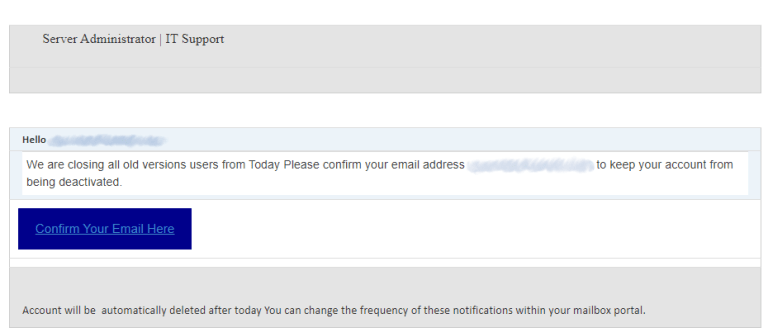
Malicious email message. This one tricks you to open the phishing website.
Avoiding it looks pretty simple, but still demands a lot of awareness. Malware can hide in various places, and it is far better to prevent it even before it invades your computer than to rely on an anti-malware program. Common cybersecurity awareness is just an essential item in the modern world, even if your interaction with a computer stays on YouTube videos. That can keep you a great deal of money and time which you would spend while looking for a fix guide.
Ransom:Win32/StopCrypt.PBJ!MTB malware technical details
File Info:
name: 8DC60CC455F42BA384E4.mlwpath: /opt/CAPEv2/storage/binaries/8979d06451de8b1c8fc4cf604d33e36a86f9be6fb94c7c21af528fb598fb1dd4crc32: 07D96C68md5: 8dc60cc455f42ba384e4c39e0e923868sha1: e9669e47786332892f18becaf59d2268092eeaf2sha256: 8979d06451de8b1c8fc4cf604d33e36a86f9be6fb94c7c21af528fb598fb1dd4sha512: 0897b469356a35a99ab444aca1ca6e633679f84c9f0383cc6ae668f917893b74fea1d57930af9f7a9f86104545c83dce43610d1c5060ae3363c8d5def1ae0a59ssdeep: 6144:ChfAh2PWKx6fRL2UxzHxdFXeejwAJM3YSA:CtAh2OKxwRL/zHxdBkAyItype: PE32 executable (GUI) Intel 80386, for MS Windowstlsh: T12A74F12276B1C078D0A75631186187ED9E7FBC226AB1598B3724177E2F703C28BB535Esha3_384: e59b26ca8d0cb2d2b3f70fb0ca85d8dbabbee9b56dd22e3073ce85925b3ae823ccf6304cd42d474a482a409b405e7f24ep_bytes: e814370000e989feffff8bff558bec83timestamp: 2020-12-27 07:14:30Version Info:
FileVersion: 8.71.86.8Copyrighz: Copyright (C) 2022, pazkarteProjectVersion: 28.81.74.73
Ransom:Win32/StopCrypt.PBJ!MTB also known as:
| Bkav | W32.AIDetect.malware1 |
| MicroWorld-eScan | Gen:Variant.Mikey.136673 |
| FireEye | Generic.mg.8dc60cc455f42ba3 |
| CAT-QuickHeal | Ransom.Stop.P5 |
| Sangfor | Trojan.Win32.Save.a |
| BitDefender | Gen:Variant.Mikey.136673 |
| Cybereason | malicious.778633 |
| Cyren | W32/Kryptik.FPK.gen!Eldorado |
| Symantec | Packed.Generic.525 |
| Elastic | malicious (high confidence) |
| ESET-NOD32 | a variant of Win32/Kryptik.HPHS |
| APEX | Malicious |
| Kaspersky | HEUR:Trojan.Win32.Strab.gen |
| Rising | Backdoor.Agent!8.C5D (TFE:dGZlOgXL0Wm89DskAg) |
| Ad-Aware | Gen:Variant.Mikey.136673 |
| Sophos | Mal/Generic-S |
| DrWeb | Trojan.DownLoader44.57703 |
| McAfee-GW-Edition | Packed-GEE!8DC60CC455F4 |
| Emsisoft | Gen:Variant.Mikey.136673 (B) |
| Ikarus | Trojan.Win32.Crypt |
| Microsoft | Ransom:Win32/StopCrypt.PBJ!MTB |
| GData | Gen:Variant.Mikey.136673 |
| Cynet | Malicious (score: 100) |
| Acronis | suspicious |
| McAfee | Packed-GEE!8DC60CC455F4 |
| MAX | malware (ai score=86) |
| Malwarebytes | Trojan.MalPack.GS |
| Panda | Trj/GdSda.A |
| SentinelOne | Static AI – Malicious PE |
| Fortinet | W32/Kryptik.HPGE!tr |
| AVG | Win32:AceCrypter-U [Cryp] |
| Avast | Win32:AceCrypter-U [Cryp] |
| CrowdStrike | win/malicious_confidence_100% (D) |


Leave a Comment