
Spectating the Ransom:Win32/StopCrypt.PAY!MTB malware detection usually means that your PC is in big danger. This malware can correctly be named as ransomware – sort of malware which encrypts your files and forces you to pay for their decryption. Stopping it requires some specific steps that must be taken as soon as possible.
Ransom:Win32/StopCrypt.PAY!MTB detection is a virus detection you can spectate in your system. It generally appears after the provoking procedures on your computer – opening the dubious e-mail, clicking the banner in the Internet or mounting the program from unreliable resources. From the instance it appears, you have a short time to take action before it starts its malicious activity. And be sure – it is far better not to await these harmful effects.
What is Ransom:Win32/StopCrypt.PAY!MTB virus?
Ransom:Win32/StopCrypt.PAY!MTB Summary
In summary, Ransom:Win32/StopCrypt.PAY!MTB ransomware actions in the infected PC are next:
- SetUnhandledExceptionFilter detected (possible anti-debug);
- Behavioural detection: Executable code extraction – unpacking;
- Executed a command line with /C or /R argument to terminate command shell on completion which can be used to hide execution;
- Yara rule detections observed from a process memory dump/dropped files/CAPE;
- Creates RWX memory;
- Dynamic (imported) function loading detected;
- Reads data out of its own binary image;
- A process created a hidden window;
- CAPE extracted potentially suspicious content;
- Authenticode signature is invalid;
- Uses Windows utilities for basic functionality;
- Enumerates services, possibly for anti-virtualization;
- Installs itself for autorun at Windows startup;
- Installs itself for autorun at Windows startup;
- CAPE detected the Tofsee malware family;
- Anomalous binary characteristics;
- Uses suspicious command line tools or Windows utilities;
- Ciphering the documents located on the target’s drive — so the victim cannot open these files;
- Blocking the launching of .exe files of anti-malware apps
- Blocking the launching of installation files of anti-virus programs
Ransomware has been a major problem for the last 4 years. It is hard to picture a more damaging virus for both individuals and companies. The algorithms utilized in Ransom:Win32/StopCrypt.PAY!MTB (generally, RHA-1028 or AES-256) are not hackable – with minor exclusions. To hack it with a brute force, you need more time than our galaxy already exists, and possibly will exist. However, that virus does not do all these terrible things instantly – it can require up to a few hours to cipher all of your documents. Therefore, seeing the Ransom:Win32/StopCrypt.PAY!MTB detection is a clear signal that you should start the elimination process.
Where did I get the Ransom:Win32/StopCrypt.PAY!MTB?
Typical ways of Ransom:Win32/StopCrypt.PAY!MTB spreading are usual for all other ransomware variants. Those are one-day landing websites where users are offered to download and install the free software, so-called bait emails and hacktools. Bait e-mails are a quite modern strategy in malware distribution – you receive the email that imitates some standard notifications about shipments or bank service conditions updates. Within the e-mail, there is a malicious MS Office file, or a link which opens the exploit landing site.
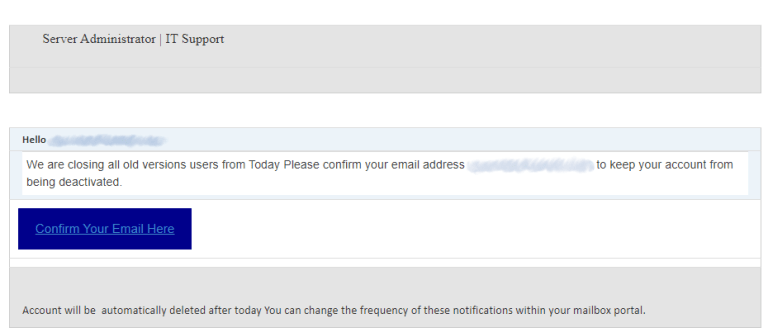
Malicious email message. This one tricks you to open the phishing website.
Avoiding it looks fairly easy, but still demands a lot of attention. Malware can hide in different spots, and it is far better to stop it even before it gets into your PC than to rely on an anti-malware program. General cybersecurity awareness is just an important thing in the modern-day world, even if your relationship with a computer stays on YouTube videos. That may keep you a lot of money and time which you would spend while looking for a solution.
Ransom:Win32/StopCrypt.PAY!MTB malware technical details
File Info:
name: 5F55F19C3B8B10A19A00.mlwpath: /opt/CAPEv2/storage/binaries/c75311ec4549dd2f54d08eb9c0652328e6170db0e89337b462ccca141fdccbaacrc32: F7D2650Dmd5: 5f55f19c3b8b10a19a005b41bc0a80besha1: afa0bb3f823141d275417fb99e6045dac043e7c4sha256: c75311ec4549dd2f54d08eb9c0652328e6170db0e89337b462ccca141fdccbaasha512: ca36a50a5ab0604669457d30ffb9ce483e72f5fa109a7393caf40d6dcffba0c1e5cbb20572c0698a289871c900d70293647d5b59dcd9b2bd7b63405a18f73fb5ssdeep: 98304:sjjjjjjjjjjjjjjjjjjjjjjjjjjjjjjjjjjjjjjjjjjjjjjjjjjjjjjjjjjjjjjj:type: PE32 executable (GUI) Intel 80386, for MS Windowstlsh: T17AD66BDA6BE1D945E5E64E30B83997E8523BFC829830A21EE254FF0F3CB17911592353sha3_384: 3f4beb5c9f6d25c585fe11e89646d6c63a405d41e59bfc6480334f9b92827a128c7a1875848f4d76d832406943df0a28ep_bytes: e8712f0000e978feffff8bff558bec8btimestamp: 2021-06-26 19:25:13Version Info:
FileVersion: 21.79.125.49InternationalName: povgwaoci.iweCopyrighz: Copyrighz (C) 2021, fuzkortaTranslations: 0x0127 0x010f
Ransom:Win32/StopCrypt.PAY!MTB also known as:
| Bkav | W32.AIDetect.malware2 |
| Elastic | malicious (high confidence) |
| MicroWorld-eScan | Trojan.GenericKDZ.84207 |
| FireEye | Generic.mg.5f55f19c3b8b10a1 |
| CAT-QuickHeal | Ransom.Stop.P5 |
| ALYac | Trojan.GenericKDZ.84207 |
| Cylance | Unsafe |
| Sangfor | Trojan.Win32.Save.a |
| K7AntiVirus | Trojan ( 0058eae71 ) |
| K7GW | Trojan ( 0058eae71 ) |
| BitDefenderTheta | Gen:NN.ZexaF.34606.@t0@aScS4gce |
| Cyren | W32/Kryptik.EYC.gen!Eldorado |
| Symantec | ML.Attribute.HighConfidence |
| ESET-NOD32 | a variant of Win32/Kryptik.HOMC |
| APEX | Malicious |
| Cynet | Malicious (score: 100) |
| Kaspersky | HEUR:Trojan.Win32.Bingoml.gen |
| BitDefender | Trojan.GenericKDZ.84207 |
| NANO-Antivirus | Trojan.Win32.Kryptik.jmxxha |
| Avast | Win32:AceCrypter-F [Cryp] |
| Tencent | Trojan.Win32.Bingoml.16000307 |
| Ad-Aware | Trojan.GenericKDZ.84207 |
| Emsisoft | Trojan.Crypt (A) |
| DrWeb | Trojan.MulDrop19.53567 |
| Zillya | Trojan.Kryptik.Win32.3704517 |
| TrendMicro | Mal_Tofsee |
| McAfee-GW-Edition | BehavesLike.Win32.Lockbit.rh |
| Sophos | Mal/Generic-R + Mal/Agent-AWV |
| Ikarus | Trojan.Win32.Crypt |
| GData | Trojan.GenericKDZ.84207 |
| Jiangmin | TrojanDropper.Agent.gqbv |
| MAX | malware (ai score=87) |
| Antiy-AVL | Trojan/Generic.ASMalwS.3533F82 |
| Microsoft | Ransom:Win32/StopCrypt.PAY!MTB |
| AhnLab-V3 | Infostealer/Win.SmokeLoader.R473956 |
| Acronis | suspicious |
| McAfee | GenericRXRX-VG!5F55F19C3B8B |
| VBA32 | BScope.Trojan.DiskWriter |
| Malwarebytes | Trojan.MalPack.GS |
| TrendMicro-HouseCall | Mal_Tofsee |
| Rising | Malware.Obscure!1.A3BB (RDMK:cmRtazoNaK6nTvYlynlseWJuQy5n) |
| SentinelOne | Static AI – Malicious PE |
| Fortinet | W32/Azorult.7BBD!tr |
| AVG | Win32:AceCrypter-F [Cryp] |
| Panda | Trj/GdSda.A |
| CrowdStrike | win/malicious_confidence_100% (W) |


Leave a Comment