
Seeing the Ransom:Win32/Sfiles.B!dha malware detection usually means that your system is in big danger. This malware can correctly be named as ransomware – type of malware which ciphers your files and forces you to pay for their decryption. Deleteing it requires some specific steps that must be done as soon as possible.
Ransom:Win32/Sfiles.B!dha detection is a virus detection you can spectate in your system. It frequently shows up after the preliminary procedures on your computer – opening the dubious e-mail, clicking the banner in the Internet or installing the program from untrustworthy sources. From the instance it shows up, you have a short time to take action until it begins its harmful action. And be sure – it is better not to await these malicious actions.
What is Ransom:Win32/Sfiles.B!dha virus?
Ransom:Win32/Sfiles.B!dha Summary
In total, Ransom:Win32/Sfiles.B!dha ransomware activities in the infected PC are next:
- Authenticode signature is invalid;
- Writes a potential ransom message to disk;
- Exhibits possible ransomware file modification behavior;
- CAPE detected the Sfile malware family;
- Encrypting the files kept on the victim’s drives — so the victim cannot check these documents;
- Blocking the launching of .exe files of anti-malware programs
- Blocking the launching of installation files of anti-virus programs
Ransomware has actually been a horror story for the last 4 years. It is difficult to realize a more hazardous malware for both individuals and organizations. The algorithms utilized in Ransom:Win32/Sfiles.B!dha (typically, RHA-1028 or AES-256) are not hackable – with minor exclusions. To hack it with a brute force, you need a lot more time than our galaxy already exists, and possibly will exist. But that malware does not do all these horrible things immediately – it can require up to a few hours to cipher all of your files. Hence, seeing the Ransom:Win32/Sfiles.B!dha detection is a clear signal that you need to begin the clearing process.
Where did I get the Ransom:Win32/Sfiles.B!dha?
General tactics of Ransom:Win32/Sfiles.B!dha injection are common for all other ransomware examples. Those are one-day landing websites where victims are offered to download the free program, so-called bait e-mails and hacktools. Bait e-mails are a relatively new method in malware spreading – you get the email that imitates some normal notifications about shippings or bank service conditions shifts. Within the email, there is a corrupted MS Office file, or a link which leads to the exploit landing site.
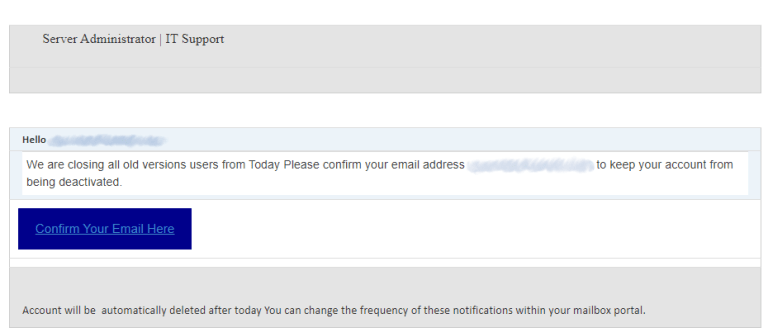
Malicious email message. This one tricks you to open the phishing website.
Preventing it looks pretty uncomplicated, however, still requires a lot of attention. Malware can hide in various places, and it is better to prevent it even before it gets into your computer than to depend on an anti-malware program. Essential cybersecurity awareness is just an important item in the modern-day world, even if your relationship with a computer remains on YouTube videos. That can save you a lot of time and money which you would spend while looking for a fixing guide.
Ransom:Win32/Sfiles.B!dha malware technical details
File Info:
name: 78D6CA966B7A7129C729.mlwpath: /opt/CAPEv2/storage/binaries/32c818f61944d9f44605c17ca8ba3ff4bd3b2799ed31222975b3c812f9d1126ccrc32: CF100E1Cmd5: 78d6ca966b7a7129c729e985a539ebb6sha1: 9bc1972a75bb88501d92901efc9970824e6ee3f5sha256: 32c818f61944d9f44605c17ca8ba3ff4bd3b2799ed31222975b3c812f9d1126csha512: ead8c9f0992a321451b3d8efa10603867b2f7cb74e0d1aa5c45bbd5d805055774fab4902cc04721b83c0975689ebae437363615dddb4a542b86af56c9b31d604ssdeep: 6144:Z5mxA3lGjQIcuYWavcjp9vMGwrT6mB/TvgLYcJlr3mHIrT1bes:Z8AZPUjnM/imBMYcJZ2HITctype: PE32 executable (GUI) Intel 80386, for MS Windowstlsh: T164542A00B2D29635FDF304B5B77B1AAB886D6A312359D3D707D22CC929613D3AB30B56sha3_384: c772e50f51212ef7747e4976e5e1945120841d1dbef3fb60cfc09c59c20d016149653acd871249a155cdc6e50de83e4fep_bytes: 6690558bec6a03ff1540c043006afffftimestamp: 2022-04-04 18:24:40Version Info:
0: [No Data]
Ransom:Win32/Sfiles.B!dha also known as:
| Bkav | W32.AIDetect.malware2 |
| Lionic | Trojan.Win32.Agent.j!c |
| Elastic | Windows.Trojan.CobaltStrike |
| FireEye | Generic.mg.78d6ca966b7a7129 |
| CAT-QuickHeal | TrojanPWS.Zbot.Y |
| McAfee | GenericRXLS-WT!78D6CA966B7A |
| Cylance | Unsafe |
| Sangfor | Ransom.Win32.Sfile.z |
| K7AntiVirus | Trojan ( 0058c24c1 ) |
| Alibaba | Ransom:Win32/generic.ali2000010 |
| K7GW | Trojan ( 0058c24c1 ) |
| CrowdStrike | win/malicious_confidence_100% (W) |
| Cyren | W32/ABRisk.EOXT-2009 |
| ESET-NOD32 | a variant of Win32/Filecoder.SFile.A |
| APEX | Malicious |
| Paloalto | generic.ml |
| Cynet | Malicious (score: 100) |
| Kaspersky | Trojan-Ransom.Win32.Sfile.z |
| BitDefender | Gen:Variant.Ransom.Mindware.1 |
| MicroWorld-eScan | Gen:Variant.Ransom.Mindware.1 |
| Tencent | Win32.Trojan.Filecoder.Akpi |
| Ad-Aware | Gen:Variant.Ransom.Mindware.1 |
| Sophos | ML/PE-A + Harmony Loader (PUA) |
| DrWeb | Trojan.Encoder.34939 |
| Zillya | Trojan.Filecoder.Win32.23341 |
| TrendMicro | Ransom_Agent.R002C0PD622 |
| McAfee-GW-Edition | BehavesLike.Win32.Generic.dh |
| Emsisoft | Gen:Variant.Ransom.Mindware.1 (B) |
| Ikarus | Trojan.Win32.CobaltStrike |
| GData | Gen:Variant.Ransom.Mindware.1 |
| Jiangmin | Trojan.Sfile.c |
| Webroot | W32.Ransom.Gen |
| Avira | HEUR/AGEN.1221199 |
| MAX | malware (ai score=88) |
| Arcabit | Trojan.Ransom.Mindware.1 |
| Microsoft | Ransom:Win32/Sfiles.B!dha |
| AhnLab-V3 | Malware/Win.Ransom.R447846 |
| VBA32 | BScope.TrojanRansom.Crypmodng |
| ALYac | Trojan.Ransom.Filecoder |
| Malwarebytes | Ransom.Escal |
| TrendMicro-HouseCall | Ransom_Agent.R002C0PD622 |
| Rising | Ransom.SFile!1.CA6C (CLASSIC) |
| SentinelOne | Static AI – Malicious PE |
| MaxSecure | Trojan.Malware.300983.susgen |
| Fortinet | W32/Filecoder.OBU!tr.ransom |
| BitDefenderTheta | AI:Packer.0658BBEB1E |
| AVG | Win32:RansomX-gen [Ransom] |
| Cybereason | malicious.66b7a7 |
| Avast | Win32:RansomX-gen [Ransom] |


Leave a Comment