
Spectating the Ransom:Win32/Gandcrab.RPS!MTB malware detection usually means that your system is in big danger. This virus can correctly be named as ransomware – type of malware which encrypts your files and asks you to pay for their decryption. Removing it requires some unusual steps that must be done as soon as possible.
Ransom:Win32/Gandcrab.RPS!MTB detection is a virus detection you can spectate in your system. It generally appears after the preliminary activities on your PC – opening the dubious email messages, clicking the banner in the Internet or setting up the program from suspicious resources. From the second it shows up, you have a short time to take action before it begins its harmful action. And be sure – it is better not to await these destructive actions.
What is Ransom:Win32/Gandcrab.RPS!MTB virus?
Ransom:Win32/Gandcrab.RPS!MTB Summary
Summarizingly, Ransom:Win32/Gandcrab.RPS!MTB virus activities in the infected computer are next:
- SetUnhandledExceptionFilter detected (possible anti-debug);
- Behavioural detection: Executable code extraction – unpacking;
- Yara rule detections observed from a process memory dump/dropped files/CAPE;
- Creates RWX memory;
- Anomalous file deletion behavior detected (10+);
- Dynamic (imported) function loading detected;
- Performs HTTP requests potentially not found in PCAP.;
- Enumerates running processes;
- CAPE extracted potentially suspicious content;
- Unconventionial language used in binary resources: Czech;
- The binary likely contains encrypted or compressed data.;
- Authenticode signature is invalid;
- Steals private information from local Internet browsers;
- Collects information about installed applications;
- Checks the CPU name from registry, possibly for anti-virtualization;
- Attempts to modify proxy settings;
- Harvests cookies for information gathering;
- Harvests credentials from local FTP client softwares;
- Harvests information related to installed instant messenger clients;
- Harvests information related to installed mail clients;
- Collects information to fingerprint the system;
- Ciphering the files located on the victim’s disk drive — so the victim cannot check these files;
- Blocking the launching of .exe files of anti-virus programs
- Blocking the launching of installation files of anti-malware programs
Ransomware has been a major problem for the last 4 years. It is difficult to realize a more hazardous malware for both individuals and corporations. The algorithms utilized in Ransom:Win32/Gandcrab.RPS!MTB (typically, RHA-1028 or AES-256) are not hackable – with minor exclusions. To hack it with a brute force, you need to have more time than our galaxy currently exists, and possibly will exist. But that virus does not do all these terrible things without delay – it can require up to several hours to cipher all of your documents. Hence, seeing the Ransom:Win32/Gandcrab.RPS!MTB detection is a clear signal that you need to start the clearing procedure.
Where did I get the Ransom:Win32/Gandcrab.RPS!MTB?
Common methods of Ransom:Win32/Gandcrab.RPS!MTB distribution are common for all other ransomware examples. Those are one-day landing sites where users are offered to download the free program, so-called bait e-mails and hacktools. Bait e-mails are a quite new tactic in malware distribution – you receive the e-mail that imitates some standard notifications about shipments or bank service conditions updates. Inside of the email, there is a malicious MS Office file, or a link which leads to the exploit landing site.
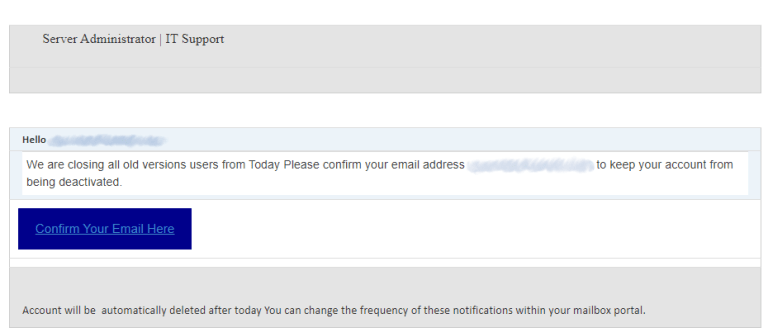
Malicious email message. This one tricks you to open the phishing website.
Avoiding it looks fairly simple, however, still requires a lot of focus. Malware can hide in various places, and it is better to prevent it even before it gets into your computer than to trust in an anti-malware program. Essential cybersecurity awareness is just an essential item in the modern-day world, even if your relationship with a computer stays on YouTube videos. That can save you a great deal of time and money which you would spend while looking for a fixing guide.
Ransom:Win32/Gandcrab.RPS!MTB malware technical details
File Info:
name: 337F97B4013876534AF3.mlwpath: /opt/CAPEv2/storage/binaries/df312bb32034185a3f1eb2ce0fb6cc08286da30179c62f5d9c8ae1baac7ebfdbcrc32: 8C3125FDmd5: 337f97b4013876534af3dbccc1881528sha1: 62004fab6bf61c6f7a21bb009597b64c050ab76csha256: df312bb32034185a3f1eb2ce0fb6cc08286da30179c62f5d9c8ae1baac7ebfdbsha512: 3c85b11e36f1d5d2df5865a1f63294203b2f1b77b128204e614ddb6e89c2ee937d4646b881b3ebb3ef8440e3c731acf0789a5cf72696b741e8dd5e3840ab1df4ssdeep: 12288:asoJJL5BJbPowSQLxdzX+e1L39Z4KglmmzZo/aZ4/dTE/JMcadh6M3yoMLm:gFBJbPowSQLxZ1LtZPVg+/3/W6c86M3Ptype: PE32 executable (GUI) Intel 80386, for MS Windowstlsh: T165E40126A3C0C079DC92B179C0A5CBF04D967C31C4525A8F2AD97DB9BB74AF59224F0Bsha3_384: a2d21ad557f8d92898c3413323ee69e8fe97d6e05544f5d5463fdad99cdfd2e72a130c7ddd1f8d697a2e1c2accddd328ep_bytes: e8791b0000e979feffff8bff558bec83timestamp: 2018-04-08 06:35:32Version Info:
0: [No Data]
Ransom:Win32/Gandcrab.RPS!MTB also known as:
| Bkav | W32.AIDetect.malware1 |
| MicroWorld-eScan | Trojan.BrsecmonE.1 |
| FireEye | Generic.mg.337f97b401387653 |
| ALYac | Trojan.BrsecmonE.1 |
| Cylance | Unsafe |
| VIPRE | Trojan.BrsecmonE.1 |
| Sangfor | Trojan.Win32.Save.a |
| Cybereason | malicious.401387 |
| Symantec | ML.Attribute.HighConfidence |
| Elastic | malicious (high confidence) |
| ESET-NOD32 | a variant of Win32/Kryptik.GRRG |
| APEX | Malicious |
| Kaspersky | HEUR:Trojan.Win32.Generic |
| BitDefender | Trojan.BrsecmonE.1 |
| NANO-Antivirus | Trojan.Win32.Encoder.fovadm |
| Avast | Win32:MalwareX-gen [Trj] |
| Ad-Aware | Trojan.BrsecmonE.1 |
| Emsisoft | Trojan.BrsecmonE.1 (B) |
| DrWeb | Trojan.Encoder.24384 |
| TrendMicro | Trojan.Win32.SODINOK.SM.hp |
| McAfee-GW-Edition | BehavesLike.Win32.Dropper.jh |
| Trapmine | malicious.high.ml.score |
| Sophos | ML/PE-A |
| SentinelOne | Static AI – Malicious PE |
| GData | Trojan.BrsecmonE.1 |
| Avira | HEUR/AGEN.1209924 |
| MAX | malware (ai score=88) |
| Arcabit | Trojan.BrsecmonE.1 |
| Microsoft | Ransom:Win32/Gandcrab.RPS!MTB |
| Cynet | Malicious (score: 100) |
| AhnLab-V3 | Win-Trojan/MalPe2.Suspicious.X1937 |
| Acronis | suspicious |
| McAfee | Packed-FSF!337F97B40138 |
| VBA32 | BScope.Trojan.Fuerboos |
| Malwarebytes | Malware.Heuristic.1006 |
| TrendMicro-HouseCall | Trojan.Win32.SODINOK.SM.hp |
| Rising | [email protected] (RDML:oPiMqMWL+nggFFBJetwYpg) |
| Ikarus | Trojan.Win32.Krypt |
| MaxSecure | Trojan.Malware.300983.susgen |
| Fortinet | W32/Kryptik.GRWA!tr |
| BitDefenderTheta | Gen:NN.ZexaF.34742.QuW@aqcJ!GjG |
| AVG | Win32:MalwareX-gen [Trj] |
| Panda | Trj/GdSda.A |
| CrowdStrike | win/malicious_confidence_100% (W) |


Leave a Comment