
Spectating the Ransom:Win32/CryptLockr.PB!MTB malware detection means that your system is in big danger. This malware can correctly be identified as ransomware – sort of malware which ciphers your files and asks you to pay for their decryption. Removing it requires some unusual steps that must be done as soon as possible.
Ransom:Win32/CryptLockr.PB!MTB detection is a malware detection you can spectate in your system. It usually shows up after the preliminary procedures on your computer – opening the dubious email messages, clicking the advertisement in the Web or mounting the program from dubious sources. From the moment it shows up, you have a short time to take action before it starts its harmful activity. And be sure – it is far better not to wait for these malicious things.
What is Ransom:Win32/CryptLockr.PB!MTB virus?
Ransom:Win32/CryptLockr.PB!MTB Summary
Summarizingly, Ransom:Win32/CryptLockr.PB!MTB malware activities in the infected system are next:
- Behavioural detection: Executable code extraction – unpacking;
- Executed a command line with /C or /R argument to terminate command shell on completion which can be used to hide execution;
- Sample contains Overlay data;
- CAPE extracted potentially suspicious content;
- Executed a very long command line or script command which may be indicative of chained commands or obfuscation;
- The binary contains an unknown PE section name indicative of packing;
- Authenticode signature is invalid;
- A scripting utility was executed;
- Uses Windows utilities for basic functionality;
- Appears to use command line obfuscation;
- Deletes executed files from disk;
- Attempts to execute suspicious powershell command arguments;
- A powershell command using multiple variables was executed possibly indicative of obfuscation;
- Creates a known Syrk ransomware decryption instruction / key file.;
- Uses cipher.exe to wipe the free space, as seen in some ransomware;
- Encrypting the documents located on the target’s drive — so the victim cannot use these files;
- Blocking the launching of .exe files of security tools
- Blocking the launching of installation files of security tools
Ransomware has been a horror story for the last 4 years. It is challenging to imagine a more harmful malware for both individuals and organizations. The algorithms utilized in Ransom:Win32/CryptLockr.PB!MTB (generally, RHA-1028 or AES-256) are not hackable – with minor exclusions. To hack it with a brute force, you need to have a lot more time than our galaxy already exists, and possibly will exist. However, that virus does not do all these terrible things immediately – it can take up to several hours to cipher all of your files. Hence, seeing the Ransom:Win32/CryptLockr.PB!MTB detection is a clear signal that you must begin the elimination procedure.
Where did I get the Ransom:Win32/CryptLockr.PB!MTB?
General methods of Ransom:Win32/CryptLockr.PB!MTB distribution are standard for all other ransomware variants. Those are one-day landing websites where users are offered to download the free software, so-called bait emails and hacktools. Bait emails are a quite modern tactic in malware spreading – you receive the e-mail that imitates some regular notifications about shipments or bank service conditions updates. Inside of the e-mail, there is a malicious MS Office file, or a web link which opens the exploit landing page.
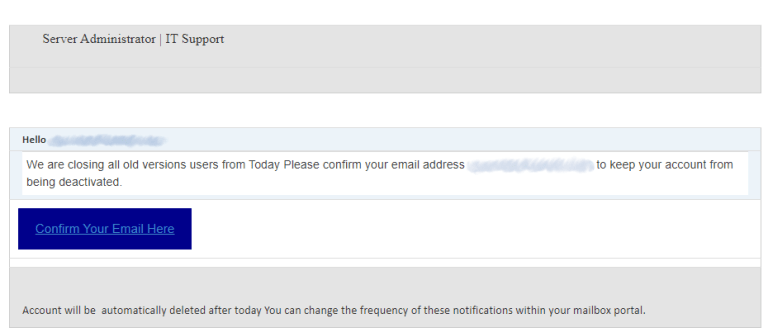
Malicious email message. This one tricks you to open the phishing website.
Avoiding it looks fairly uncomplicated, but still needs a lot of attention. Malware can hide in various spots, and it is far better to prevent it even before it goes into your PC than to rely on an anti-malware program. General cybersecurity knowledge is just an essential thing in the modern world, even if your relationship with a computer remains on YouTube videos. That may keep you a great deal of time and money which you would certainly spend while seeking a fix guide.
Ransom:Win32/CryptLockr.PB!MTB malware technical details
File Info:
name: CE60DE91977524C136D5.mlwpath: /opt/CAPEv2/storage/binaries/a061a2e00768601d2a5f97d950e5b56891f29801dc2d52141166f3c992315ec2crc32: 36653DE4md5: ce60de91977524c136d5d5c19d56ed7asha1: 9e4504a50019ff194896747e1acd941cd1dc59b1sha256: a061a2e00768601d2a5f97d950e5b56891f29801dc2d52141166f3c992315ec2sha512: ef4fa516f4304163005361bfa6297ae4b6dc51620a62ee45d146589d73cb6121a473a2eb4b8ac5113d3401a56c44f8dee41ee23e908796943369954ae6328f08ssdeep: 6144:qSA+CxES9XIY08tBwQ28uV07ATSdGRJYD8LPYkbBvkcsQ4xuEE72lxbt:qSrdqYA3cmeThvoCCtype: PE32 executable (console) Intel 80386, for MS Windowstlsh: T108742A54F642FFF1E44A87BD14F2230A52EEA284EB1DF6373944FD68064AA7C12B3945sha3_384: 97b42936c854f0fab7a07de82f4a6a242e3be462e5207ad3a4119b9baafb736251b2e197008922503cae6f87941a3846ep_bytes: 83ec0cc70598d3400000000000e8ee01timestamp: 2019-09-06 16:14:58Version Info:
0: [No Data]
Ransom:Win32/CryptLockr.PB!MTB also known as:
| Elastic | malicious (high confidence) |
| MicroWorld-eScan | DeepScan:Generic.Ransom.PWS.Locker.13270C8B |
| FireEye | Generic.mg.ce60de91977524c1 |
| McAfee | RDN/Ransom |
| Cylance | Unsafe |
| Zillya | Trojan.Filecoder.Script.5 |
| Sangfor | Trojan.Win32.Save.a |
| Cybereason | malicious.197752 |
| Cyren | W32/Rozena.AA.gen!Eldorado |
| ESET-NOD32 | a variant of PowerShell/Filecoder.P |
| APEX | Malicious |
| Kaspersky | Trojan-Ransom.Win32.Gen.acww |
| BitDefender | DeepScan:Generic.Ransom.PWS.Locker.13270C8B |
| NANO-Antivirus | Riskware.Win32.FakeRansom.forfre |
| Avast | Win32:Trojan-gen |
| Tencent | Win32.Trojan.Gen.Cflw |
| Ad-Aware | DeepScan:Generic.Ransom.PWS.Locker.13270C8B |
| Sophos | Generic ML PUA (PUA) |
| Comodo | MalCrypt.Indus!@1qrzi1 |
| VIPRE | DeepScan:Generic.Ransom.PWS.Locker.13270C8B |
| TrendMicro | Ransom.Win32.SYRK.SM |
| McAfee-GW-Edition | RDN/Ransom |
| Emsisoft | DeepScan:Generic.Ransom.PWS.Locker.13270C8B (B) |
| SentinelOne | Static AI – Suspicious PE |
| Jiangmin | Trojan.Generic.cundr |
| Detected | |
| Avira | VBS/FileCoder.zzkxj |
| MAX | malware (ai score=81) |
| Microsoft | Ransom:Win32/CryptLockr.PB!MTB |
| GData | DeepScan:Generic.Ransom.PWS.Locker.13270C8B |
| Cynet | Malicious (score: 100) |
| AhnLab-V3 | Malware/Win32.RL_Generic.R325705 |
| BitDefenderTheta | Gen:NN.ZexaF.34698.v8Y@ayC1Lsb |
| VBA32 | BScope.TrojanRansom.Agent |
| Malwarebytes | Malware.AI.2482742154 |
| TrendMicro-HouseCall | Ransom.Win32.SYRK.SM |
| Rising | Trojan.Filecoder!8.68 (RDMK:cmRtazo6pBG1CvXgjml+dxlPpsuQ) |
| Yandex | Trojan.GenAsa!tuRj7gk50h4 |
| Ikarus | Trojan-Ransom.PS.Cry69 |
| Fortinet | W32/Filecoder.Q!tr |
| AVG | Win32:Trojan-gen |
| Panda | Trj/GdSda.A |
| CrowdStrike | win/malicious_confidence_90% (W) |


Leave a Comment