
Seeing the Ransom:HTML/MalScript detection usually means that your system is in big danger. This malware can correctly be identified as ransomware – sort of malware which encrypts your files and forces you to pay for their decryption. Deleteing it requires some peculiar steps that must be taken as soon as possible.
Ransom:HTML/MalScript detection is a virus detection you can spectate in your computer. It frequently shows up after the provoking activities on your computer – opening the suspicious email messages, clicking the banner in the Web or setting up the program from untrustworthy sources. From the moment it shows up, you have a short time to do something about it before it begins its destructive activity. And be sure – it is much better not to wait for these malicious things.
What is Ransom:HTML/MalScript virus?
Ransom:HTML/MalScript Summary
In summary, Ransom:HTML/MalScript malware actions in the infected computer are next:
- SetUnhandledExceptionFilter detected (possible anti-debug);
- Yara rule detections observed from a process memory dump/dropped files/CAPE;
- Creates RWX memory;
- Anomalous file deletion behavior detected (10+);
- Dynamic (imported) function loading detected;
- Reads data out of its own binary image;
- Drops a binary and executes it;
- Authenticode signature is invalid;
- Creates or sets a registry key to a long series of bytes, possibly to store a binary or malware config;
- Installs itself for autorun at Windows startup;
- Encrypting the documents kept on the victim’s drive — so the victim cannot open these files;
- Blocking the launching of .exe files of security tools
- Blocking the launching of installation files of security tools
Ransomware has actually been a major problem for the last 4 years. It is hard to imagine a more hazardous malware for both individual users and businesses. The algorithms utilized in Ransom:HTML/MalScript (generally, RHA-1028 or AES-256) are not hackable – with minor exclusions. To hack it with a brute force, you need a lot more time than our galaxy currently exists, and possibly will exist. However, that malware does not do all these horrible things instantly – it can require up to several hours to cipher all of your files. Thus, seeing the Ransom:HTML/MalScript detection is a clear signal that you have to begin the removal process.
Where did I get the Ransom:HTML/MalScript?
Typical methods of Ransom:HTML/MalScript distribution are standard for all other ransomware examples. Those are one-day landing sites where users are offered to download and install the free software, so-called bait e-mails and hacktools. Bait e-mails are a relatively new tactic in malware distribution – you receive the email that imitates some normal notifications about shipments or bank service conditions modifications. Within the email, there is an infected MS Office file, or a web link which leads to the exploit landing page.
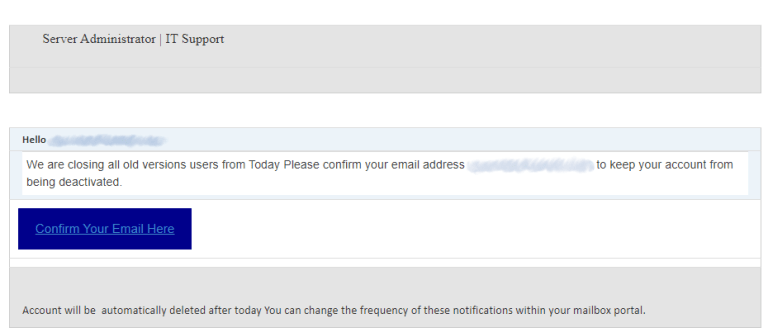
Malicious email message. This one tricks you to open the phishing website.
Preventing it looks quite uncomplicated, but still demands a lot of recognition. Malware can hide in various places, and it is far better to prevent it even before it gets into your computer than to rely upon an anti-malware program. General cybersecurity knowledge is just an important item in the modern world, even if your interaction with a PC stays on YouTube videos. That may save you a lot of time and money which you would certainly spend while searching for a solution.
Ransom:HTML/MalScript malware technical details
File Info:
name: 4D549EB48FE1D18E8EBC.mlwpath: /opt/CAPEv2/storage/binaries/d3a77409e3039c6ccaeb16f499d6356d8218e071614d44a07f5402a5fe377291crc32: 876699F9md5: 4d549eb48fe1d18e8ebcc8dc0211ed6fsha1: f5b9fbfbae17db9bba116c74720eabd80b32e049sha256: d3a77409e3039c6ccaeb16f499d6356d8218e071614d44a07f5402a5fe377291sha512: fd814be73a68271baef460760003fdfab0dc8a2d21d44c392d912a4409cff685f95435a0870d7a7665efe8fd0c2066f2db567aaf52f9bb21841b747b90c0f819ssdeep: 49152:x98kiaPdwFQ3o6PYYB2sJv5ply9N0aahXMM:/31m8NwYnP29yaahXLtype: PE32 executable (GUI) Intel 80386, for MS Windowstlsh: T1FE8533CD60F59F84D5B572360934B304E379E79CA9E0DA6BEE86D748AD1FCC72182A01sha3_384: 5a70f3e7598babd652d0b4faefafc1138a10afded32641d9fdae938f2b0a6a2e7d774eb3d59c50348da67806426f2c4dep_bytes: 558bec81ec2c0500005356576a015e6atimestamp: 2001-10-25 19:47:11Version Info:
CompanyName: 科立讯(深圳)有限公司FileDescription: KSP260_V1.07 InstallationFileVersion: KSP3500SLegalCopyright: 科立讯(深圳)有限公司
Ransom:HTML/MalScript also known as:
| MicroWorld-eScan | Trojan.HTML.Agent.EA |
| FireEye | Trojan.HTML.Agent.EA |
| ALYac | Trojan.HTML.Agent.EA |
| Cylance | Unsafe |
| Sangfor | Trojan.Win32.Occamy.CD3 |
| K7AntiVirus | Riskware ( 0040f0f51 ) |
| Alibaba | TrojanDownloader:HTML/Microfsot.10c6c0b8 |
| K7GW | Riskware ( 0040f0f51 ) |
| Cybereason | malicious.48fe1d |
| Cyren | JS/ScrScr.B |
| Symantec | Trojan.Malscript!html |
| ESET-NOD32 | JS/Agent.OEY |
| Baidu | Multi.Threats.InArchive |
| TrendMicro-HouseCall | Ransom_MalScript.R002C0DIH21 |
| Paloalto | generic.ml |
| Kaspersky | Trojan-Downloader.HTML.JScript.bp |
| BitDefender | Trojan.HTML.Agent.EA |
| NANO-Antivirus | Trojan.Url.IframeB.xpjci |
| Avast | HTML:Script-inf [Susp] |
| Tencent | Js.Trojan-downloader.Jscript.Pepw |
| Emsisoft | Trojan.HTML.Agent.EA (B) |
| Comodo | Malware@#3bmsefek3thb9 |
| VIPRE | Trojan.Win32.Generic!BT |
| TrendMicro | Ransom_MalScript.R002C0DIH21 |
| McAfee-GW-Edition | Artemis!Trojan |
| Sophos | Mal/Generic-S |
| Webroot | W32.Malware.Gen |
| MAX | malware (ai score=99) |
| Antiy-AVL | Trojan/Generic.ASScript.A3FC1 |
| Microsoft | Ransom:HTML/MalScript |
| ZoneAlarm | Trojan-Downloader.HTML.JScript.bp |
| GData | Trojan.HTML.Agent.EA (33x) |
| McAfee | Artemis!4D549EB48FE1 |
| VBA32 | TrojanDownloader.HTML.JScript |
| Ikarus | Trojan.JS.Microfsot |
| Rising | Downloader.JScript!8.DE0 (CLOUD) |
| Fortinet | HTML/JScript.BP!tr.dldr |
| AVG | HTML:Script-inf [Susp] |
| Panda | Trj/CI.A |


Leave a Comment