
The PWS:Win32/MPass notification, is a sign that your computer has a problem. Giving it a go may lead to really bad consequences.
MPass is malicious software that targets on grabbing different types of information from your PC. It applies a lot of hacks to evade security software detection, and uses secured connections to exfiltrate data. The activity of this malware usually results in losing access to your social media accounts, and exposing your identity. Moreover, some samples are also able to deliver other malicious programs to the system.
Any kind of malware exists with the only target – generate profits on you. And the programmers of these things are not thinking about ethicality – they utilize all available ways. Stealing your personal data, receiving the comission for the promotions you watch for them, exploiting your system components to mine cryptocurrencies – that is not the full list of what they do. Do you like to be a riding steed? That is a rhetorical question.
What does the notification with PWS:Win32/MPass detection mean?
The PWS:Win32/MPass detection you can see in the lower right corner is demonstrated to you by Microsoft Defender. That anti-malware program is quite OK at scanning, but prone to be mainly unstable. It is unprotected to malware invasions, it has a glitchy interface and bugged malware removal features. Therefore, the pop-up which states about the MPass is simply an alert that Defender has spotted it. To remove it, you will likely need to make use of a separate anti-malware program.
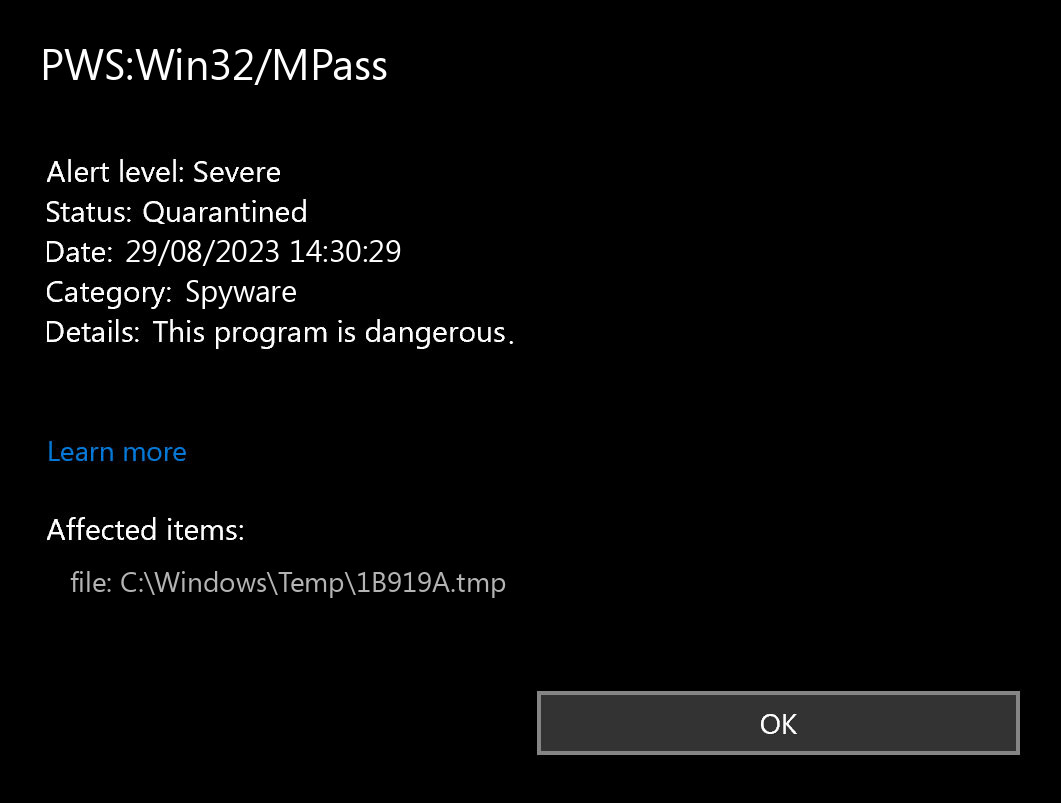
Microsoft Defender: “PWS:Win32/MPass”
Having PWS:Win32/MPass malware in your system is a bad thing from any point of view. The most troublesome issue is that you will barely see anything wrong. Key trick of any spyware is being as secretive as possible. Some MPass samples are also able to perform self-removal after grabbing all the valuables available on the PC. Then, it will be nearly impossible to uncover the flow of events and understand how your accounts were hacked. Variants of spyware that aim at long-term action can target the specific directory or file type. After that, files grabbed in such a way will be put for sale on the Darknet – at one of its numerous marketplaces with stolen data.
Spyware Summary:
| Name | MPass Spyware |
| Detection | PWS:Win32/MPass |
| Damage | Steal personal data contained in the attacked system. |
| Similar | Trojan:Win32/Cerdigent.A!dha Trojan Virus (Cerdigent Removal)X.x.exe Virus (Coin Miner Trojan) RemovalDimmer Removal. How to remove Dimmer Adware?Prowsetup.exe Virus (Coin Miner Trojan) RemovalSpacepop.exe Virus (Coin Miner Trojan) RemovalMusallat.exe Virus (Coin Miner Trojan) RemovalManualfinderapp Virus (Coin Miner Trojan) RemovalPdfskills_updater.exe Virus (Coin Miner Trojan) Removal |
| Fix Tool | See If Your System Has Been Affected by MPass Spyware |
Is PWS:Win32/MPass dangerous?
As I said before, any malware is harmful. And PWS:Win32/MPass is not even near of making more disturbance than real damage. The most misleading characteristic of this malware is the fact you cannot witness its activity in any way, other than with anti-malware software scanning. And when you are having no clue, crooks who successfully implemented their nasty thing to your computer are starting to count the money. Darknet forums offer numerous opportunities to market malware logs for a hefty sum – especially when these logs are new. And it is a bad idea to imagine what will happen to your accounts when other rascals will put their hands on your credentials.
However, things may have much faster flow. In some situations, hackers are delivering their virus precisely to the person they are attempting to steal from. Spyware is priceless when it comes to collecting login credentials, and some examples aim precisely at online banking accounts or cryprocurrency wallets. One may say, giving spyware a run equals to sending all your money to criminals.
How did I get this virus?
It is hard to line the origins of malware on your PC. Nowadays, things are mixed up, and distribution ways utilized by adware 5 years ago can be utilized by spyware these days. But if we abstract from the exact spreading method and will think about why it works, the answer will be pretty simple – low level of cybersecurity understanding. People press on ads on odd websites, open the pop-ups they get in their browsers, call the “Microsoft tech support” believing that the odd banner that states about malware is true. It is essential to recognize what is legit – to avoid misunderstandings when attempting to identify a virus.
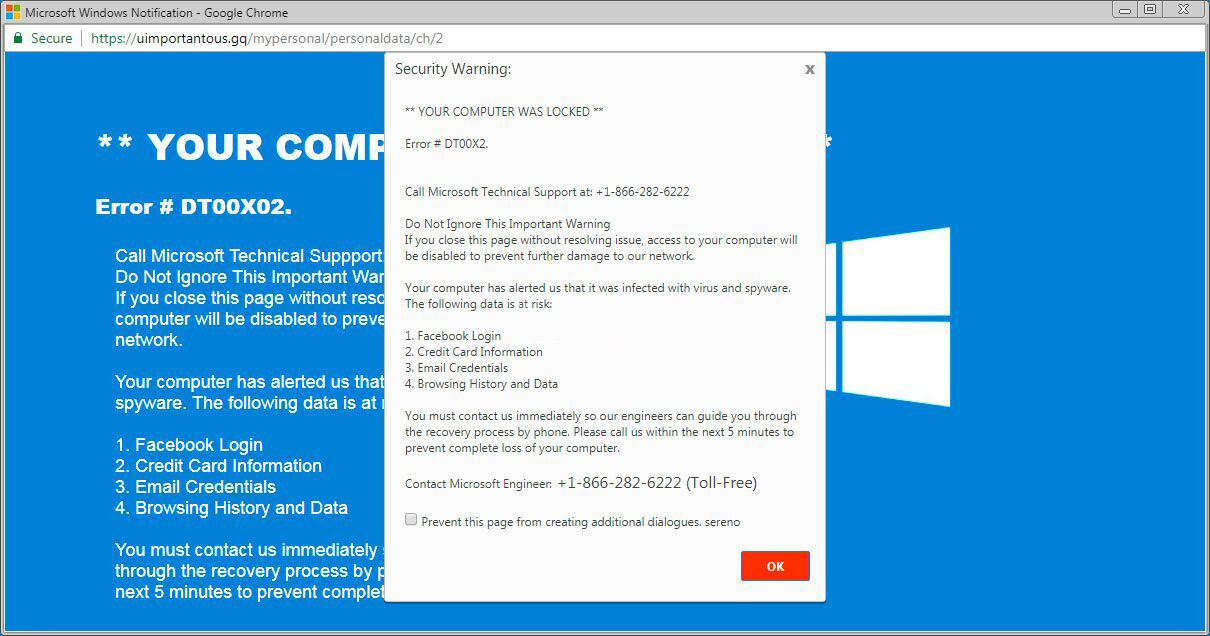
The example of Microsoft Tech support scam banner
Nowadays, there are two of the most widespread tactics of malware spreading – lure e-mails and also injection into a hacked program. While the first one is not so easy to avoid – you should know a lot to recognize a counterfeit – the 2nd one is very easy to address: just don’t use cracked apps. Torrent-trackers and other providers of “free” applications (which are, in fact, paid, but with a disabled license checking) are just a giveaway place of malware. And PWS:Win32/MPass is just among them.


Leave a Comment