
Seeing the NSIS/TrojanDownloader.Agent.OBN detection name means that your system is in big danger. This malware can correctly be identified as ransomware – virus which ciphers your files and forces you to pay for their decryption. Removing it requires some specific steps that must be taken as soon as possible.
NSIS/TrojanDownloader.Agent.OBN detection is a virus detection you can spectate in your system. It usually appears after the provoking activities on your PC – opening the dubious email, clicking the banner in the Web or installing the program from suspicious resources. From the instance it shows up, you have a short time to do something about it before it starts its harmful activity. And be sure – it is better not to await these harmful things.
What is NSIS/TrojanDownloader.Agent.OBN virus?
NSIS/TrojanDownloader.Agent.OBN Summary
Summarizingly, NSIS/TrojanDownloader.Agent.OBN ransomware activities in the infected PC are next:
- Sample contains Overlay data;
- Performs HTTP requests potentially not found in PCAP.;
- Reads data out of its own binary image;
- Authenticode signature is invalid;
- Attempts to modify proxy settings;
- Deletes executed files from disk;
- Encrypting the files kept on the target’s disks — so the victim cannot use these files;
- Blocking the launching of .exe files of security tools
- Blocking the launching of installation files of anti-malware apps
Ransomware has been a horror story for the last 4 years. It is hard to picture a more damaging malware for both individuals and businesses. The algorithms utilized in NSIS/TrojanDownloader.Agent.OBN (usually, RHA-1028 or AES-256) are not hackable – with minor exclusions. To hack it with a brute force, you need more time than our galaxy currently exists, and possibly will exist. However, that virus does not do all these bad things without delay – it can take up to several hours to cipher all of your files. Thus, seeing the NSIS/TrojanDownloader.Agent.OBN detection is a clear signal that you must start the clearing procedure.
Where did I get the NSIS/TrojanDownloader.Agent.OBN?
Typical tactics of NSIS/TrojanDownloader.Agent.OBN injection are typical for all other ransomware variants. Those are one-day landing websites where users are offered to download and install the free app, so-called bait emails and hacktools. Bait e-mails are a pretty modern method in malware distribution – you get the e-mail that imitates some regular notifications about shippings or bank service conditions changes. Within the email, there is a malicious MS Office file, or a web link which opens the exploit landing site.
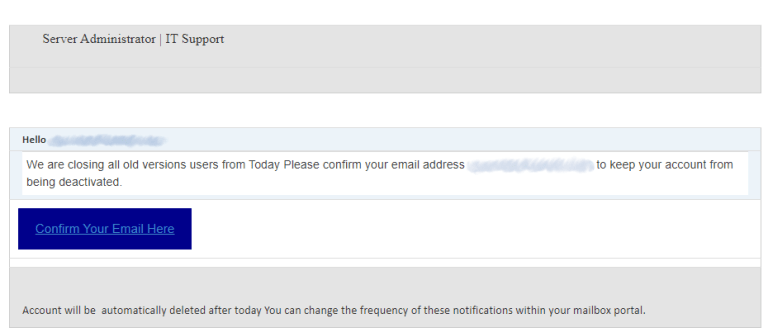
Malicious email message. This one tricks you to open the phishing website.
Preventing it looks quite uncomplicated, but still requires a lot of focus. Malware can hide in various places, and it is better to stop it even before it goes into your computer than to trust in an anti-malware program. Standard cybersecurity knowledge is just an essential item in the modern-day world, even if your interaction with a PC stays on YouTube videos. That may save you a lot of time and money which you would certainly spend while searching for a solution.
NSIS/TrojanDownloader.Agent.OBN malware technical details
File Info:
name: D8C01F57D0CADAC3AE91.mlwpath: /opt/CAPEv2/storage/binaries/09e677fa0ac11d79e5acf4613d6deb767b04e40e94c6eba152602e63a29a8112crc32: 9833C8B1md5: d8c01f57d0cadac3ae9105299063a5b7sha1: 69bebb4a2725a6c6065ee024959e18f1172b102fsha256: 09e677fa0ac11d79e5acf4613d6deb767b04e40e94c6eba152602e63a29a8112sha512: ced779d7504283a99fe32d278e87a02cb9e41898c77c03ed5886006c4e3f2e201f27255f7b85123a14fb5c6c3be15dc76415ad2ba149f1c13f2da64aa5dfdb1fssdeep: 6144:bfL+oqaAAaB+OLFGCZssey0BQdf5+Ew2OtuXHH:bfLZA8MGCZsKsQxw2OtuXHtype: PE32 executable (GUI) Intel 80386, for MS Windowstlsh: T18B541221E750C03ADBB21732953B77EB4BFB98251690674303607E3EBDB2909821FE59sha3_384: 4cbf6a4a63dc983276bd594771fa611c4c45dc8d99f4be6bc9b2f8f7bc42e1734698bd5b36fb13f92d512226831c2be0ep_bytes: 81ecf80300005556576a205f33ed6801timestamp: 2023-07-02 02:09:48Version Info:
0: [No Data]
NSIS/TrojanDownloader.Agent.OBN also known as:
| Bkav | W32.AIDetectMalware |
| Elastic | malicious (high confidence) |
| MicroWorld-eScan | Gen:Variant.Ransom.Loki.1155 |
| FireEye | Generic.mg.d8c01f57d0cadac3 |
| VIPRE | Gen:Variant.Ransom.Loki.1155 |
| CrowdStrike | win/malicious_confidence_60% (D) |
| VirIT | Trojan.Win32.NSISDrp.CHQB |
| ESET-NOD32 | NSIS/TrojanDownloader.Agent.OBN |
| APEX | Malicious |
| Avast | NSIS:DropperX-gen [Drp] |
| Kaspersky | HEUR:Trojan-Downloader.Win32.OffLoader.gen |
| BitDefender | Gen:Variant.Ransom.Loki.1155 |
| Emsisoft | Gen:Variant.Ransom.Loki.1155 (B) |
| Detected | |
| F-Secure | Trojan.TR/Dropper.Gen |
| DrWeb | Trojan.DownLoad4.16275 |
| Trapmine | malicious.moderate.ml.score |
| Sophos | Generic ML PUA (PUA) |
| Varist | W32/Trojan.WMIT-7221 |
| Avira | TR/Dropper.Gen |
| MAX | malware (ai score=81) |
| Antiy-AVL | Trojan[Downloader]/Win32.OffLoader.gen |
| Kingsoft | malware.kb.a.909 |
| Arcabit | Trojan.Ransom.Loki.D483 |
| ZoneAlarm | HEUR:Trojan-Downloader.Win32.OffLoader.gen |
| GData | Gen:Variant.Ransom.Loki.1155 |
| Cynet | Malicious (score: 99) |
| VBA32 | suspected of Trojan.Downloader.gen |
| Cylance | unsafe |
| Fortinet | NSIS/Agent.OBN!tr.dldr |
| AVG | NSIS:DropperX-gen [Drp] |
| Cybereason | malicious.7d0cad |
| DeepInstinct | MALICIOUS |


Leave a Comment