
Seeing the MSIL/TrojanDownloader.Tiny.BNJ malware detection usually means that your PC is in big danger. This malware can correctly be named as ransomware – sort of malware which encrypts your files and forces you to pay for their decryption. Removing it requires some specific steps that must be taken as soon as possible.
MSIL/TrojanDownloader.Tiny.BNJ detection is a virus detection you can spectate in your system. It frequently appears after the provoking procedures on your PC – opening the suspicious e-mail, clicking the advertisement in the Internet or mounting the program from untrustworthy sources. From the second it appears, you have a short time to act before it starts its harmful action. And be sure – it is much better not to await these malicious effects.
What is MSIL/TrojanDownloader.Tiny.BNJ virus?
MSIL/TrojanDownloader.Tiny.BNJ Summary
In summary, MSIL/TrojanDownloader.Tiny.BNJ virus actions in the infected system are next:
- CAPE extracted potentially suspicious content;
- Authenticode signature is invalid;
- Ciphering the documents located on the target’s drive — so the victim cannot use these files;
- Blocking the launching of .exe files of security tools
- Blocking the launching of installation files of anti-virus programs
Ransomware has been a major problem for the last 4 years. It is challenging to realize a more dangerous malware for both individuals and organizations. The algorithms utilized in MSIL/TrojanDownloader.Tiny.BNJ (typically, RHA-1028 or AES-256) are not hackable – with minor exclusions. To hack it with a brute force, you need a lot more time than our galaxy already exists, and possibly will exist. However, that virus does not do all these unpleasant things instantly – it may require up to a few hours to cipher all of your documents. Hence, seeing the MSIL/TrojanDownloader.Tiny.BNJ detection is a clear signal that you have to start the clearing process.
Where did I get the MSIL/TrojanDownloader.Tiny.BNJ?
Typical methods of MSIL/TrojanDownloader.Tiny.BNJ injection are usual for all other ransomware examples. Those are one-day landing web pages where victims are offered to download the free software, so-called bait emails and hacktools. Bait emails are a quite modern tactic in malware spreading – you get the email that imitates some routine notifications about deliveries or bank service conditions modifications. Within the e-mail, there is a corrupted MS Office file, or a link which opens the exploit landing site.
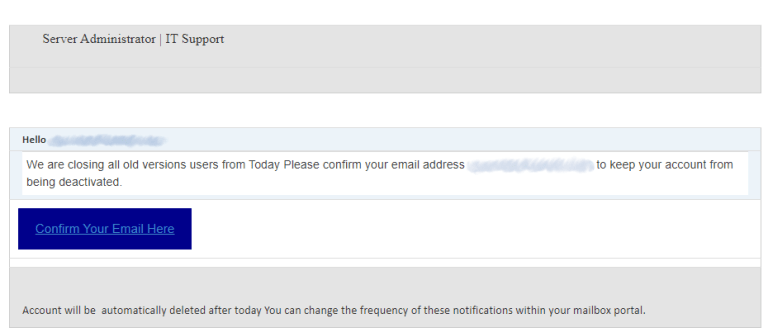
Malicious email message. This one tricks you to open the phishing website.
Preventing it looks quite uncomplicated, however, still requires a lot of recognition. Malware can hide in various places, and it is better to prevent it even before it goes into your PC than to rely on an anti-malware program. Simple cybersecurity awareness is just an important thing in the modern-day world, even if your relationship with a computer remains on YouTube videos. That may save you a lot of time and money which you would certainly spend while searching for a fix guide.
MSIL/TrojanDownloader.Tiny.BNJ malware technical details
File Info:
name: DB12B62406D9FE24739C.mlwpath: /opt/CAPEv2/storage/binaries/94fe501374e23c00b193726045b2d64970366d5d0b33c663603d6e3c581916c9crc32: 69520C64md5: db12b62406d9fe24739c50606ef39566sha1: 7f5da6842ce9c6c9763ad9dc9f7f07dc32052b49sha256: 94fe501374e23c00b193726045b2d64970366d5d0b33c663603d6e3c581916c9sha512: ff1713e8664429b1f9f45c7784c5e07bfa134d348df1eb7e2717dff135b0e1864986e776894b06e333287f2520577b05131e7ae3e5e0fa01821f84fe1e68c250ssdeep: 1536:OWQC2ebEFTnJHFD0Ef3ezmkEuAf3zQ0njbjCNr11m/eJu21xIck:UC2eATnJlrfezmkfAfDbHehM/eJu4+xtype: PE32 executable (GUI) Intel 80386, for MS Windowstlsh: T18DC3C25A76848B05D54C5AB9C0E7593407F2AA8737B7DB853E8852CB0F013E8DD8F789sha3_384: fabd071d66e896b22229ca065dccaf4db7239a3627f01ff112138dba76b37041286e8129e2a76ffcd66c2b04535d733dep_bytes: ff250020400000000000000000000000timestamp: 2022-09-01 14:36:57Version Info:
Translation: 0x0000 0x04b0Comments: CompanyName: HugoTeam by PaimonFileDescription: FileVersion: 1.0.0.0InternalName: FUD.exeLegalCopyright: Copyright © 2022LegalTrademarks: OriginalFilename: FUD.exeProductName: FUDProductVersion: 1.0.0.0Assembly Version: 1.0.0.0
MSIL/TrojanDownloader.Tiny.BNJ also known as:
| Bkav | W32.AIDetectNet.01 |
| Lionic | Trojan.Win32.Johnnie.4!c |
| MicroWorld-eScan | Gen:Variant.Johnnie.2635 |
| FireEye | Generic.mg.db12b62406d9fe24 |
| ALYac | Gen:Variant.Johnnie.2635 |
| Cylance | Unsafe |
| Sangfor | Trojan.Msil.Agent.V8m4 |
| CrowdStrike | win/malicious_confidence_90% (W) |
| Alibaba | Trojan:MSIL/Generic.5e87d0b2 |
| K7GW | Trojan-Downloader ( 0058cfac1 ) |
| K7AntiVirus | Trojan-Downloader ( 0058cfac1 ) |
| Symantec | ML.Attribute.HighConfidence |
| Elastic | malicious (high confidence) |
| ESET-NOD32 | a variant of MSIL/TrojanDownloader.Tiny.BNJ |
| APEX | Malicious |
| Paloalto | generic.ml |
| Cynet | Malicious (score: 100) |
| Kaspersky | HEUR:Trojan-Ransom.MSIL.Gen.gen |
| BitDefender | Gen:Variant.Johnnie.2635 |
| Avast | Win32:DropperX-gen [Drp] |
| Tencent | Win32.Trojan.Agen.Ekjl |
| Ad-Aware | Gen:Variant.Johnnie.2635 |
| Emsisoft | Gen:Variant.Johnnie.2635 (B) |
| VIPRE | Gen:Variant.Johnnie.2635 |
| McAfee-GW-Edition | Artemis |
| Sophos | Generic ML PUA (PUA) |
| SentinelOne | Static AI – Malicious PE |
| GData | Gen:Variant.Johnnie.2635 |
| Avira | HEUR/AGEN.1203866 |
| MAX | malware (ai score=87) |
| Antiy-AVL | Trojan/Generic.ASMalwS.A16 |
| Arcabit | Trojan.Johnnie.DA4B |
| Microsoft | Trojan:Win32/Sabsik.FL.B!ml |
| Acronis | suspicious |
| McAfee | Artemis!DB12B62406D9 |
| TrendMicro-HouseCall | TROJ_GEN.R002H0CI222 |
| Rising | Trojan.Generic/[email protected] (RDM.MSIL:eCcqzUdzhojjaSqqs5KUug) |
| MaxSecure | Trojan.Malware.300983.susgen |
| Fortinet | PossibleThreat |
| BitDefenderTheta | Gen:NN.ZemsilF.34606.hm0@aK2HsMk |
| AVG | Win32:DropperX-gen [Drp] |
| Cybereason | malicious.406d9f |


Leave a Comment