
Seeing the MSIL/Spy.Agent.DTP detection name means that your computer is in big danger. This malware can correctly be identified as ransomware – type of malware which encrypts your files and forces you to pay for their decryption. Stopping it requires some peculiar steps that must be taken as soon as possible.
MSIL/Spy.Agent.DTP detection is a malware detection you can spectate in your computer. It frequently appears after the preliminary procedures on your computer – opening the untrustworthy email messages, clicking the banner in the Web or mounting the program from unreliable sources. From the second it appears, you have a short time to take action before it starts its destructive action. And be sure – it is better not to await these harmful effects.
What is MSIL/Spy.Agent.DTP virus?
MSIL/Spy.Agent.DTP Summary
In summary, MSIL/Spy.Agent.DTP malware activities in the infected PC are next:
- The binary contains an unknown PE section name indicative of packing;
- The binary likely contains encrypted or compressed data.;
- Authenticode signature is invalid;
- Ciphering the documents located on the victim’s disk — so the victim cannot check these documents;
- Blocking the launching of .exe files of security tools
- Blocking the launching of installation files of anti-malware programs
Ransomware has actually been a major problem for the last 4 years. It is hard to realize a more damaging malware for both individuals and corporations. The algorithms used in MSIL/Spy.Agent.DTP (typically, RHA-1028 or AES-256) are not hackable – with minor exclusions. To hack it with a brute force, you need to have more time than our galaxy already exists, and possibly will exist. However, that malware does not do all these horrible things immediately – it can take up to a few hours to cipher all of your documents. Thus, seeing the MSIL/Spy.Agent.DTP detection is a clear signal that you have to begin the clearing procedure.
Where did I get the MSIL/Spy.Agent.DTP?
General tactics of MSIL/Spy.Agent.DTP injection are basic for all other ransomware variants. Those are one-day landing websites where users are offered to download and install the free software, so-called bait e-mails and hacktools. Bait emails are a relatively modern method in malware spreading – you get the email that imitates some routine notifications about shippings or bank service conditions changes. Inside of the e-mail, there is a corrupted MS Office file, or a web link which opens the exploit landing site.
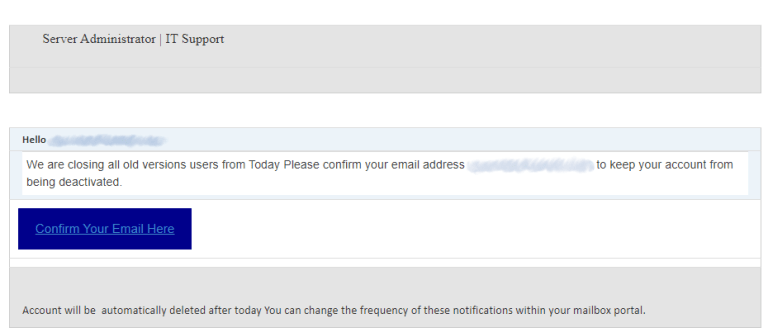
Malicious email message. This one tricks you to open the phishing website.
Preventing it looks quite uncomplicated, however, still requires a lot of focus. Malware can hide in various places, and it is far better to stop it even before it invades your PC than to rely upon an anti-malware program. Essential cybersecurity knowledge is just an important item in the modern-day world, even if your interaction with a computer stays on YouTube videos. That may keep you a lot of money and time which you would spend while looking for a solution.
MSIL/Spy.Agent.DTP malware technical details
File Info:
name: EFBF7033EEEAADC8D546.mlwpath: /opt/CAPEv2/storage/binaries/885522de6a8980a97729bc86c29d3ae0670ccf857b99e810497a016fce46e1a1crc32: E7AFC170md5: efbf7033eeeaadc8d546ad80b1029309sha1: 4c956c6f659c690e64a05153c81431f4f91a6ab7sha256: 885522de6a8980a97729bc86c29d3ae0670ccf857b99e810497a016fce46e1a1sha512: a18b240ba497e281ed5e37accc80f86c01f0742b1e2c83f130a46b336f04c646359ad3cd8de9de77672bad14ebc722acd567f3341921f1739bd7124dff3f1870ssdeep: 49152:e5c3soYs5CenH5dnv0QCNZaatUw7ojuV:e5IYCXnsPaocitype: PE32 executable (GUI) Intel 80386, for MS Windowstlsh: T196A5AD02BE44CA11F0195233C2EF454887B0AD5266A6E32B7DBE376E65123B77D0D9CBsha3_384: 3fef470b23a4859480cf20edd99923587c30b5376c026879a836f20c38a07d109f4be227fdf979627281bed9e5c8475dep_bytes: ff250020400000000000000000000000timestamp: 2022-07-24 15:13:08Version Info:
ProductName: zGTaeBj9IGumjPz5tlHC54CompanyName: U3zpDEyLHR2InternalName: ftj0ndUqL.exeLegalCopyright: wtbg12h8fbmc8jzef4f5Yon9Fqb1TComments: arJUeOcYMdyJfOriginalFilename: q1u.exeProductVersion: 368.387.95.676FileVersion: 171.55.389.794Translation: 0x0409 0x0514
MSIL/Spy.Agent.DTP also known as:
| Bkav | W32.AIDetectMalware.CS |
| tehtris | Generic.Malware |
| Cynet | Malicious (score: 100) |
| CAT-QuickHeal | Trojan.DCRat.S29707587 |
| Skyhigh | BehavesLike.Win32.Generic.vc |
| McAfee | Trojan-FUJL!EFBF7033EEEA |
| Malwarebytes | Generic.Spyware.Stealer.DDS |
| Zillya | Trojan.BasicGen.Win32.4 |
| Sangfor | Suspicious.Win32.Save.a |
| K7AntiVirus | Spyware ( 0058ebd51 ) |
| K7GW | Spyware ( 0058ebd51 ) |
| Cybereason | malicious.f659c6 |
| VirIT | Trojan.Win32.MSIL_Heur.A |
| Symantec | ML.Attribute.HighConfidence |
| Elastic | malicious (high confidence) |
| ESET-NOD32 | a variant of MSIL/Spy.Agent.DTP |
| APEX | Malicious |
| ClamAV | Win.Packed.Basic-9952747-0 |
| Kaspersky | HEUR:Trojan-Spy.MSIL.Stealer.gen |
| BitDefender | Gen:Variant.Ransom.Prometheus.1 |
| MicroWorld-eScan | Gen:Variant.Ransom.Prometheus.1 |
| Avast | Win32:RATX-gen [Trj] |
| Tencent | Backdoor.MSIL.Stealer.11025419 |
| Emsisoft | Gen:Variant.Ransom.Prometheus.1 (B) |
| F-Secure | Heuristic.HEUR/AGEN.1323984 |
| DrWeb | Trojan.PWS.StealerNET.124 |
| VIPRE | Gen:Variant.Ransom.Prometheus.1 |
| Sophos | Troj/DCRat-N |
| Ikarus | Trojan.MSIL.Injector |
| GData | Gen:Variant.Ransom.Prometheus.1 |
| Varist | W32/MSIL_Agent.LQ.gen!Eldorado |
| Avira | HEUR/AGEN.1323984 |
| Antiy-AVL | Trojan[Spy]/MSIL.Stealer |
| Kingsoft | malware.kb.c.942 |
| Arcabit | Trojan.Ransom.Prometheus.1 |
| ZoneAlarm | HEUR:Trojan-Spy.MSIL.Stealer.gen |
| Microsoft | Backdoor:MSIL/DCRat!MTB |
| Detected | |
| AhnLab-V3 | Trojan/Win.FUJL.C5130705 |
| Acronis | suspicious |
| BitDefenderTheta | Gen:NN.ZemsilF.36680.as0@aOiWUcni |
| VBA32 | TScope.Trojan.MSIL |
| Cylance | unsafe |
| Panda | Trj/GdSda.A |
| Rising | Backdoor.DCRat!8.129D9 (TFE:dGZlOg17w21gZmgvxA) |
| Yandex | TrojanSpy.Agent!dgkjoRlBFbk |
| SentinelOne | Static AI – Malicious PE |
| MaxSecure | Trojan.Malware.300983.susgen |
| Fortinet | MSIL/Agent.DVA!tr |
| AVG | Win32:RATX-gen [Trj] |
| DeepInstinct | MALICIOUS |
| CrowdStrike | win/malicious_confidence_100% (D) |


Leave a Comment