
Spectating the MSIL/PSW.Agent.SSQ detection usually means that your PC is in big danger. This virus can correctly be named as ransomware – sort of malware which encrypts your files and forces you to pay for their decryption. Removing it requires some peculiar steps that must be done as soon as possible.
MSIL/PSW.Agent.SSQ detection is a malware detection you can spectate in your system. It frequently shows up after the provoking actions on your PC – opening the untrustworthy email messages, clicking the banner in the Internet or installing the program from untrustworthy resources. From the instance it appears, you have a short time to act before it starts its destructive activity. And be sure – it is better not to wait for these destructive things.
What is MSIL/PSW.Agent.SSQ virus?
MSIL/PSW.Agent.SSQ Summary
Summarizingly, MSIL/PSW.Agent.SSQ malware activities in the infected computer are next:
- Dynamic (imported) function loading detected;
- CAPE extracted potentially suspicious content;
- Authenticode signature is invalid;
- Binary compilation timestomping detected;
- Ciphering the files kept on the target’s disk — so the victim cannot check these documents;
- Blocking the launching of .exe files of security tools
- Blocking the launching of installation files of security tools
Ransomware has been a nightmare for the last 4 years. It is challenging to imagine a more hazardous malware for both individuals and companies. The algorithms utilized in MSIL/PSW.Agent.SSQ (generally, RHA-1028 or AES-256) are not hackable – with minor exclusions. To hack it with a brute force, you need more time than our galaxy actually exists, and possibly will exist. But that virus does not do all these horrible things without delay – it can take up to several hours to cipher all of your documents. Hence, seeing the MSIL/PSW.Agent.SSQ detection is a clear signal that you must begin the clearing procedure.
Where did I get the MSIL/PSW.Agent.SSQ?
Usual tactics of MSIL/PSW.Agent.SSQ spreading are basic for all other ransomware variants. Those are one-day landing websites where users are offered to download the free software, so-called bait e-mails and hacktools. Bait e-mails are a quite new method in malware spreading – you receive the e-mail that mimics some routine notifications about shipments or bank service conditions modifications. Inside of the email, there is a corrupted MS Office file, or a web link which opens the exploit landing site.
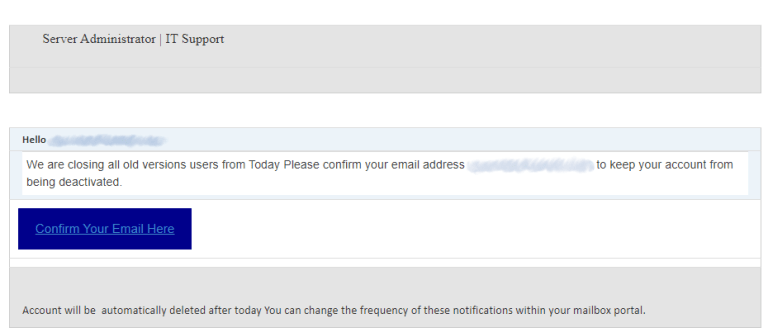
Malicious email message. This one tricks you to open the phishing website.
Preventing it looks fairly easy, however, still needs a lot of attention. Malware can hide in various places, and it is better to prevent it even before it gets into your PC than to trust in an anti-malware program. Standard cybersecurity awareness is just an important thing in the modern-day world, even if your relationship with a PC stays on YouTube videos. That can keep you a great deal of time and money which you would spend while seeking a fixing guide.
MSIL/PSW.Agent.SSQ malware technical details
File Info:
name: 1ADA11B1DD7E43F9A253.mlwpath: /opt/CAPEv2/storage/binaries/8ee96e943f287bd8e766e32d0b246f488da8a4813a6964014f802c587782e8b3crc32: F5A73E99md5: 1ada11b1dd7e43f9a2532c9f90a13abesha1: 87c6e0f35fe2beac5ef4a62538cca02853652f11sha256: 8ee96e943f287bd8e766e32d0b246f488da8a4813a6964014f802c587782e8b3sha512: ff5b31f36d4ce9a2f726a7d09c08ca4236c966c5e2d99a8dedb4c3502185c0fc52ff9d3ce523d8052c40f095ff1984e3454064d707d1212cf839bf95d03612d2ssdeep: 192:Gek/16KSA2k8wqxx07rTebL1bOmDbhCUX:T06K4DwqxkrTebLh/type: PE32 executable (console) Intel 80386, for MS Windowstlsh: T19F22D901B7F88125F1BF0F795AB2214096BAFA539C25CF4E18D6510F0E27B46C9A1F63sha3_384: 2984de96c55a399adb7bdf5fac4b5cf3a125677003086585e38fa652cdd987106ae695be501b5b047ee9168645445161ep_bytes: ff250020400000000000000000000000timestamp: 2065-10-22 12:44:24Version Info:
Translation: 0x0000 0x04b0Comments: CompanyName: FileDescription: SQ MultitoolFileVersion: 1.0.0.0InternalName: SQ Multitool.exeLegalCopyright: Copyright © 2022LegalTrademarks: OriginalFilename: SQ Multitool.exeProductName: SQ MultitoolProductVersion: 1.0.0.0Assembly Version: 1.0.0.0
MSIL/PSW.Agent.SSQ also known as:
| Bkav | W32.AIDetectNet.01 |
| MicroWorld-eScan | Trojan.Ransom.GenericKD.39592972 |
| FireEye | Trojan.Ransom.GenericKD.39592972 |
| ALYac | Trojan.Ransom.GenericKD.39592972 |
| Cylance | Unsafe |
| Sangfor | Suspicious.Win32.Artemis.1ADA11B1DD7E |
| Alibaba | Trojan:MSIL/Generic.962a674d |
| BitDefenderTheta | Gen:NN.ZemsilCO.34638.am0@aWpLJCi |
| Elastic | malicious (high confidence) |
| ESET-NOD32 | MSIL/PSW.Agent.SSQ |
| TrendMicro-HouseCall | TROJ_GEN.R002H09E422 |
| BitDefender | Trojan.Ransom.GenericKD.39592972 |
| APEX | Malicious |
| Tencent | Trojan.Win32.Polyransom.yb |
| Ad-Aware | Trojan.Ransom.GenericKD.39592972 |
| Emsisoft | Trojan.Ransom.GenericKD.39592972 (B) |
| McAfee-GW-Edition | Artemis!Trojan |
| Sophos | Mal/Generic-S |
| Ikarus | Trojan.MSIL.PSW |
| Avira | TR/PSW.Agent.pxvsq |
| MAX | malware (ai score=89) |
| Microsoft | Trojan:Win32/Sabsik.TE.B!ml |
| GData | Trojan.Ransom.GenericKD.39592972 |
| Cynet | Malicious (score: 99) |
| McAfee | Artemis!1ADA11B1DD7E |
| Malwarebytes | Trojan.Downloader.MSIL.Generic |
| Avast | Win32:Trojan-gen |
| Rising | Trojan.Generic/[email protected] (RDM.MSIL:2dSiY03RbCmp0JTYN1XG8w) |
| MaxSecure | Trojan.Malware.300983.susgen |
| Fortinet | MSIL/Agent.SSQ!tr.pws |
| AVG | Win32:Trojan-gen |


Leave a Comment