
Spectating the MSIL/Kryptik.AIEP detection name usually means that your system is in big danger. This virus can correctly be identified as ransomware – type of malware which encrypts your files and forces you to pay for their decryption. Deleteing it requires some peculiar steps that must be done as soon as possible.
MSIL/Kryptik.AIEP detection is a virus detection you can spectate in your system. It usually shows up after the preliminary activities on your computer – opening the suspicious e-mail, clicking the banner in the Web or setting up the program from unreliable resources. From the instance it appears, you have a short time to take action before it starts its destructive action. And be sure – it is better not to wait for these destructive effects.
What is MSIL/Kryptik.AIEP virus?
MSIL/Kryptik.AIEP Summary
Summarizingly, MSIL/Kryptik.AIEP ransomware activities in the infected PC are next:
- Sample contains Overlay data;
- CAPE extracted potentially suspicious content;
- Authenticode signature is invalid;
- CAPE detected the zgRAT malware family;
- Anomalous binary characteristics;
- Binary compilation timestomping detected;
- Yara rule detections observed from a process memory dump/dropped files/CAPE;
- Ciphering the files located on the target’s disks — so the victim cannot open these documents;
- Blocking the launching of .exe files of anti-malware apps
- Blocking the launching of installation files of security tools
Ransomware has actually been a horror story for the last 4 years. It is challenging to imagine a more dangerous malware for both individual users and corporations. The algorithms utilized in MSIL/Kryptik.AIEP (generally, RHA-1028 or AES-256) are not hackable – with minor exclusions. To hack it with a brute force, you need to have more time than our galaxy already exists, and possibly will exist. But that virus does not do all these unpleasant things instantly – it can require up to a few hours to cipher all of your documents. Thus, seeing the MSIL/Kryptik.AIEP detection is a clear signal that you should start the elimination process.
Where did I get the MSIL/Kryptik.AIEP?
Ordinary ways of MSIL/Kryptik.AIEP injection are standard for all other ransomware variants. Those are one-day landing sites where victims are offered to download the free app, so-called bait emails and hacktools. Bait e-mails are a pretty new tactic in malware distribution – you receive the email that mimics some routine notifications about shipments or bank service conditions changes. Within the e-mail, there is a malicious MS Office file, or a web link which leads to the exploit landing site.
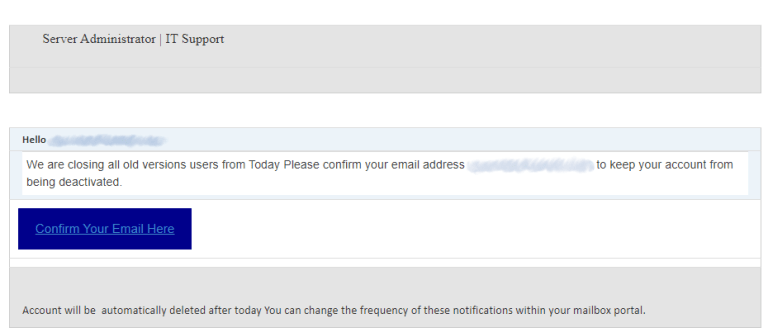
Malicious email message. This one tricks you to open the phishing website.
Avoiding it looks pretty uncomplicated, however, still demands a lot of recognition. Malware can hide in different places, and it is better to stop it even before it invades your PC than to rely on an anti-malware program. Standard cybersecurity awareness is just an essential thing in the modern world, even if your interaction with a PC remains on YouTube videos. That may keep you a lot of money and time which you would spend while searching for a solution.
MSIL/Kryptik.AIEP malware technical details
File Info:
name: CE5A4A37230338213AB7.mlwpath: /opt/CAPEv2/storage/binaries/e7607f336c49acc24498dd78ccac6c91ec5e19863aa471ab4ae8668e7ba912bccrc32: 1A11A5BBmd5: ce5a4a37230338213ab7cd3963e6d88asha1: a6981f8f560a92e62b5f5e976d672340cc24605esha256: e7607f336c49acc24498dd78ccac6c91ec5e19863aa471ab4ae8668e7ba912bcsha512: 38b6069fcf7a032ed9dbdee8e87dd2c2830633c2c899d43f111b254495f2108ed032844edef3c24015b75ae81925a0c25651781d915f3531083cadf8184c2a8essdeep: 49152:7Dm8d7IgxBuoTqba+3JXeAfwriM7sUOnt/d/2I:7Dm8Ktype: PE32 executable (GUI) Intel 80386, for MS Windowstlsh: T1FC061216BEEB8C21C659C336D0671904C7FC3D8664AFE68A74C433CA1A3BBA1D947197sha3_384: ba780136fc701d8128e11a6e7fc1593585ff051fc7b527d1387b5082858344b443f5f078df913296c7e9ca13164721c0ep_bytes: ff250020400000000000000000000000timestamp: 2046-12-05 05:13:04Version Info:
Comments: User-Centric High-Level ProductivityCompanyName: Greenfelder-EichmannFileDescription: Hoeger-KovacekFileVersion: 6.0.0.7InternalName: Inject Resources App For Process Form.exeLegalCopyright: Greenfelder-Eichmann Copyright © 2023LegalTrademarks: Customizable Value-Added OrchestrationOriginalFilename: Application Software.exeProductName: Harness Bleeding-Edge Supply-ChainsProductVersion: 6.0.0.7Assembly Version: 4.9.4.8Translation: 0x0000 0x04b0
MSIL/Kryptik.AIEP also known as:
| Lionic | Trojan.Win32.Gen.4!c |
| Elastic | malicious (high confidence) |
| MicroWorld-eScan | Trojan.GenericKD.65541626 |
| FireEye | Generic.mg.ce5a4a3723033821 |
| McAfee | Artemis!CE5A4A372303 |
| Malwarebytes | Backdoor.AsyncRAT |
| Zillya | Trojan.Generic.Win32.1693046 |
| Sangfor | Suspicious.Win32.Save.a |
| Alibaba | Ransom:MSIL/Kryptik.6c71848b |
| CrowdStrike | win/malicious_confidence_100% (W) |
| BitDefenderTheta | Gen:NN.ZemsilF.36196.Gp3@aKS7DEi |
| Cyren | W32/ABRisk.MOZX-7187 |
| Symantec | ML.Attribute.HighConfidence |
| ESET-NOD32 | a variant of MSIL/Kryptik.AIEP |
| APEX | Malicious |
| Paloalto | generic.ml |
| Kaspersky | HEUR:Trojan-Ransom.MSIL.Gen.gen |
| BitDefender | Trojan.GenericKD.65541626 |
| NANO-Antivirus | Trojan.Win32.Ransom.juyiad |
| Avast | Win32:TrojanX-gen [Trj] |
| Tencent | Malware.Win32.Gencirc.10bdfb42 |
| Emsisoft | Trojan.GenericKD.65541626 (B) |
| F-Secure | Trojan.TR/AD.SubtiRAT.xzjyh |
| DrWeb | Trojan.Inject4.53325 |
| VIPRE | Trojan.GenericKD.65541626 |
| TrendMicro | Backdoor.Win32.ASYNCRAT.YXDBPZ |
| McAfee-GW-Edition | Artemis |
| Sophos | Mal/Generic-S |
| SentinelOne | Static AI – Malicious PE |
| GData | Trojan.GenericKD.65541626 |
| Jiangmin | Trojan.MSIL.aohaz |
| Detected | |
| Avira | TR/AD.SubtiRAT.xzjyh |
| Antiy-AVL | Trojan/Win32.Wacatac |
| Arcabit | Trojan.Generic.D3E815FA |
| ZoneAlarm | HEUR:Trojan-Ransom.MSIL.Gen.gen |
| Microsoft | Trojan:Win32/Casur.A!cl |
| Cynet | Malicious (score: 99) |
| AhnLab-V3 | Trojan/Win.Generic.C5388331 |
| Acronis | suspicious |
| VBA32 | Trojan.MSIL.zgRAT.Heur |
| ALYac | Trojan.GenericKD.65541626 |
| MAX | malware (ai score=87) |
| Cylance | unsafe |
| Panda | Trj/Chgt.AD |
| TrendMicro-HouseCall | Backdoor.Win32.ASYNCRAT.YXDBPZ |
| Rising | Malware.Obfus/[email protected] (RDM.MSIL2:bH6Wzflw2qWIY1ETmwSEZw) |
| MaxSecure | Trojan.Malware.73762894.susgen |
| Fortinet | W32/Malicious_Behavior.VEX |
| AVG | Win32:TrojanX-gen [Trj] |
| Cybereason | malicious.f560a9 |
| DeepInstinct | MALICIOUS |


Leave a Comment