
Seeing the MSIL/GenKryptik.GMYU detection name usually means that your PC is in big danger. This virus can correctly be identified as ransomware – virus which ciphers your files and forces you to pay for their decryption. Removing it requires some unusual steps that must be done as soon as possible.
MSIL/GenKryptik.GMYU detection is a malware detection you can spectate in your system. It frequently appears after the preliminary actions on your computer – opening the suspicious e-mail, clicking the banner in the Internet or setting up the program from untrustworthy sources. From the moment it appears, you have a short time to take action until it starts its malicious activity. And be sure – it is far better not to await these malicious effects.
What is MSIL/GenKryptik.GMYU virus?
MSIL/GenKryptik.GMYU Summary
Summarizingly, MSIL/GenKryptik.GMYU ransomware activities in the infected computer are next:
- CAPE extracted potentially suspicious content;
- The binary likely contains encrypted or compressed data.;
- Authenticode signature is invalid;
- Encrypting the files located on the target’s disk — so the victim cannot check these documents;
- Blocking the launching of .exe files of anti-virus apps
- Blocking the launching of installation files of anti-virus apps
Ransomware has been a headache for the last 4 years. It is challenging to imagine a more harmful virus for both individuals and organizations. The algorithms utilized in MSIL/GenKryptik.GMYU (usually, RHA-1028 or AES-256) are not hackable – with minor exclusions. To hack it with a brute force, you need more time than our galaxy actually exists, and possibly will exist. But that malware does not do all these horrible things without delay – it may require up to several hours to cipher all of your documents. Hence, seeing the MSIL/GenKryptik.GMYU detection is a clear signal that you need to start the elimination procedure.
Where did I get the MSIL/GenKryptik.GMYU?
Typical methods of MSIL/GenKryptik.GMYU distribution are common for all other ransomware variants. Those are one-day landing sites where victims are offered to download the free software, so-called bait e-mails and hacktools. Bait emails are a relatively new method in malware spreading – you get the email that simulates some standard notifications about shipments or bank service conditions updates. Inside of the e-mail, there is a corrupted MS Office file, or a link which opens the exploit landing page.
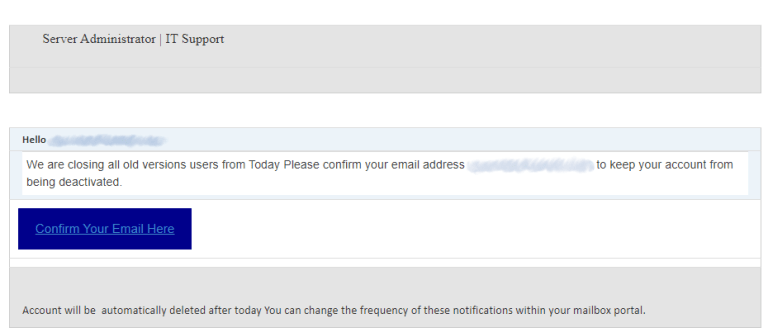
Malicious email message. This one tricks you to open the phishing website.
Avoiding it looks pretty easy, but still demands a lot of focus. Malware can hide in various spots, and it is far better to prevent it even before it goes into your PC than to rely upon an anti-malware program. General cybersecurity awareness is just an essential thing in the modern-day world, even if your interaction with a computer remains on YouTube videos. That can keep you a lot of time and money which you would spend while looking for a fix guide.
MSIL/GenKryptik.GMYU malware technical details
File Info:
name: 856BF7B7004D53945250.mlwpath: /opt/CAPEv2/storage/binaries/3a053a35b807d4bc9c1c3dcb73e4a921581daf849be4babfb191deab187a9f0fcrc32: 70D082ABmd5: 856bf7b7004d53945250596795d8dc30sha1: ff6d0a14ee800f74713c82a11b71a7719fd59785sha256: 3a053a35b807d4bc9c1c3dcb73e4a921581daf849be4babfb191deab187a9f0fsha512: d7594ab90e89555609ca69f903b1ab609b209e203e6cdcd5c4250178ebd725cb8c6501aa306f834667b59b1e1084d85941dc62a7772da3b4100dd00723e635f1ssdeep: 24576:fteZiqcHXG9AslaD4QOV6AGwLbr/HAaIRTjVRbzltTZ:6cHXG9rlakhVR9L/IaIBVRflJtype: PE32 executable (GUI) Intel 80386, for MS Windowstlsh: T1FE25E017BA5789B1C2955B3AC6C7000057B0C692F7A3D70A3DCE23DA8BD37AA9DC5607sha3_384: d0b79e09220898c054e114847ce153612d9cd4fe8badfa15635c217e36ce478987b05d1eb5f495a10d19d989adcc524cep_bytes: ff250020400000000000000000000000timestamp: 2023-08-18 06:56:12Version Info:
Translation: 0x0000 0x04b0Comments: CompanyName: FileDescription: FileVersion: 1.0.0.0InternalName: product.exeLegalCopyright: LegalTrademarks: OriginalFilename: product.exeProductName: ProductVersion: 1.0.0.0Assembly Version: 1.0.0.0
MSIL/GenKryptik.GMYU also known as:
| Elastic | malicious (high confidence) |
| Cynet | Malicious (score: 100) |
| Malwarebytes | MachineLearning/Anomalous.95% |
| Sangfor | Suspicious.Win32.Save.a |
| Cybereason | malicious.7004d5 |
| VirIT | Trojan.Win32.MSIL_Heur.A |
| Cyren | W32/MSIL_Agent.GGE.gen!Eldorado |
| Symantec | ML.Attribute.HighConfidence |
| tehtris | Generic.Malware |
| ESET-NOD32 | a variant of MSIL/GenKryptik.GMYU |
| APEX | Malicious |
| Kaspersky | HEUR:Trojan.Win32.Generic |
| BitDefender | Gen:Variant.Ransom.PadCrypt.18 |
| MicroWorld-eScan | Gen:Variant.Ransom.PadCrypt.18 |
| Avast | Win32:CrypterX-gen [Trj] |
| F-Secure | Heuristic.HEUR/AGEN.1323341 |
| VIPRE | Gen:Variant.Ransom.PadCrypt.18 |
| McAfee-GW-Edition | BehavesLike.Win32.Generic.fc |
| Trapmine | malicious.moderate.ml.score |
| FireEye | Generic.mg.856bf7b7004d5394 |
| Emsisoft | Gen:Variant.Ransom.PadCrypt.18 (B) |
| SentinelOne | Static AI – Malicious PE |
| Avira | HEUR/AGEN.1323341 |
| Microsoft | Trojan:Win32/Leonem |
| Arcabit | Trojan.Ransom.PadCrypt.18 |
| ZoneAlarm | HEUR:Trojan.Win32.Generic |
| GData | Gen:Variant.Ransom.PadCrypt.18 |
| Detected | |
| AhnLab-V3 | Trojan/Win.Leonem.C5472620 |
| BitDefenderTheta | Gen:NN.ZemsilF.36350.@m0@aq5zoZj |
| ALYac | Gen:Variant.Ransom.PadCrypt.18 |
| MAX | malware (ai score=82) |
| Cylance | unsafe |
| Yandex | Trojan.Igent.b0Hffk.3 |
| Ikarus | Trojan.MSIL.Inject |
| MaxSecure | Trojan.Malware.300983.susgen |
| Fortinet | MSIL/Agent.OXE!tr.dldr |
| AVG | Win32:CrypterX-gen [Trj] |
| DeepInstinct | MALICIOUS |
| CrowdStrike | win/malicious_confidence_100% (D) |


Leave a Comment