
Spectating the MSIL/Filecoder.SLAM.A detection usually means that your computer is in big danger. This malware can correctly be identified as ransomware – sort of malware which ciphers your files and forces you to pay for their decryption. Deleteing it requires some unusual steps that must be done as soon as possible.
MSIL/Filecoder.SLAM.A detection is a virus detection you can spectate in your computer. It frequently appears after the preliminary actions on your computer – opening the suspicious email messages, clicking the advertisement in the Internet or setting up the program from unreliable sources. From the moment it shows up, you have a short time to take action before it starts its harmful activity. And be sure – it is far better not to wait for these destructive things.
What is MSIL/Filecoder.SLAM.A virus?
MSIL/Filecoder.SLAM.A Summary
In summary, MSIL/Filecoder.SLAM.A virus actions in the infected computer are next:
- CAPE extracted potentially suspicious content;
- Authenticode signature is invalid;
- Encrypting the files kept on the target’s drives — so the victim cannot check these documents;
- Blocking the launching of .exe files of security tools
- Blocking the launching of installation files of security tools
Ransomware has been a headache for the last 4 years. It is hard to picture a more harmful malware for both individuals and organizations. The algorithms utilized in MSIL/Filecoder.SLAM.A (usually, RHA-1028 or AES-256) are not hackable – with minor exclusions. To hack it with a brute force, you need a lot more time than our galaxy actually exists, and possibly will exist. However, that malware does not do all these unpleasant things without delay – it may require up to several hours to cipher all of your files. Thus, seeing the MSIL/Filecoder.SLAM.A detection is a clear signal that you must start the clearing procedure.
Where did I get the MSIL/Filecoder.SLAM.A?
Typical tactics of MSIL/Filecoder.SLAM.A spreading are usual for all other ransomware variants. Those are one-day landing web pages where victims are offered to download and install the free app, so-called bait emails and hacktools. Bait emails are a relatively modern tactic in malware spreading – you receive the e-mail that simulates some routine notifications about shippings or bank service conditions modifications. Within the e-mail, there is a malicious MS Office file, or a web link which opens the exploit landing site.
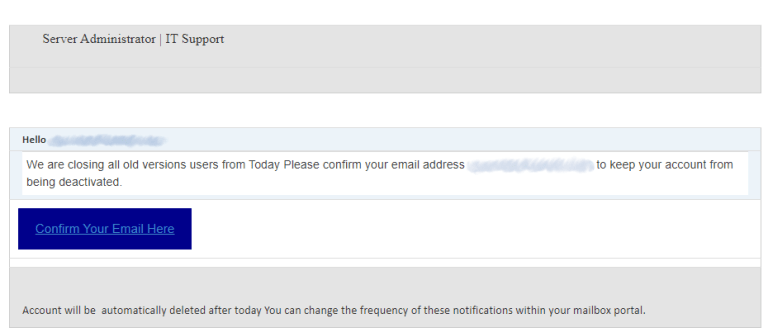
Malicious email message. This one tricks you to open the phishing website.
Avoiding it looks pretty uncomplicated, but still demands a lot of attention. Malware can hide in various spots, and it is much better to prevent it even before it goes into your computer than to rely on an anti-malware program. Standard cybersecurity knowledge is just an important thing in the modern world, even if your relationship with a PC remains on YouTube videos. That may save you a lot of money and time which you would certainly spend while seeking a fixing guide.
MSIL/Filecoder.SLAM.A malware technical details
File Info:
name: 2067B087C553EC770B61.mlwpath: /opt/CAPEv2/storage/binaries/32b1315bd48b4f49ccd3303f5fcf7d16b5c66c2523a75b7123b9c0bef2a0a76dcrc32: 9FFE452Dmd5: 2067b087c553ec770b61b36c6dfc8aa5sha1: 038879f23ff375a11fbabc654b7e12e891496449sha256: 32b1315bd48b4f49ccd3303f5fcf7d16b5c66c2523a75b7123b9c0bef2a0a76dsha512: 7bf32d18dff784d7b29fbda790a15dab787dbe83f19bb46b12df1b4e8770ae0d8dbee542777e9e242cbd0615c2a10e9c88460383e8d98213e20d9063d75ffc28ssdeep: 12288:c9BzaPm657wqehcZBLX+HK+kPJUQEKx07N0TCBGiBCjC0PDgM5j9FKjc3Q8PkoWb:c8m657w6ZBLmkitKqBCjC0PDgM5AB++type: PE32 executable (console) Intel 80386, for MS Windowstlsh: T187357B526BF84B12E1AE0735B8300E2846F6FD06E5B6D7DF6505F8A91D737908E40B2Bsha3_384: 4d3db274a09963fb6b9a3fc88833049320de12935511ec0cd39c48c8c2cfa7725fbca0c71d2f20884bed17a8e8b2cddbep_bytes: ff250020400000000000000000000000timestamp: 2022-10-09 16:18:23Version Info:
Translation: 0x0000 0x04b0FileDescription: FileVersion: 1.0.0.0InternalName: ConsoleApp2.exeLegalCopyright: OriginalFilename: ConsoleApp2.exeProductVersion: 1.0.0.0Assembly Version: 1.0.0.0
MSIL/Filecoder.SLAM.A also known as:
| Bkav | W32.AIDetectNet.01 |
| Elastic | malicious (moderate confidence) |
| McAfee | GenericRXTE-ND!2067B087C553 |
| Malwarebytes | Ransom.FileCryptor |
| VIPRE | Generic.Malware.SDBV2.055A57CA |
| Symantec | Ransom.HiddenTear!g1 |
| ESET-NOD32 | a variant of MSIL/Filecoder.SLAM.A |
| APEX | Malicious |
| BitDefender | Generic.Malware.SDBV2.055A57CA |
| MicroWorld-eScan | Generic.Malware.SDBV2.055A57CA |
| Ad-Aware | Generic.Malware.SDBV2.055A57CA |
| Emsisoft | Generic.Malware.SDBV2.055A57CA (B) |
| McAfee-GW-Edition | GenericRXTE-ND!2067B087C553 |
| FireEye | Generic.Malware.SDBV2.055A57CA |
| Sophos | Mal/Cryptear-A |
| SentinelOne | Static AI – Malicious PE |
| GData | Generic.Malware.SDBV2.055A57CA |
| Arcabit | Generic.Malware.SDBV2.055A57CA |
| Microsoft | Ransom:MSIL/Ryzerlo.A |
| Detected | |
| ALYac | Generic.Malware.SDBV2.055A57CA |
| MAX | malware (ai score=89) |
| VBA32 | Trojan.MSIL.DelShad.Heur |
| Cylance | Unsafe |
| Rising | Ransom.Destructor!1.B060 (CLASSIC) |
| BitDefenderTheta | Gen:NN.ZemsilF.34698.bn0@ausyk0 |
| Cybereason | malicious.7c553e |


Leave a Comment