
Seeing the MSIL/Filecoder.IV malware detection usually means that your computer is in big danger. This malware can correctly be identified as ransomware – sort of malware which ciphers your files and asks you to pay for their decryption. Removing it requires some specific steps that must be done as soon as possible.
MSIL/Filecoder.IV detection is a virus detection you can spectate in your system. It often shows up after the preliminary procedures on your PC – opening the dubious email, clicking the banner in the Web or mounting the program from suspicious sources. From the second it shows up, you have a short time to act before it starts its harmful action. And be sure – it is far better not to wait for these destructive things.
What is MSIL/Filecoder.IV virus?
MSIL/Filecoder.IV Summary
In total, MSIL/Filecoder.IV malware activities in the infected system are next:
- CAPE extracted potentially suspicious content;
- The binary likely contains encrypted or compressed data.;
- Authenticode signature is invalid;
- Ciphering the files located on the victim’s drives — so the victim cannot check these files;
- Blocking the launching of .exe files of anti-malware programs
- Blocking the launching of installation files of anti-malware apps
Ransomware has been a major problem for the last 4 years. It is hard to realize a more damaging virus for both individual users and corporations. The algorithms utilized in MSIL/Filecoder.IV (generally, RHA-1028 or AES-256) are not hackable – with minor exclusions. To hack it with a brute force, you need to have more time than our galaxy actually exists, and possibly will exist. But that malware does not do all these terrible things without delay – it may require up to a few hours to cipher all of your documents. Thus, seeing the MSIL/Filecoder.IV detection is a clear signal that you need to begin the removal procedure.
Where did I get the MSIL/Filecoder.IV?
Common tactics of MSIL/Filecoder.IV injection are common for all other ransomware variants. Those are one-day landing sites where users are offered to download and install the free program, so-called bait e-mails and hacktools. Bait e-mails are a quite modern tactic in malware distribution – you receive the email that mimics some standard notifications about deliveries or bank service conditions modifications. Within the e-mail, there is a malicious MS Office file, or a web link which opens the exploit landing site.
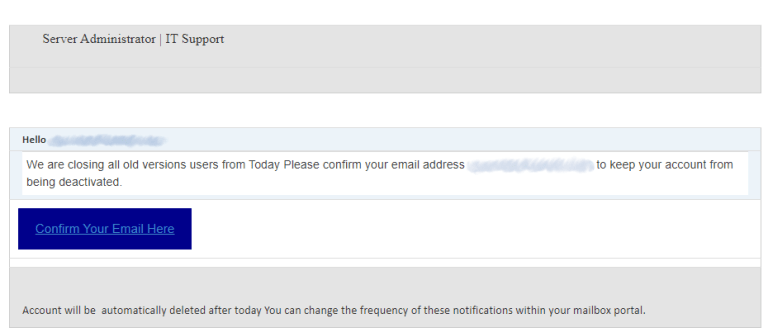
Malicious email message. This one tricks you to open the phishing website.
Avoiding it looks quite uncomplicated, but still needs a lot of attention. Malware can hide in various spots, and it is better to prevent it even before it invades your computer than to trust in an anti-malware program. Basic cybersecurity awareness is just an important thing in the modern world, even if your interaction with a computer remains on YouTube videos. That may save you a great deal of time and money which you would certainly spend while trying to find a fixing guide.
MSIL/Filecoder.IV malware technical details
File Info:
name: 367FE1C9582E752FE1E4.mlwpath: /opt/CAPEv2/storage/binaries/836356bf6ed464026561c2e3e1ab466a8830600328a2150937d835d94f83203bcrc32: 039A652Fmd5: 367fe1c9582e752fe1e4021771ad6bb5sha1: 0b6d6ca0ce728ed7deac49e37e0ce82da4c573ddsha256: 836356bf6ed464026561c2e3e1ab466a8830600328a2150937d835d94f83203bsha512: 873246f2d020a562ff5c7f8a22c3c1c11c3983abe614f9563b37514d0176a2fc2196d00317ff71ccd62d1cbfae063df7ce641d25e340b1f308175a0cc4e578b0ssdeep: 3072:zQNxADg4ASBlpAMnr2m14jhW+8A/sYd3d7rA:z49SBlpAMaLQnosYd3dXtype: PE32 executable (GUI) Intel 80386, for MS Windowstlsh: T1E9B349D633E4AA63C34D5B35A1F213003B3AE1757B22E7474988513EACAF3D6AD49487sha3_384: 66016e690b0ba5b6aa8c038601d0e4999b2f8d4d6bd8c20a3d452126b1dfae7733cb5706edff8cf0b7fcddef20b2b8b9ep_bytes: ff250020400000000000000000000000timestamp: 2017-04-10 14:32:08Version Info:
Translation: 0x0000 0x04b0Comments: CompanyName: FileDescription: LockerFileVersion: 1.0.0.0InternalName: Locker.exeLegalCopyright: Copyright © 2017LegalTrademarks: OriginalFilename: Locker.exeProductName: LockerProductVersion: 1.0.0.0Assembly Version: 1.0.0.0
MSIL/Filecoder.IV also known as:
| Bkav | W32.AIDetectNet.01 |
| Lionic | Trojan.Win32.Generic.4!c |
| Elastic | malicious (high confidence) |
| McAfee | Artemis!367FE1C9582E |
| Cylance | Unsafe |
| Sangfor | Trojan.Win32.Gen.usrg |
| K7AntiVirus | Riskware ( 0040eff71 ) |
| Alibaba | Ransom:Win32/Filecoder.9217d384 |
| K7GW | Riskware ( 0040eff71 ) |
| Cybereason | malicious.9582e7 |
| BitDefenderTheta | Gen:NN.ZemsilF.34646.gm0@aSF4Cjh |
| Symantec | ML.Attribute.HighConfidence |
| ESET-NOD32 | a variant of MSIL/Filecoder.IV |
| Paloalto | generic.ml |
| Kaspersky | Trojan-Ransom.Win32.Gen.dnf |
| NANO-Antivirus | Trojan.Win32.Fuery.eoqvpv |
| Cynet | Malicious (score: 99) |
| Avast | Win32:Malware-gen |
| Tencent | Win32.Trojan.Gen.Hajl |
| Sophos | Mal/Generic-S |
| Comodo | Malware@#1h4nz69yelq3a |
| F-Secure | Heuristic.HEUR/AGEN.1218045 |
| DrWeb | Trojan.DownLoader25.11796 |
| Zillya | Trojan.Gen.Win32.1212 |
| McAfee-GW-Edition | Artemis!Trojan |
| SentinelOne | Static AI – Malicious PE |
| Trapmine | malicious.moderate.ml.score |
| APEX | Malicious |
| Jiangmin | Trojan.Gen.jj |
| Avira | HEUR/AGEN.1218045 |
| Antiy-AVL | Trojan/Generic.ASMalwS.4A94 |
| Microsoft | Ransom:Win32/Genasom |
| ZoneAlarm | Trojan-Ransom.Win32.Gen.dnf |
| Detected | |
| MAX | malware (ai score=100) |
| Rising | Ransom.Locker!1.AC6C (CLASSIC) |
| Ikarus | Trojan-Ransom.Rokku |
| MaxSecure | Trojan.Malware.300983.susgen |
| Fortinet | W32/Gen.DNF!tr |
| AVG | Win32:Malware-gen |
| Panda | Trj/GdSda.A |
| CrowdStrike | win/malicious_confidence_70% (W) |


Leave a Comment