
Spectating the MSIL/Filecoder.APU detection usually means that your PC is in big danger. This virus can correctly be identified as ransomware – type of malware which ciphers your files and forces you to pay for their decryption. Deleteing it requires some specific steps that must be done as soon as possible.
MSIL/Filecoder.APU detection is a malware detection you can spectate in your computer. It frequently appears after the provoking activities on your computer – opening the suspicious email messages, clicking the advertisement in the Web or installing the program from unreliable sources. From the moment it shows up, you have a short time to take action before it starts its malicious activity. And be sure – it is far better not to await these destructive actions.
What is MSIL/Filecoder.APU virus?
MSIL/Filecoder.APU Summary
Summarizingly, MSIL/Filecoder.APU virus actions in the infected system are next:
- Dynamic (imported) function loading detected;
- Authenticode signature is invalid;
- Anomalous .NET characteristics;
- CAPE detected the Chaos malware family;
- Encrypting the files located on the victim’s drives — so the victim cannot use these files;
- Blocking the launching of .exe files of security tools
- Blocking the launching of installation files of anti-virus programs
Ransomware has been a nightmare for the last 4 years. It is challenging to imagine a more hazardous virus for both individual users and businesses. The algorithms used in MSIL/Filecoder.APU (generally, RHA-1028 or AES-256) are not hackable – with minor exclusions. To hack it with a brute force, you need to have a lot more time than our galaxy already exists, and possibly will exist. However, that virus does not do all these terrible things instantly – it may require up to several hours to cipher all of your documents. Thus, seeing the MSIL/Filecoder.APU detection is a clear signal that you should begin the removal procedure.
Where did I get the MSIL/Filecoder.APU?
General ways of MSIL/Filecoder.APU spreading are basic for all other ransomware examples. Those are one-day landing web pages where users are offered to download the free program, so-called bait e-mails and hacktools. Bait emails are a quite modern method in malware distribution – you get the email that mimics some routine notifications about deliveries or bank service conditions modifications. Inside of the email, there is an infected MS Office file, or a link which leads to the exploit landing site.
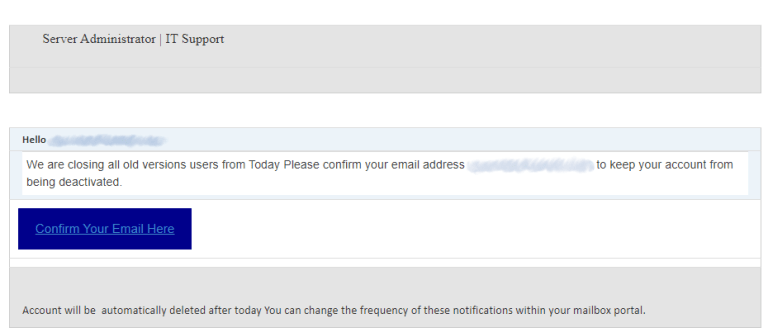
Malicious email message. This one tricks you to open the phishing website.
Preventing it looks pretty simple, but still demands a lot of awareness. Malware can hide in different places, and it is much better to prevent it even before it gets into your computer than to trust in an anti-malware program. Common cybersecurity knowledge is just an essential item in the modern-day world, even if your relationship with a computer stays on YouTube videos. That can save you a great deal of time and money which you would spend while trying to find a fix guide.
MSIL/Filecoder.APU malware technical details
File Info:
name: C5005E5BD3804B5375CF.mlwpath: /opt/CAPEv2/storage/binaries/3e45ee14467ed9ed044c0d02e4030e693a304b85b4e5f56dc1a5f3a6357a98facrc32: F273A6A2md5: c5005e5bd3804b5375cfcf6d34d3a700sha1: fde8ec38628b314ae10662de99f7d9d116355662sha256: 3e45ee14467ed9ed044c0d02e4030e693a304b85b4e5f56dc1a5f3a6357a98fasha512: 1077100ff01dcf73768f93101dd7b1b56cfad6bda8396b7b5eb8feb288299244f8d7f788c3b139bb5c7a6ed5e269d5e59cf2cc791e37c68da0e64eff25806da9ssdeep: 384:M0JORJNKLK87gh71pYS2aNnI+OVs918/H0b5LWl:UJH8qD2Ot96UbFQtype: PE32 executable (GUI) Intel 80386, for MS Windowstlsh: T1F9C2D608A7FA4639F6FB6F3899B262015775B916EC29C74D0D8D509E0C33B9C8C61B63sha3_384: 4a43a82ed3e406c0e43e5f6a508585660359c0e07831c510c45784683d9c289e5323ef0d3ebffd3fd53b51d1a2f5d5b0ep_bytes: ff250020400000000000000000000000timestamp: 2022-06-06 18:58:49Version Info:
Translation: 0x0000 0x04b0FileDescription: FileVersion: 0.0.0.0InternalName: test.exeLegalCopyright: OriginalFilename: test.exeProductVersion: 0.0.0.0Assembly Version: 0.0.0.0
MSIL/Filecoder.APU also known as:
| Bkav | W32.AIDetectNet.01 |
| ClamAV | Win.Ransomware.Hydracrypt-9878672-0 |
| CAT-QuickHeal | Trojan.MsilFC.S23210140 |
| McAfee | Ransomware-FTD!C5005E5BD380 |
| Malwarebytes | Ransom.Chaos |
| Sangfor | Trojan.Win32.Save.a |
| Cyren | W32/Azorult.D.gen!Eldorado |
| Elastic | malicious (high confidence) |
| ESET-NOD32 | a variant of MSIL/Filecoder.APU |
| APEX | Malicious |
| Avast | Win32:RansomX-gen [Ransom] |
| Cynet | Malicious (score: 100) |
| Kaspersky | HEUR:Trojan-Ransom.Win32.Generic |
| BitDefender | IL:Trojan.MSILZilla.5554 |
| MicroWorld-eScan | IL:Trojan.MSILZilla.5554 |
| Ad-Aware | IL:Trojan.MSILZilla.5554 |
| Sophos | ML/PE-A |
| F-Secure | Heuristic.HEUR/AGEN.1250041 |
| DrWeb | Trojan.ClipBankerNET.7 |
| TrendMicro | Ransom.MSIL.CHAOS.SMYPBHET |
| McAfee-GW-Edition | BehavesLike.Win32.Trojan.mm |
| Trapmine | malicious.moderate.ml.score |
| FireEye | Generic.mg.c5005e5bd3804b53 |
| Emsisoft | IL:Trojan.MSILZilla.5554 (B) |
| SentinelOne | Static AI – Malicious PE |
| GData | IL:Trojan.MSILZilla.5554 |
| Avira | HEUR/AGEN.1250041 |
| Arcabit | IL:Trojan.MSILZilla.D15B2 |
| Microsoft | Ransom:MSIL/Cryptolocker.RW!MTB |
| AhnLab-V3 | Ransomware/Win.FTD.C4597900 |
| Acronis | suspicious |
| ALYac | IL:Trojan.MSILZilla.5554 |
| MAX | malware (ai score=83) |
| Cylance | Unsafe |
| Rising | Ransom.Destructor!1.B060 (CLASSIC) |
| Ikarus | Trojan-Ransom.FileCrypter |
| MaxSecure | Trojan.Malware.300983.susgen |
| Fortinet | MSIL/ClipBanker.MZ!tr.ransom |
| BitDefenderTheta | Gen:NN.ZemsilF.34712.bm0@a0vQ9om |
| AVG | Win32:RansomX-gen [Ransom] |
| Cybereason | malicious.bd3804 |


Leave a Comment