
Spectating the MSIL/Filecoder.AOH malware detection usually means that your system is in big danger. This malware can correctly be identified as ransomware – type of malware which encrypts your files and forces you to pay for their decryption. Deleteing it requires some unusual steps that must be done as soon as possible.
MSIL/Filecoder.AOH detection is a virus detection you can spectate in your system. It usually appears after the provoking activities on your computer – opening the dubious e-mail messages, clicking the advertisement in the Web or setting up the program from suspicious resources. From the instance it shows up, you have a short time to do something about it until it begins its malicious action. And be sure – it is far better not to await these harmful actions.
What is MSIL/Filecoder.AOH virus?
MSIL/Filecoder.AOH Summary
In total, MSIL/Filecoder.AOH virus actions in the infected computer are next:
- Dynamic (imported) function loading detected;
- CAPE extracted potentially suspicious content;
- Authenticode signature is invalid;
- Ciphering the documents kept on the victim’s disk — so the victim cannot check these files;
- Blocking the launching of .exe files of anti-virus apps
- Blocking the launching of installation files of anti-virus apps
Ransomware has actually been a major problem for the last 4 years. It is difficult to realize a more harmful malware for both individual users and businesses. The algorithms used in MSIL/Filecoder.AOH (usually, RHA-1028 or AES-256) are not hackable – with minor exclusions. To hack it with a brute force, you need more time than our galaxy actually exists, and possibly will exist. However, that virus does not do all these unpleasant things instantly – it can take up to several hours to cipher all of your files. Therefore, seeing the MSIL/Filecoder.AOH detection is a clear signal that you must begin the removal procedure.
Where did I get the MSIL/Filecoder.AOH?
General ways of MSIL/Filecoder.AOH spreading are usual for all other ransomware variants. Those are one-day landing sites where users are offered to download and install the free app, so-called bait e-mails and hacktools. Bait emails are a relatively modern strategy in malware distribution – you get the email that simulates some regular notifications about shippings or bank service conditions changes. Within the e-mail, there is an infected MS Office file, or a web link which opens the exploit landing page.
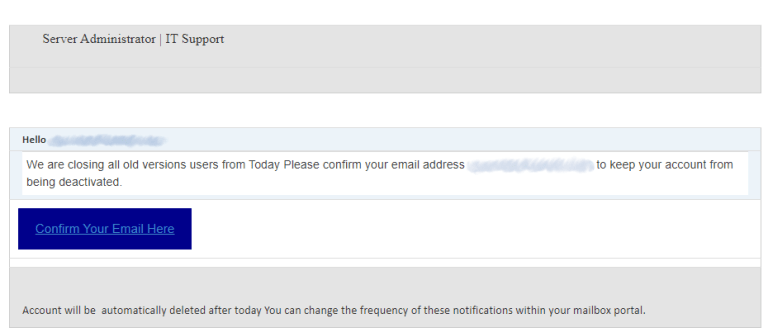
Malicious email message. This one tricks you to open the phishing website.
Preventing it looks quite easy, however, still demands a lot of awareness. Malware can hide in various places, and it is better to prevent it even before it goes into your PC than to depend on an anti-malware program. Basic cybersecurity awareness is just an essential item in the modern-day world, even if your interaction with a PC remains on YouTube videos. That may save you a lot of time and money which you would spend while seeking a fixing guide.
MSIL/Filecoder.AOH malware technical details
File Info:
name: 26E214AF66829D0F0F11.mlwpath: /opt/CAPEv2/storage/binaries/e6813b4bb97a83671aa384c40a044c8e46daa1bfca0e65be96457e1c7c6f3cf7crc32: B32AB402md5: 26e214af66829d0f0f11c316048b1a1asha1: a259b2406e97374d14f430c35db9c9dabe593bbesha256: e6813b4bb97a83671aa384c40a044c8e46daa1bfca0e65be96457e1c7c6f3cf7sha512: 527a9cf14912b5e074060cfa816faa395e010a78e63ab294e5833cbd8c8ae14c2ff4271becfb8ed2eda9b601a8fc5185037f573856280223efb87c0d2277f3e4ssdeep: 6144:LtnGtnGtnGtnGtnGtnGtnGtnGtnGtnGtnGtnGtnGtnGtnGtnGtnGtnGtnGtnGtns:LFGFGFGFGFGFGFGFGFGFGFGFGFGFGFG1type: PE32 executable (GUI) Intel 80386, for MS Windowstlsh: T14324E81C63E8C625F5BE477A5D7222816370F5839C3A876F218A631B3E3179489D3F62sha3_384: dd46ef2793e4ce11753d7eb4c594c5058a1844be8fecdd38247f5020e26672689f3760d81fe9b73a00653f0c00f53215ep_bytes: ff250020400000000000000000000000timestamp: 2022-02-11 07:20:07Version Info:
Translation: 0x0000 0x04b0FileDescription: Virus.win32RozbehStrikeFileVersion: 1.0.8076.42003InternalName: Virus.win32RozbehStrike.exeLegalCopyright: Copyright 2022OriginalFilename: Virus.win32RozbehStrike.exeProductName: Virus.win32RozbehStrikeProductVersion: 1.0.8076.42003Assembly Version: 1.0.8076.42003
MSIL/Filecoder.AOH also known as:
| Lionic | Trojan.Win32.Malicious.4!c |
| Elastic | malicious (high confidence) |
| MicroWorld-eScan | Trojan.GenericKD.38951292 |
| FireEye | Generic.mg.26e214af66829d0f |
| McAfee | Artemis!26E214AF6682 |
| Cylance | Unsafe |
| Sangfor | Trojan.Win32.Save.a |
| K7AntiVirus | Trojan ( 0058e5021 ) |
| K7GW | Trojan ( 0058e5021 ) |
| CrowdStrike | win/malicious_confidence_90% (W) |
| Symantec | ML.Attribute.HighConfidence |
| ESET-NOD32 | a variant of MSIL/Filecoder.AOH |
| APEX | Malicious |
| Avast | Win32:MalwareX-gen [Trj] |
| Kaspersky | HEUR:Trojan-Ransom.MSIL.Encoder.gen |
| BitDefender | Trojan.GenericKD.38951292 |
| Ad-Aware | Trojan.GenericKD.38951292 |
| Emsisoft | Trojan.GenericKD.38951292 (B) |
| DrWeb | Trojan.Encoder.34949 |
| McAfee-GW-Edition | BehavesLike.Win32.Generic.dt |
| Sophos | ML/PE-A |
| Paloalto | generic.ml |
| GData | Trojan.GenericKD.38951292 |
| Avira | HEUR/Malware |
| Microsoft | Trojan:Win32/Wacatac.B!ml |
| Cynet | Malicious (score: 100) |
| BitDefenderTheta | Gen:NN.ZemsilCO.34212.nm3@aS@50wo |
| ALYac | Trojan.GenericKD.38951292 |
| MAX | malware (ai score=83) |
| Malwarebytes | Trojan.Injector |
| Rising | Trojan.Generic/[email protected] (RDM.MSIL:k4HSnVkyaV1I3AXsiBNpjQ) |
| SentinelOne | Static AI – Malicious PE |
| Fortinet | MSIL/Filecoder.AOH!tr |
| AVG | Win32:MalwareX-gen [Trj] |
| Cybereason | malicious.06e973 |
| Panda | Trj/CI.A |


Leave a Comment