
Spectating the MSIL/Disabler.DR detection name means that your PC is in big danger. This malware can correctly be identified as ransomware – type of malware which ciphers your files and forces you to pay for their decryption. Removing it requires some peculiar steps that must be done as soon as possible.
MSIL/Disabler.DR detection is a virus detection you can spectate in your system. It frequently shows up after the preliminary actions on your PC – opening the suspicious email messages, clicking the banner in the Web or installing the program from untrustworthy sources. From the instance it appears, you have a short time to act before it starts its malicious action. And be sure – it is far better not to wait for these malicious things.
What is MSIL/Disabler.DR virus?
MSIL/Disabler.DR Summary
In summary, MSIL/Disabler.DR virus actions in the infected computer are next:
- Behavioural detection: Executable code extraction – unpacking;
- CAPE extracted potentially suspicious content;
- Drops a binary and executes it;
- The binary likely contains encrypted or compressed data.;
- Authenticode signature is invalid;
- Uses Windows utilities for basic functionality;
- Uses Windows utilities to create a scheduled task;
- Attempts to identify installed AV products by installation directory;
- Attempts to modify proxy settings;
- Deletes executed files from disk;
- Uses suspicious command line tools or Windows utilities;
- Encrypting the files kept on the target’s disk drive — so the victim cannot check these files;
- Blocking the launching of .exe files of anti-malware apps
- Blocking the launching of installation files of anti-virus apps
Ransomware has been a horror story for the last 4 years. It is difficult to picture a more damaging malware for both individual users and companies. The algorithms used in MSIL/Disabler.DR (usually, RHA-1028 or AES-256) are not hackable – with minor exclusions. To hack it with a brute force, you need more time than our galaxy actually exists, and possibly will exist. However, that malware does not do all these bad things immediately – it may require up to a few hours to cipher all of your documents. Therefore, seeing the MSIL/Disabler.DR detection is a clear signal that you have to begin the elimination process.
Where did I get the MSIL/Disabler.DR?
Usual methods of MSIL/Disabler.DR injection are usual for all other ransomware examples. Those are one-day landing websites where victims are offered to download the free software, so-called bait e-mails and hacktools. Bait emails are a relatively new strategy in malware distribution – you get the e-mail that simulates some routine notifications about deliveries or bank service conditions changes. Inside of the e-mail, there is a malicious MS Office file, or a web link which leads to the exploit landing page.
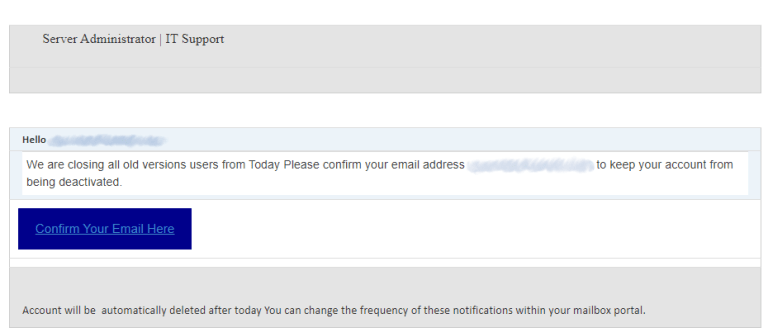
Malicious email message. This one tricks you to open the phishing website.
Preventing it looks quite easy, but still needs a lot of awareness. Malware can hide in various spots, and it is better to stop it even before it gets into your computer than to trust in an anti-malware program. General cybersecurity knowledge is just an essential item in the modern world, even if your interaction with a PC remains on YouTube videos. That can save you a great deal of money and time which you would certainly spend while looking for a fix guide.
MSIL/Disabler.DR malware technical details
File Info:
name: CE82D1A7AB3E438CA7E3.mlwpath: /opt/CAPEv2/storage/binaries/5010debbc2cc5fce4a50d4c0df148fd51e64ec598d5eea1683d594f127d30d49crc32: AC421959md5: ce82d1a7ab3e438ca7e39c227090167csha1: cce2c639d46e8f407571f2050494d1418567674csha256: 5010debbc2cc5fce4a50d4c0df148fd51e64ec598d5eea1683d594f127d30d49sha512: 025896620a01aec5f55a5f2b5e73249b814e0c80a80ef1d865a0928d49e1ec44bee790f8a09a5859d99d580f5156475585af8ddb51ff2ed887faf541010100cdssdeep: 6144:KXy+bnr+Up0yN90QElJLnPju/g7VWyLUPw9tKhb17bl7:9MrQy90E/OPPGb1Pl7type: PE32 executable (GUI) Intel 80386, for MS Windowstlsh: T17D64F112A7D85473D8B527B058FB02832F32FCA19D34836B2355985E5CB2AD4A93637Bsha3_384: 1e5fe2da68d3c486549383798ae43d604820c87d375f4fe26e75daae9e296a525d394907cc19cee794a4e7be94677b31ep_bytes: e8f0060000e9000000006a5868b87240timestamp: 2022-05-24 22:49:06Version Info:
CompanyName: Microsoft CorporationFileDescription: Win32 Cabinet Self-Extractor FileVersion: 11.00.17763.1 (WinBuild.160101.0800)InternalName: Wextract LegalCopyright: © Microsoft Corporation. All rights reserved.OriginalFilename: WEXTRACT.EXE .MUIProductName: Internet ExplorerProductVersion: 11.00.17763.1Translation: 0x0409 0x04b0
MSIL/Disabler.DR also known as:
| Elastic | malicious (high confidence) |
| MicroWorld-eScan | Trojan.GenericKDZ.98386 |
| ClamAV | Win.Packer.pkr_ce1a-9980177-0 |
| CAT-QuickHeal | Trojan.YakbeexMSIL.ZZ4 |
| McAfee | PWS-FDON!7E93BACBBC33 |
| Malwarebytes | Trojan.Crypt.MSIL.Generic |
| K7AntiVirus | Trojan ( 0059e3df1 ) |
| K7GW | Trojan ( 0059e3df1 ) |
| Cyren | W32/Kryptik.JKR.gen!Eldorado |
| Symantec | ML.Attribute.HighConfidence |
| ESET-NOD32 | MSIL/Disabler.DR |
| APEX | Malicious |
| Cynet | Malicious (score: 99) |
| Kaspersky | UDS:Trojan.Win32.Agent.gen |
| NANO-Antivirus | Trojan.Win32.Disabler.junsud |
| SUPERAntiSpyware | Trojan.Agent/Gen-Downloader |
| Avast | Win32:TrojanX-gen [Trj] |
| Tencent | Trojan.MSIL.Agent.hg |
| F-Secure | Trojan.TR/Disabler.ocayi |
| DrWeb | Trojan.Siggen19.32857 |
| VIPRE | Trojan.GenericKDZ.98386 |
| TrendMicro | TROJ_GEN.R002C0PBK23 |
| McAfee-GW-Edition | BehavesLike.Win32.AgentTesla.fc |
| SentinelOne | Static AI – Suspicious SFX |
| Jiangmin | Trojan.MSIL.aocbf |
| Avira | TR/Disabler.ocayi |
| Antiy-AVL | Trojan/Script.Phonzy |
| Microsoft | Ransom:Win32/StopCrypt.SL!MTB |
| Xcitium | ApplicUnwnt@#1ftfc2ja2g1dd |
| ZoneAlarm | HEUR:Trojan.MSIL.Agent.gen |
| GData | Generic.Trojan.PSEB.WGPCII |
| Detected | |
| ALYac | Gen:Variant.Babar.187493 |
| TrendMicro-HouseCall | TROJ_GEN.R002C0PBK23 |
| Rising | [email protected] (RDML:fWQZ6M6sKbc0RtZaFkAhNA) |
| Yandex | Trojan.Disabler!G6z7qDxyklM |
| Ikarus | Trojan.MSIL.Disabler |
| Fortinet | PossibleThreat |
| AVG | Win32:TrojanX-gen [Trj] |
| DeepInstinct | MALICIOUS |


Leave a Comment