
You may have wondered seeing the email saying something like “I have to share bad news with you”. This message usually continues with a scary saying that a crook has some compromising materials on you. To avoid publishing that content, fraudsters offer you to pay a ransom in Bitcoins. I will show you why it is a 100% lie, and how to ensure that your private information is safe.
“I have to share bad news with you”. What is this?
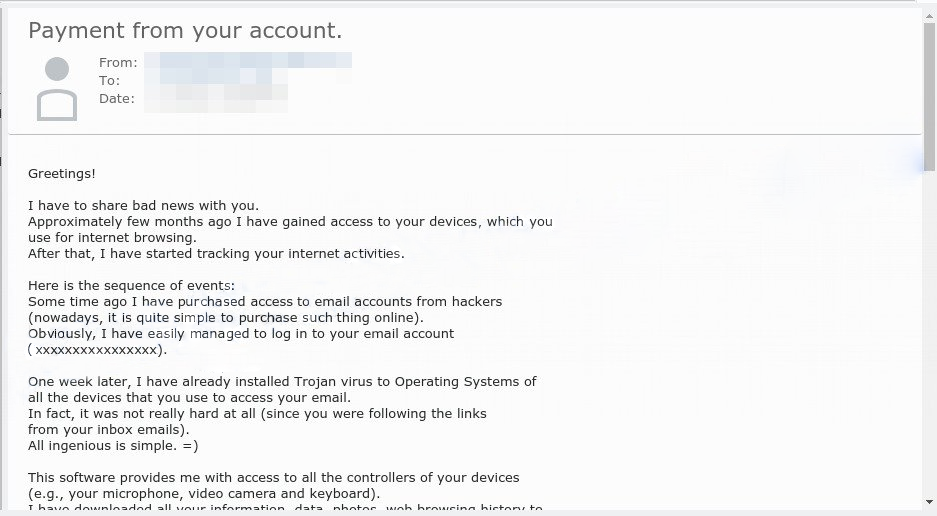
The fraudulent “I have to share bad news with you” message which states that a third party has some compromising information on you. As email states, crooks injected trojan viruses (spyware is implied) into your PC, gained access to all your devices, and spied on your activities. They say that they have a video of you self-satisfying with porn videos. To avoid publishing that video, you need to pay a significant ransom to the specified Bitcoin wallet. The exact text is there:
As you can see, crook says that his virus is undetectable, since it is driver-based and updates constantly. At least this fact is a marker which surely says that these claims are fake. Anti-malware software can easily detect malicious items among the drivers, just like in case of virus injection into any other system element. Moreover, even if the virus is designed so well, and antivirus software cannot detect it because it misses all detection databases, it will surely be spotted by the heuristic engines. Last ones are used in the security tools with a proactive protection function.
“*Do not reply me (I have created this email inside your inbox and generated the return address).” Sounds like a tale for children who don’t know how mailing clients work. You can’t see the message created on your device in the Inbox tab. Hence, you will likely spot it among the messages in Drafts, or in Sent. So, the fraudster is definitely lying, in order to scare you and force you to think that he is omnipotent. In fact, he/she just tries to scare you and force you to pay the ransom.
In my opinion, it is just unlogical to extort money in such a primitive way when you can create a spyware which integrates into the victim system on such a low level. Software engineers can easily get a well-paid job, so there is no need to extort small amounts of money through cybercrimes.
Identifying the scam
The correct name for “I have to share bad news with you” fraud is blackmailing, or so-called sextortion. Exact definition of it says that this is the case when an unknown person extorts money, threatening to publish your naked photos or videos where you are making some sort of lewd actions. As you can see in the previous paragraphs, fraudsters have a lot of dubious elements in their claims. In past cases of blackmailing, crooks used the email database purchased in Darknet. The victim can be a deeply religious person who does not visit any “adult” sites, but those crooks do not care about such possibilities.
| Heading | “I have to share bad news with you” |
| Classification | Blackmailing, money extortion |
| Ransom amount | $750-$1650, €1200-€1250, ₩200,000 |
| BTC wallet addresses | 12sLp7GKLznuNRq62TFkjqqQQZ6JYmRoRA, 1Hjpu99iHc3oi55ZJKf6RHhKbwit8vEzTS, 1DyrpsBJnuZyUt6gpJK1Pmpq5zMetdPALt, 14AhgtTrXKHGcUsWJRsshN3HPu64rLdxB6, 1H9sA9Che7bdg4SVrAjj8jwUyvK9A3cnQC, 1FD71hUPhsi7hLarvx5ueBxaeEHYfp8o7H, 15NQNgBXsTjdmXEaobxKJdk6d18FerjSuW, 1G6tobNb4DdEJxaaKxyivp2xdqCtdwhaSS, 17sJ89mf4ZLaMfrw9obMDAGptoTFzPBqmX, 1Ps2HsbfZ9yuCyFzWdWFwMgnHGgs9Bnv5h, 18gi6L2coL8oU3v7BT9s7sex1MSepMS4dF, 1GGZpqXsqKWSRnjJ1SHFaE5VPkMHHsKToX, 1KpNtDDNCP1QeApSwjSTG7a3KcXx2aKVi9, 133MphKowvCC1PDyfZVF9L76mQvxTtRY93, 16aqr3rXxCtxa8AK3ErftnBQLfzyyhjpXJ, 1xPr18gM8YKsaiUkGz9MgpjtwcBQcME2i, 1L6XxPRuLJdr6JCqw8dwNUm1wFLisrGREL |
| Form | Scary email message |
| Prevention method |

