
Spectating the HackTool.Win32.WinCred.b malware detection means that your system is in big danger. This computer virus can correctly be identified as ransomware – virus which encrypts your files and asks you to pay for their decryption. Deleteing it requires some unusual steps that must be taken as soon as possible.
HackTool.Win32.WinCred.b detection is a malware detection you can spectate in your system. It frequently appears after the provoking actions on your PC – opening the suspicious e-mail messages, clicking the banner in the Web or installing the program from suspicious resources. From the second it shows up, you have a short time to take action until it starts its destructive action. And be sure – it is far better not to wait for these destructive effects.
What is HackTool.Win32.WinCred.b virus?
HackTool.Win32.WinCred.b Summary
Summarizingly, HackTool.Win32.WinCred.b ransomware activities in the infected computer are next:
- SetUnhandledExceptionFilter detected (possible anti-debug);
- Yara rule detections observed from a process memory dump/dropped files/CAPE;
- Dynamic (imported) function loading detected;
- Unconventionial binary language: Chinese (Simplified);
- Unconventionial language used in binary resources: Chinese (Simplified);
- The binary contains an unknown PE section name indicative of packing;
- The binary likely contains encrypted or compressed data.;
- The executable is compressed using UPX;
- Authenticode signature is invalid;
- Encrypting the files located on the target’s disk drive — so the victim cannot open these files;
- Blocking the launching of .exe files of anti-virus apps
- Blocking the launching of installation files of anti-malware apps
Ransomware has actually been a major problem for the last 4 years. It is difficult to realize a more damaging malware for both individuals and corporations. The algorithms utilized in HackTool.Win32.WinCred.b (usually, RHA-1028 or AES-256) are not hackable – with minor exclusions. To hack it with a brute force, you need a lot more time than our galaxy currently exists, and possibly will exist. But that virus does not do all these terrible things instantly – it can take up to a few hours to cipher all of your files. Therefore, seeing the HackTool.Win32.WinCred.b detection is a clear signal that you must start the clearing procedure.
Where did I get the HackTool.Win32.WinCred.b?
General tactics of HackTool.Win32.WinCred.b spreading are typical for all other ransomware examples. Those are one-day landing websites where victims are offered to download the free program, so-called bait e-mails and hacktools. Bait emails are a pretty new strategy in malware distribution – you get the e-mail that imitates some standard notifications about shipments or bank service conditions updates. Inside of the e-mail, there is an infected MS Office file, or a link which leads to the exploit landing site.
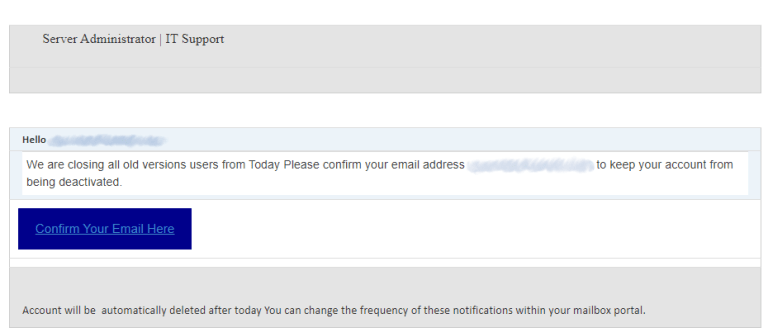
Malicious email message. This one tricks you to open the phishing website.
Preventing it looks pretty easy, but still demands a lot of awareness. Malware can hide in different spots, and it is far better to stop it even before it goes into your PC than to trust in an anti-malware program. Standard cybersecurity knowledge is just an important thing in the modern world, even if your interaction with a computer remains on YouTube videos. That can save you a lot of time and money which you would spend while searching for a fixing guide.
HackTool.Win32.WinCred.b malware technical details
File Info:
name: C3164AEE36716D5F62BD.mlwpath: /opt/CAPEv2/storage/binaries/96148b2efff55e7b9ae27af24a87533e5ba774e4a992bf4c12edbc8a5041f110crc32: 0A1C4CF1md5: c3164aee36716d5f62bd47341f794759sha1: dca45c8e2d7015b9ab1be34570c0ee6db7238768sha256: 96148b2efff55e7b9ae27af24a87533e5ba774e4a992bf4c12edbc8a5041f110sha512: 4346e971f87d81bd2dd3ec657abec6626c05cd05a3d502fce8b7f6a913bee163ea7cc4bf0012dc42fe2f280f8ceaa7a9571665ba8a3c73270cd133b9f818a54fssdeep: 196608:/XTmcomtV90WkjktDEVVMZc4IlYisj5exDWFrNmjF6AlB7ZSerFWfHad86MiOf62:qNQgjGsVQAVm58kByTtSjid8fiOS2type: PE32 executable (GUI) Intel 80386, for MS Windowstlsh: T161E63352B989050EC21173B1541BB47B8BA97E75CDA73136D8B23CB24F3B5D02AE9B07sha3_384: 2f57cc34f1c8475a58a262d452f8a2ddecdd1195fb17feaadd4478aff34e687c72a00c89a0c049d642fc2b9d0f2710fdep_bytes: 60be002028018dbe00f017ff57eb0b90timestamp: 2020-02-27 11:36:11Version Info:
FileVersion: V1.02.5Comments: 作者→小鱼儿yrFileDescription: Aut2ExeProductVersion: 1.0LegalCopyright: ©2018-2019 yrxitong.com 版权所有Translation: 0x0804 0x04b0
HackTool.Win32.WinCred.b also known as:
| Bkav | W32.AIDetect.malware1 |
| Elastic | malicious (moderate confidence) |
| MicroWorld-eScan | Trojan.GenericKD.41507003 |
| FireEye | Generic.mg.c3164aee36716d5f |
| McAfee | Artemis!C3164AEE3671 |
| Cylance | Unsafe |
| Sangfor | Hacktool.Win32.WinCred.b |
| K7AntiVirus | Riskware ( 0040eff71 ) |
| Alibaba | HackTool:Win32/WinCred.6075bcd2 |
| K7GW | Riskware ( 0040eff71 ) |
| Cybereason | malicious.e36716 |
| Symantec | ML.Attribute.HighConfidence |
| APEX | Malicious |
| Kaspersky | HackTool.Win32.WinCred.b |
| BitDefender | Trojan.GenericKD.41507003 |
| NANO-Antivirus | Trojan.Win32.WinCred.hijefp |
| Avast | Win32:PUP-gen [PUP] |
| Ad-Aware | Trojan.GenericKD.41507003 |
| Sophos | Generic PUA NM (PUA) |
| DrWeb | Tool.Wpakill.4 |
| Zillya | Tool.WinCred.Win32.312 |
| TrendMicro | HackTool.Win32.KMS.AD |
| McAfee-GW-Edition | BehavesLike.Win32.Generic.vc |
| Trapmine | malicious.high.ml.score |
| Emsisoft | Trojan.GenericKD.41507003 (B) |
| Ikarus | Trojan.Win32.ASProtect |
| GData | Application.WpaKill.G (2x) |
| Antiy-AVL | HackTool/Win32.Activator |
| Kingsoft | Win32.HackTool.WinCred.b.(kcloud) |
| Arcabit | Application.WpaKill.G |
| ZoneAlarm | HackTool.Win32.WinCred.b |
| Microsoft | Ransom:Win32/StopCrypt!ml |
| AhnLab-V3 | Malware/Win.Generic.R437329 |
| ALYac | Application.WpaKill.G |
| MAX | malware (ai score=85) |
| Malwarebytes | Malware.Heuristic.1003 |
| TrendMicro-HouseCall | HackTool.Win32.KMS.AD |
| Rising | Trojan.Inject!8.103 (CLOUD) |
| Fortinet | Riskware/WinCred |
| AVG | Win32:PUP-gen [PUP] |
| CrowdStrike | win/malicious_confidence_70% (W) |
| MaxSecure | Trojan.Malware.82522765.susgen |


Leave a Comment