
The HackTool:Win32/Activator detection is a sign of an unwanted program running on your PC. This detection stands for an app that performs outlaw activations a certain program.
Usually, Activator detection just notifies that the program you’ve downloaded to activate another program is illegal to use. However, there are instances where such activation tools were used as shells around actual malware. That’s why you should be especially careful using this software.
HackTool:Win32/Activator Overview
The HackTool:Win32/Activator detection you can see in the lower right side is shown to you by Microsoft Defender. As Microsoft thoroughly follows international copyright laws, their built-in antivirus will block any programs with functionality like Activator has. Though, that does not mean you should ignore this warning and command the antivirus to stop blocking it.
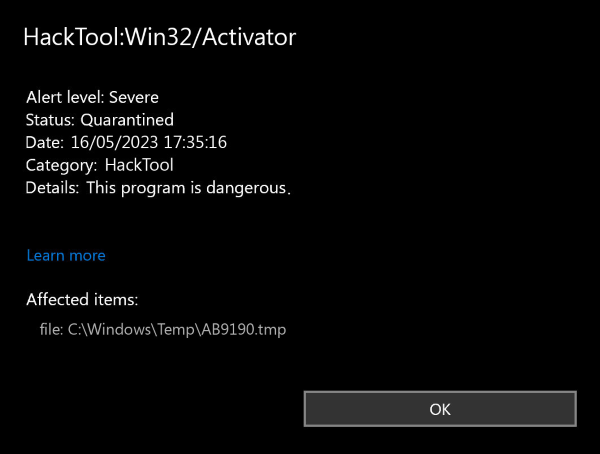
Microsoft Defender: “HackTool:Win32/Activator”
Since cracking the programs or creating a utility for that purpose is impossible to monetize in a legal manner, handymen seek for an alternative. And malware happens to be one of a few ones for them. They simply embed a malicious script into the Win32/Activator, and once you run it, the script will download malware to your system.
Threat Summary:
| Name | Activator HackTool |
| Detection | HackTool:Win32/Activator |
| Details | Activator is attached to another program (such as a document), which can replicate and spread after an initial execution. |
Is HackTool:Win32/Activator dangerous?
As I have said, HackTool Win32 Activator is not outright dangerous. However, in most cases, its use is illegal. In addition, although it is not malware, scammers can inject malicious scripts into the code of this utility. This is where the main danger lies.
Since Activator usually requires administrative privileges, it can bypass any system limitations. As a result, once a malicious script is inside, it will have no problem connecting to the remote server and downloading malware. And having admin privileges, it can grant the same privileges to the payload.
- Using cracks or activators to avoid software licensing can result in legal consequences.
- Activators can contain malware and expose your system to viruses, Trojans, or ransomware.
- Untrusted activators can expose your system to vulnerabilities by tampering with software code.
- Cracked software lacks support and updates, making it vulnerable to threats and compatibility issues.
- Activators can install unwanted software and degrade user experience with intrusive ads and browser redirects.


Leave a Comment