
Spectating the Floxif.Virus.FileInfector.DDS malware detection usually means that your system is in big danger. This virus can correctly be named as ransomware – virus which encrypts your files and asks you to pay for their decryption. Removing it requires some peculiar steps that must be done as soon as possible.
Floxif.Virus.FileInfector.DDS detection is a virus detection you can spectate in your computer. It often shows up after the provoking procedures on your PC – opening the suspicious e-mail messages, clicking the advertisement in the Web or setting up the program from unreliable resources. From the second it appears, you have a short time to act until it begins its destructive activity. And be sure – it is better not to await these harmful actions.
What is Floxif.Virus.FileInfector.DDS virus?
Floxif.Virus.FileInfector.DDS Summary
In summary, Floxif.Virus.FileInfector.DDS virus actions in the infected computer are next:
- Behavioural detection: Executable code extraction – unpacking;
- Uses Windows utilities for basic functionality;
- CAPE extracted potentially suspicious content;
- Unconventionial language used in binary resources: Assamese;
- The binary contains an unknown PE section name indicative of packing;
- The binary likely contains encrypted or compressed data.;
- Authenticode signature is invalid;
- CAPE detected the OnlyLogger malware family;
- Detects Bochs through the presence of a registry key;
- Checks the version of Bios, possibly for anti-virtualization;
- Attempted to write directly to a physical drive;
- Deletes executed files from disk;
- Collects information to fingerprint the system;
- Uses suspicious command line tools or Windows utilities;
- Yara rule detections observed from a process memory dump/dropped files/CAPE;
- Ciphering the files kept on the target’s drives — so the victim cannot check these documents;
- Blocking the launching of .exe files of anti-virus apps
- Blocking the launching of installation files of security tools
Ransomware has been a major problem for the last 4 years. It is challenging to imagine a more hazardous virus for both individuals and businesses. The algorithms utilized in Floxif.Virus.FileInfector.DDS (generally, RHA-1028 or AES-256) are not hackable – with minor exclusions. To hack it with a brute force, you need more time than our galaxy actually exists, and possibly will exist. But that malware does not do all these unpleasant things immediately – it can require up to several hours to cipher all of your files. Thus, seeing the Floxif.Virus.FileInfector.DDS detection is a clear signal that you must begin the elimination process.
Where did I get the Floxif.Virus.FileInfector.DDS?
Usual tactics of Floxif.Virus.FileInfector.DDS distribution are typical for all other ransomware variants. Those are one-day landing web pages where victims are offered to download the free app, so-called bait e-mails and hacktools. Bait emails are a pretty modern tactic in malware distribution – you receive the e-mail that simulates some routine notifications about shippings or bank service conditions changes. Inside of the e-mail, there is an infected MS Office file, or a web link which opens the exploit landing page.
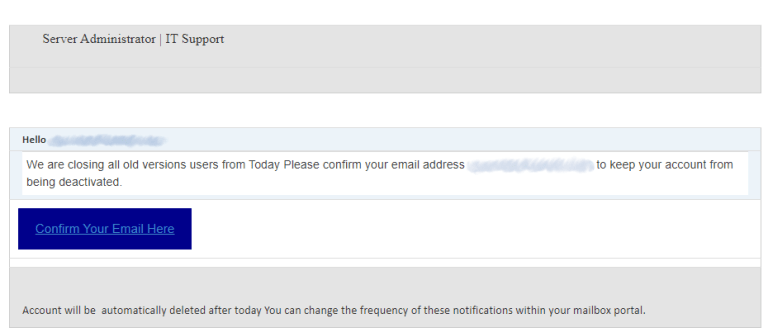
Malicious email message. This one tricks you to open the phishing website.
Preventing it looks pretty uncomplicated, but still needs a lot of focus. Malware can hide in different spots, and it is better to prevent it even before it gets into your computer than to depend on an anti-malware program. Essential cybersecurity knowledge is just an essential item in the modern-day world, even if your interaction with a PC stays on YouTube videos. That can save you a great deal of money and time which you would spend while seeking a solution.
Floxif.Virus.FileInfector.DDS malware technical details
File Info:
name: 425B312C607EAA405059.mlwpath: /opt/CAPEv2/storage/binaries/ea25dcf8f74b1d1094825d695807839f48230a800420cd2c57a05f7f6fe5a5bbcrc32: A8B247E2md5: 425b312c607eaa405059b4928a65cba8sha1: 3caefbcad6d742e8c1849ec2d8ce092c0c75152fsha256: ea25dcf8f74b1d1094825d695807839f48230a800420cd2c57a05f7f6fe5a5bbsha512: 89d9c201da31815db48bbb0fea5268044a412dac91677f8d9fc9a7ff1b9eec9d0c8b3c864b340148a22cacbd6b2e3a37dbfd94170ccba3d059ee261c402d1fa6ssdeep: 12288:hET5GSUENyq2QSfyrVVM6O83C1+ZOXzh:aTXUENRFlZVMusYOjtype: PE32 executable (GUI) Intel 80386, for MS Windowstlsh: T1C694CF10FBA0C035F5B762F85AB6936CB52E7AA2973490CF52D426ED5A346E0EC31707sha3_384: 6dfade3777471cb5601cc70e94d507ea5a198f808af957cf813e442e6feb0b0f37cb4f0160435cd086d1efdfade71099ep_bytes: 8bff558bece896d00000e8110000005dtimestamp: 2021-05-19 13:45:55Version Info:
0: [No Data]
Floxif.Virus.FileInfector.DDS also known as:
| Bkav | W32.AIDetectMalware |
| Lionic | Trojan.Multi.Generic.4!c |
| Elastic | malicious (high confidence) |
| MicroWorld-eScan | Gen:Variant.Ransom.Loki.3077 |
| CAT-QuickHeal | Trojan.IgenericRI.S26207629 |
| Skyhigh | BehavesLike.Win32.Lockbit.gc |
| McAfee | Packed-GEE!425B312C607E |
| Cylance | unsafe |
| Zillya | Trojan.Kryptik.Win32.3675132 |
| Sangfor | Ransom.Win32.Save.a |
| K7AntiVirus | Trojan ( 0058d06e1 ) |
| Alibaba | Trojan:Win32/Zenpak.4d2ff4e8 |
| K7GW | Trojan ( 0058d06e1 ) |
| Cybereason | malicious.ad6d74 |
| Baidu | Win32.Trojan.Kryptik.jm |
| Symantec | ML.Attribute.HighConfidence |
| ESET-NOD32 | a variant of Win32/Kryptik.HNZU |
| Cynet | Malicious (score: 100) |
| APEX | Malicious |
| ClamAV | Win.Packed.Crypterx-9936122-0 |
| Kaspersky | HEUR:Trojan.Win32.Zenpak.pef |
| BitDefender | Gen:Variant.Ransom.Loki.3077 |
| NANO-Antivirus | Trojan.Win32.Kryptik.jkptis |
| SUPERAntiSpyware | Trojan.Agent/Gen-Crypt |
| Avast | Win32:AceCrypter-D [Cryp] |
| Tencent | Trojan.Win32.Obfuscated.gen |
| Emsisoft | Trojan.Crypt (A) |
| F-Secure | Heuristic.HEUR/AGEN.1316834 |
| DrWeb | Trojan.Siggen16.32867 |
| VIPRE | Gen:Variant.Ransom.Loki.3077 |
| TrendMicro | TROJ_FRS.0NA103AH22 |
| Sophos | Troj/Krypt-FV |
| Ikarus | Trojan.Win32.Crypt |
| GData | Win32.Trojan.Kryptik.RW |
| Jiangmin | Backdoor.Mokes.faj |
| Varist | W32/Kryptik.GAL.gen!Eldorado |
| Avira | HEUR/AGEN.1316834 |
| Antiy-AVL | Trojan/Win32.Kryptik |
| Xcitium | Malware@#c2k03z6xk142 |
| Arcabit | Trojan.Ransom.Loki.DC05 |
| ZoneAlarm | HEUR:Trojan.Win32.Zenpak.pef |
| Microsoft | Ransom:Win32/StopCrypt.PAH!MTB |
| Detected | |
| AhnLab-V3 | Trojan/Win.MalPE.R465040 |
| VBA32 | Trojan.Zenpak |
| MAX | malware (ai score=100) |
| Malwarebytes | Floxif.Virus.FileInfector.DDS |
| Panda | Trj/GdSda.A |
| TrendMicro-HouseCall | TROJ_FRS.0NA103AH22 |
| Rising | Malware.Obscure!1.A3BB (CLASSIC) |
| Yandex | Trojan.Kryptik!exn3i5++cqI |
| SentinelOne | Static AI – Malicious PE |
| MaxSecure | Trojan.Malware.300983.susgen |
| Fortinet | W32/Kryptik.HNZY!tr |
| AVG | Win32:AceCrypter-D [Cryp] |
| DeepInstinct | MALICIOUS |
| CrowdStrike | win/malicious_confidence_100% (W) |


Leave a Comment