
Spectating the Backdoor:Win32/Htbot.B detection name means that your system is in big danger. This malware can correctly be named as ransomware – virus which ciphers your files and asks you to pay for their decryption. Deleteing it requires some peculiar steps that must be taken as soon as possible.
Backdoor:Win32/Htbot.B detection is a virus detection you can spectate in your system. It frequently appears after the provoking procedures on your computer – opening the dubious email, clicking the banner in the Internet or setting up the program from untrustworthy sources. From the moment it appears, you have a short time to do something about it until it starts its malicious action. And be sure – it is better not to await these destructive things.
What is Backdoor:Win32/Htbot.B virus?
Backdoor:Win32/Htbot.B Summary
In total, Backdoor:Win32/Htbot.B ransomware activities in the infected computer are next:
- Behavioural detection: Executable code extraction – unpacking;
- Uses Windows utilities for basic functionality;
- Reads data out of its own binary image;
- CAPE extracted potentially suspicious content;
- Drops a binary and executes it;
- Authenticode signature is invalid;
- Attempts to modify proxy settings;
- Creates a copy of itself;
- Yara rule detections observed from a process memory dump/dropped files/CAPE;
- Ciphering the files kept on the target’s disk drive — so the victim cannot open these files;
- Blocking the launching of .exe files of anti-malware programs
- Blocking the launching of installation files of security tools
Ransomware has been a major problem for the last 4 years. It is challenging to picture a more damaging malware for both individual users and corporations. The algorithms used in Backdoor:Win32/Htbot.B (generally, RHA-1028 or AES-256) are not hackable – with minor exclusions. To hack it with a brute force, you need more time than our galaxy actually exists, and possibly will exist. However, that malware does not do all these bad things without delay – it can take up to a few hours to cipher all of your documents. Hence, seeing the Backdoor:Win32/Htbot.B detection is a clear signal that you need to begin the removal procedure.
Where did I get the Backdoor:Win32/Htbot.B?
Ordinary tactics of Backdoor:Win32/Htbot.B injection are common for all other ransomware variants. Those are one-day landing sites where users are offered to download the free program, so-called bait e-mails and hacktools. Bait e-mails are a relatively new strategy in malware spreading – you get the e-mail that imitates some regular notifications about shippings or bank service conditions changes. Within the e-mail, there is a corrupted MS Office file, or a link which opens the exploit landing site.
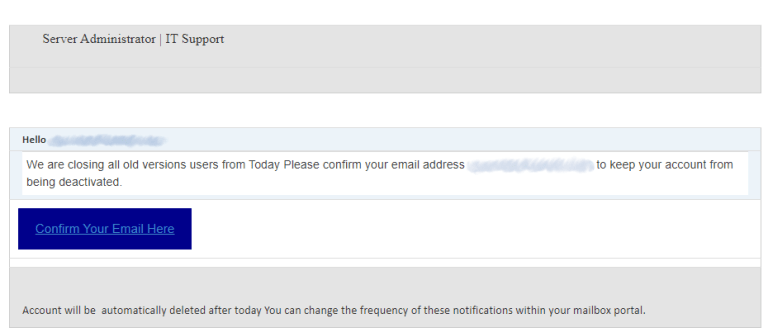
Malicious email message. This one tricks you to open the phishing website.
Preventing it looks fairly uncomplicated, however, still needs a lot of attention. Malware can hide in different spots, and it is far better to prevent it even before it gets into your system than to rely on an anti-malware program. Basic cybersecurity awareness is just an essential thing in the modern-day world, even if your interaction with a PC remains on YouTube videos. That can save you a great deal of money and time which you would certainly spend while looking for a fix guide.
Backdoor:Win32/Htbot.B malware technical details
File Info:
name: A64F21D7BC4F4D3D680B.mlwpath: /opt/CAPEv2/storage/binaries/f1485e53403de8c654783ce3e0adf754639542e41c2a89b92843ce8ecdeb4646crc32: 9D40B7A3md5: a64f21d7bc4f4d3d680b3bf4cf8f7d3fsha1: 75233e60a52d548b27f9a4ea19b75d2a9852f073sha256: f1485e53403de8c654783ce3e0adf754639542e41c2a89b92843ce8ecdeb4646sha512: 71fabd805e6e2e8fa390bacb5809e1512e7f7e68ce52a758983e9d57d79b18efab6ed16d0f00ec2fd4d1f7d2428cc94c59715ffcec318b7519888250162ece59ssdeep: 3072:CKNiJfZW1fV/QUWrZD12mYFqegKvXJ61/mVWhLgBiK7IOShegz:pQJfZW1fV/QUWlDwDFnvsWrM+Utype: PE32 executable (GUI) Intel 80386, for MS Windowstlsh: T12B149E37F73088F2C127C9F45AB8E90D2825C921162796CB698C77DB0B7639B97D0762sha3_384: 3e805d4c4f7043fb074d5badb2be00dd70191bb7f1156f3cecf54b9ff1f6f3fc276b5b79b85d70a82e520a08c6f0c1eeep_bytes: e8362d0000e989feffffc7019c624200timestamp: 2015-08-13 19:30:35Version Info:
CompanyName: Microsoft CorporationFileDescription: Self-Extracting CabinetFileVersion: 6.3.0015.0InternalName: SFXCAB.EXELegalCopyright: © Microsoft Corporation. All rights reserved.OriginalFilename: SFXCAB.EXEProductName: Microsoft® Windows® Operating SystemProductVersion: 6.3.0015.0Translation: 0x0409 0x04b0
Backdoor:Win32/Htbot.B also known as:
| Bkav | W32.AIDetectMalware |
| Lionic | Trojan.Win32.Foreign.j!c |
| Elastic | malicious (high confidence) |
| MicroWorld-eScan | Trojan.Generic.34160694 |
| FireEye | Generic.mg.a64f21d7bc4f4d3d |
| CAT-QuickHeal | Trojan.Generic.B4 |
| McAfee | RDN/Generic BackDoor |
| Cylance | unsafe |
| Zillya | Trojan.Foreign.Win32.53546 |
| Sangfor | Trojan.Win32.Save.a |
| K7AntiVirus | Trojan ( 0055dd191 ) |
| Alibaba | Ransom:Win32/Foreign.133f84cd |
| K7GW | Trojan ( 0055dd191 ) |
| CrowdStrike | win/malicious_confidence_100% (W) |
| Symantec | Backdoor.Proxyback |
| tehtris | Generic.Malware |
| ESET-NOD32 | a variant of Win32/Kryptik.DTOO |
| APEX | Malicious |
| Cynet | Malicious (score: 99) |
| Kaspersky | Trojan-Ransom.Win32.Foreign.oczp |
| BitDefender | Trojan.Generic.34160694 |
| NANO-Antivirus | Trojan.Win32.RiskGen.dvkegd |
| Avast | Win32:Malware-gen |
| TACHYON | Ransom/W32.Foreign.202240 |
| Emsisoft | Trojan.Generic.34160694 (B) |
| F-Secure | Heuristic.HEUR/AGEN.1323718 |
| DrWeb | BackDoor.Htbot.6 |
| VIPRE | Trojan.Generic.34160694 |
| TrendMicro | BKDR_HTBOT.AD |
| McAfee-GW-Edition | BehavesLike.Win32.Generic.ch |
| Trapmine | malicious.high.ml.score |
| Sophos | Mal/Generic-S |
| SentinelOne | Static AI – Suspicious PE |
| GData | Trojan.Generic.34160694 |
| Webroot | Trojan.Dropper.Gen |
| Avira | HEUR/AGEN.1323718 |
| Antiy-AVL | Trojan[Ransom]/Win32.Foreign |
| Kingsoft | malware.kb.a.988 |
| Xcitium | Malware@#2c9t9az3u76xj |
| Arcabit | Trojan.Generic.D2094036 |
| ViRobot | Backdoor.Win32.ProxyBack.202240 |
| ZoneAlarm | Trojan-Ransom.Win32.Foreign.oczp |
| Microsoft | Backdoor:Win32/Htbot.B |
| Detected | |
| AhnLab-V3 | Trojan/Win32.Gen |
| ALYac | Trojan.Generic.34160694 |
| MAX | malware (ai score=100) |
| VBA32 | BScope.Backdoor.Htbot |
| Malwarebytes | Crypt.Trojan.Malicious.DDS |
| Panda | Trj/Genetic.gen |
| TrendMicro-HouseCall | BKDR_HTBOT.AD |
| Rising | [email protected] (RDML:eYsIvdCaqNrD4JnCxdo1Gw) |
| Yandex | Trojan.Foreign!ozhn78QAwCw |
| Ikarus | Trojan.Win32.Crypt |
| Fortinet | W32/Kryptik.EJXP!tr |
| AVG | Win32:Malware-gen |
| Cybereason | malicious.0a52d5 |
| DeepInstinct | MALICIOUS |


Leave a Comment