
Weaver E-cology CVE-2026-22679 is now a practical incident-response item, not just another advisory. The flaw affects Weaver E-cology 10.0 builds before 20260312 and allows unauthenticated remote code execution through an exposed debug API. NVD rates it critical with a CVSS 3.1 score of 9.8.[1][2]
The short version: if E-cology is reachable from the internet, patch first, then review logs. Vega Threat Research says it found exploitation evidence on March 17, 2026, five days after the vendor patch date and before broader public reporting.[3] That timing is the uncomfortable part: exposed business platforms often become targets as soon as attackers can identify a reliable management endpoint.
| Item | What matters |
|---|---|
| CVE | CVE-2026-22679 |
| Product | Weaver/Fanwei E-cology 10.0 |
| Affected builds | Versions before 20260312 |
| Impact | Unauthenticated remote code execution on exposed systems |
| Priority | Patch immediately; restrict internet exposure; inspect for follow-on payloads |
What admins should check now
The vulnerability sits in a debug interface that should not be reachable in production. Researchers describe attackers reaching command-execution helpers through crafted POST requests, but defenders do not need to reproduce exploit steps to act on the risk. The useful response is simpler: identify exposed E-cology servers, confirm the build is at least 20260312, and review web, Java, PowerShell, and process-creation logs around mid-to-late March 2026.
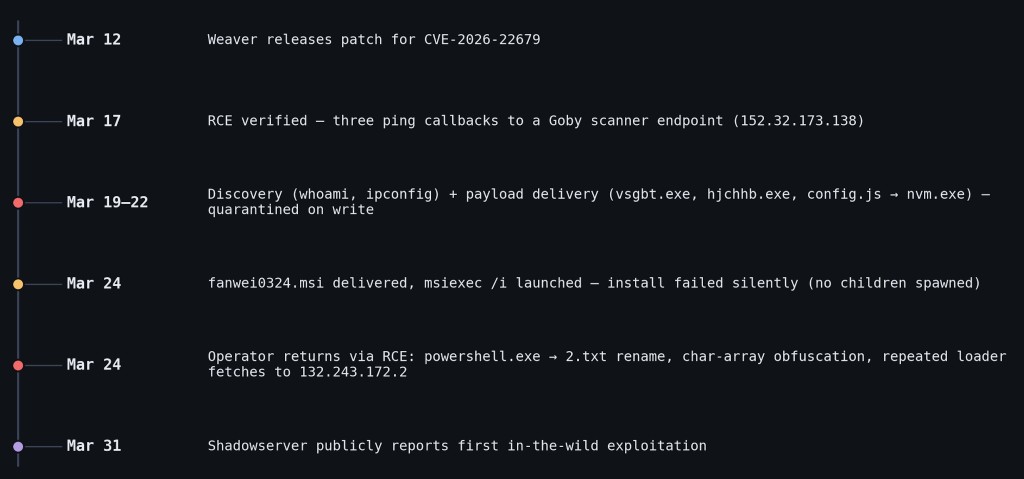
VulnCheck also tracks the issue as an unauthenticated RCE via the DubboAPI debug endpoint, with the Shadowserver Foundation credited in the advisory record.[4] The vendor download page lists security updates for E-cology, so administrators should use the official patch channel rather than random third-party mirrors.[5]
This fits the same pattern as the recent cPanel and WHM exploited vulnerability: internet-facing admin software is valuable because one bug can become direct access to business systems. Treat the patch as urgent, but do not stop there. If the server was exposed before patching, assume you need a short compromise review, not only a version check.
Practical takeaway: patch Weaver E-cology, remove direct public access where possible, put it behind VPN or trusted IP controls, and hunt for unexpected PowerShell, MSI installer activity, suspicious Java child processes, and outbound callbacks from the application host.
References
- The Hacker News, Weaver E-cology RCE flaw CVE-2026-22679 actively exploited.
- NVD, CVE-2026-22679 vulnerability record.
- Vega Threat Research, Ping, Payload, PowerShell: Active Exploitation of CVE-2026-22679 in Weaver E-cology.
- VulnCheck, Weaver E-cology 10.0 unauthenticated RCE via DubboAPI debug endpoint.
- Weaver, official security download page.


Leave a Comment