
The Trojan:Win32/Lazy alert, is a sign that your PC has a problem. Allowing it to run may lead to really bad consequences.
Lazy is a malware that aims at opening your system to further malware injection. Most of of the modern virus variants are complex, and can download other viruses. Being infected with the Trojan:Win32/Lazy malware often equals to getting a thing which is able act like spyware or stealer, downloader, and a backdoor. Spectating this detection means that you need to perform the malware removal as fast as you can.
Trojan:Win32/Lazy Detection Overview
The Trojan:Win32/Lazy detection you can see in the lower right side is demonstrated to you by Microsoft Defender. That anti-malware software is quite OK at scanning, but prone to be basically unstable. It is prone to malware invasions, it has a glitchy interface and problematic malware removal features. Thus, the pop-up which states about the Lazy is rather just a notification that Defender has spotted it. To remove it, you will likely need to use a separate anti-malware program.
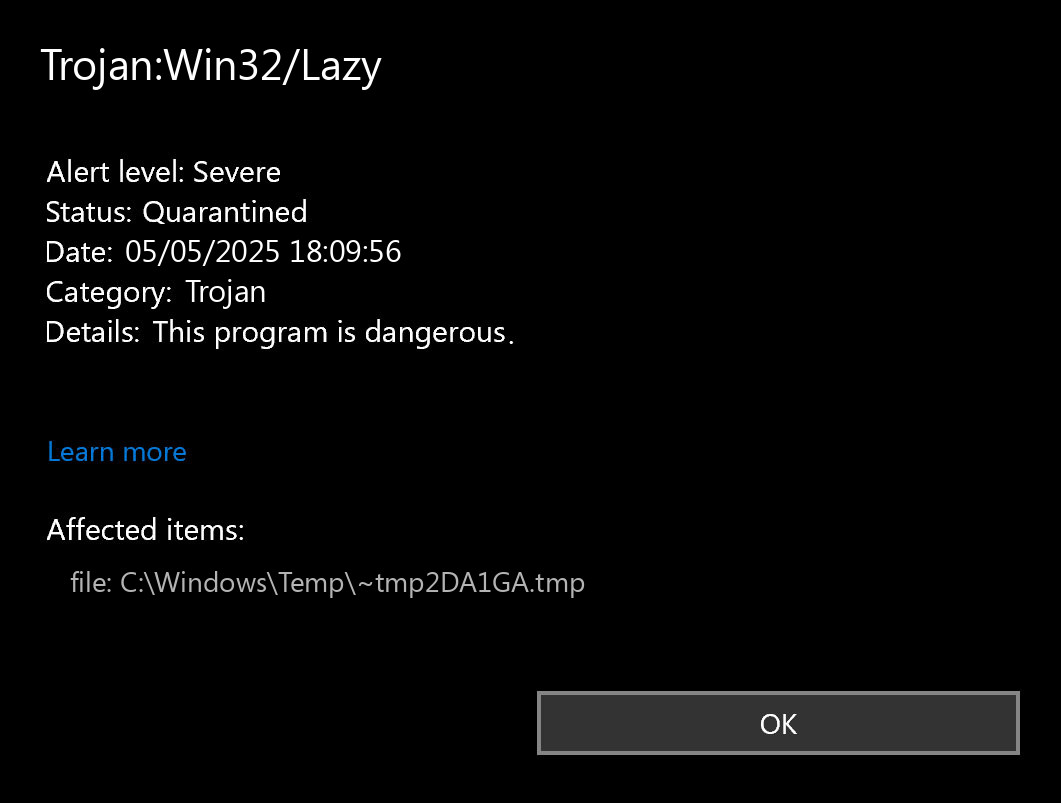
Microsoft Defender: “Trojan:Win32/Lazy”
The exact Trojan:Win32/Lazy virus is a very undesirable thing. It digs inside of your Windows under the guise of something normal, or as a part of the program you have got on a forum. Then, it makes everything to weaken your system. At the end of this “party”, it downloads other malicious things – ones which are choosen by crooks who manage this malware. Hence, it is almost impossible to predict the effects from Lazy actions. And the unpredictability is one of the most upleasant things when we are talking about malware. That’s why it is rather not to choose at all, and don’t let the malware to complete its task.
Threat Summary:
| Name | Lazy Trojan |
| Detection | Trojan:Win32/Lazy |
| Details | Lazy tool that looks legitimate but can take control of your computer. |


Leave a Comment