
Millenium, a potent Remote Access Trojan (RAT), infiltrates systems via phishing and social engineering tactics. Promoted on platforms like GitHub, it poses a significant threat. Key actions include data theft, system control, and extensive file management, along with browser data extraction.
Employing stealthy downloads, spam attachments, online scams, and dubious sources, it reaches unsuspecting victims. Millenium’s versatile capabilities and pervasive propagation make it a formidable adversary in the realm of cyber threats.
Millenium RAT Overview
The Millenium malware functions as a Remote Access Trojan (RAT). RATs are purpose-built programs that grant attackers remote access and control of compromised systems. Millenium stands out for its versatility, allowing it to execute a wide range of commands on infected devices. Additionally, this Trojan boasts robust data-stealing capabilities.
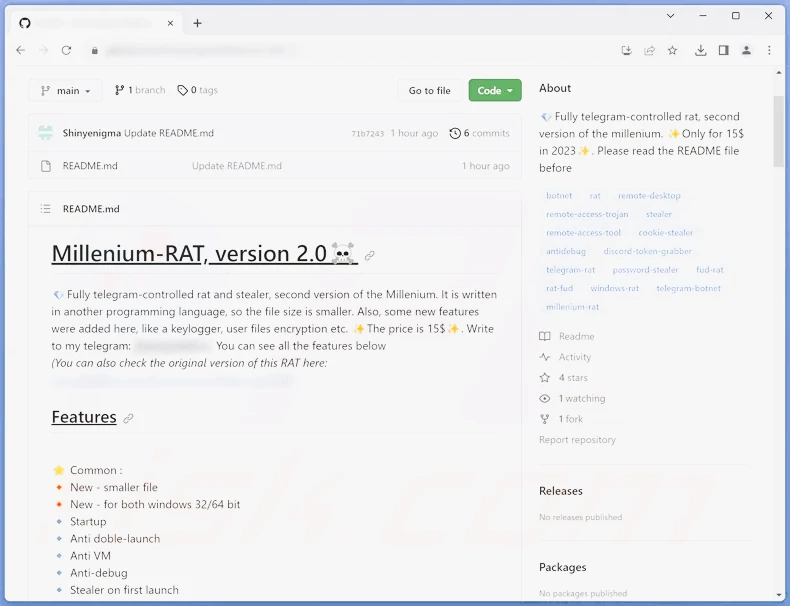
Screenshot of the Millenium RAT promoted on GitHub.
Millenium RAT boasts extensive file and folder management features, enabling actions such as copying, deleting, downloading, uploading, and other relevant operations on digital content. It can also capture screenshots as needed. The RAT exhibits proficiency in extracting data from various web browsers, including but not limited to bookmarks, internet cookies, usernames, passwords, and credit card numbers. Additionally, Millenium specifically targets data related to the Discord and Telegram messaging platforms.
| Name | Millenium (Remote Access Trojan) |
| Threat Type | Trojan, remote access trojan (RAT), password-stealing virus, banking malware, spyware. |
| Detection | Millenium RAT |
| Damage | Stolen passwords and banking information, identity theft, the victim’s computer added to a botnet. |
| Similar behivator | HiatusRAT, Loda RAT, Whiffy Recon, JanelaRAT |
Technical Analysis of Millenium RAT
Millenium excels in collecting essential device data, including CPU, GPU, RAM, IP address (for geolocation purposes), and MAC address. Moreover, this trojan possesses the ability to restart, shut down systems, and trigger the infamous Blue Screen of Death error. It also compiles information on running processes and their file paths, with the added capability to terminate these processes.
Spreading methods
The infiltration of Millenium into your computer can be attributed to various methods. This RAT has been observed being promoted on GitHub as a commercially available tool, and its distribution relies on the tactics employed by the cybercriminals who deploy it.
The most prevalent methods used for proliferating malware, including Millenium, encompass the following:
- Often delivered via email, private messages, or SMS, these contain deceptive links or attachments designed to trick the recipient.
- Cybercriminals utilize various online scams to entice users into downloading or executing malicious content.
- Malicious advertisements that lead to malware downloads when clicked.
- Attackers create counterfeit software update notifications to deceive users into downloading and installing malware.
- Malware can be distributed through pirated software versions and activation tools, preying on users seeking free access to paid software.


Leave a Comment