
Updated May 9, 2026: added CISA KEV remediation timing, affected-product scope, and a practical triage checklist for exposed EPMM deployments.
Ivanti is urging customers to patch CVE-2026-6973, a high-severity remote code execution vulnerability in Endpoint Manager Mobile (EPMM), after the company said it saw very limited exploitation in the wild.[1] The bug is less simple than a pre-authentication internet-wide RCE: successful exploitation requires an already authenticated administrator. That lowers the entry point, but it does not make the issue harmless for organizations with exposed admin panels, reused credentials, weak MFA coverage, or recently phished administrators.
NVD describes CVE-2026-6973 as improper input validation in EPMM before versions 12.6.1.1, 12.7.0.1, and 12.8.0.1, allowing a remote authenticated user with administrative access to execute code.[2] CISA added the flaw to its Known Exploited Vulnerabilities catalog on May 7, 2026, with a federal remediation due date of May 10, 2026.[3] That short deadline is a useful signal for private-sector teams too: this is not a routine backlog patch if the appliance is reachable from the internet.
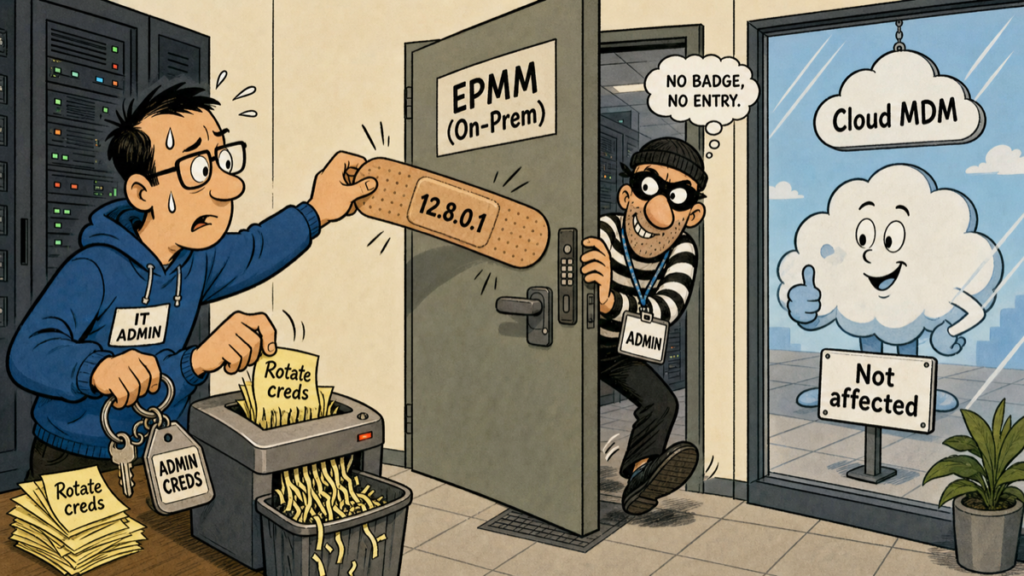
The key scope detail is important. Ivanti says the May 2026 EPMM issues affect only the on-prem EPMM product and are not present in Ivanti Neurons for MDM, Ivanti EPM, Ivanti Sentry, or other Ivanti products.[1] In practice, teams should first identify exactly which management product is deployed, then map it to the fixed release train instead of treating every Ivanti-branded console the same way.
What to check before you close the ticket
| Area | How to treat it |
|---|---|
| Ivanti EPMM on-prem | Affected if it is earlier than 12.6.1.1, 12.7.0.1, or 12.8.0.1. Patch on the supported train and verify the installed version after maintenance.[2] |
| Ivanti Neurons for MDM | Ivanti says this cloud product is not affected by the EPMM issue, but admins should still review identity controls and related alerts. |
| Ivanti EPM and Sentry | Ivanti says these are not affected by CVE-2026-6973. Do not waste incident time on the wrong product, but keep normal patch review in place.[1] |
| Internet-exposed admin portal | Treat exposure as a priority multiplier. Restrict access with VPN, IP allowlists, and firewall rules while patching and triage are underway. |
The admin-authentication requirement deserves a careful read. It means an attacker generally needs an administrator session or credential first; it does not mean the appliance is safe once attackers have that foothold. A stolen admin password, a reused credential from another incident, an AiTM phishing session, or a compromised help-desk account can turn a post-auth RCE into a practical attack path. That is why this belongs next to credential hygiene, not only patch management. For a recent example of session-focused phishing at scale, see our coverage of the Microsoft AiTM phishing campaign targeting 35,000 users.
Start triage with the version and exposure question: confirm whether EPMM is on-prem, identify the exact release, and check whether the admin interface is reachable from the public internet. Then review administrator accounts, recent privileged logins, newly created users, unexpected role changes, and any authentication changes around May 7, 2026. If the deployment was previously exposed to exploited EPMM vulnerabilities, revisit Ivanti’s earlier advice to rotate credentials; a stale admin secret can be enough to make this newer bug relevant.[1]
Next, look for post-exploitation traces rather than stopping at “patch installed.” Review web/application logs for unusual admin requests, new files, modified configuration, unexpected processes, and suspicious outbound connections from the appliance. If there is uncertainty about account compromise, rotate EPMM admin credentials, invalidate active sessions where possible, and review any secrets or integrations that an EPMM administrator could access. BleepingComputer also noted Shadowserver telemetry suggesting hundreds of EPMM instances were exposed online, which makes external visibility a practical risk factor rather than a theoretical one.[4]
The shortest useful response is: patch, restrict exposure, rotate risky admin credentials, and hunt for signs of admin-session abuse. Teams that only install the update but leave old administrator sessions, reused passwords, or public admin access untouched may close the CVE ticket while leaving the same access path open.
References
- Ivanti, “May 2026 EPMM Security Update,” last updated May 7, 2026. Advisory.
- NVD (NIST), “CVE-2026-6973,” published May 7, 2026. CVE record.
- CISA, “Known Exploited Vulnerabilities Catalog: CVE-2026-6973,” added May 7, 2026; due May 10, 2026. KEV entry.
- BleepingComputer, “Ivanti warns of new EPMM flaw exploited in zero-day attacks,” published May 7, 2026. Coverage.
Related update: Ivanti later patched a separate Sentry gateway issue, CVE-2026-10520, after CISA added the root-level RCE flaw to its Known Exploited Vulnerabilities catalog.


Leave a Comment