
The detection name “EUS:Win32/CustomEnterpriseBlock” is used by Windows Defender to identify an Enterprise Undesirable Software (EUS) that falls into the PUP category.
“CustomEnterpriseBlock” is a specific variant of the EUS adware program that can install itself on the system without the user’s consent and display unwanted advertisements. It may also modify browser settings to redirect the user’s searches or homepage to other unwanted websites. CustomEnterpriseBlock can be difficult to remove and may require advanced anti-malware tools to eradicate from the system fully.
In summary, EUS:Win32/CustomEnterpriseBlock is a potentially unwanted adware program that can negatively impact the performance and security of enterprise networks by displaying unwanted advertisements and modifying browser settings. It is important to remove this program as soon as possible to prevent further harm to the system.
The majority of CustomEnterpriseBlock is utilized to make a profit on you. The criminals elaborate the selection of unwanted programs to take your bank card details, online banking credentials, and various other information for fraudulent functions.
EUS:Win32/CustomEnterpriseBlock Overview
The EUS:Win32/CustomEnterpriseBlock detection you can see in the lower right corner is shown to you by Microsoft Defender. That anti-malware program is good at scanning, but prone to be unstable. It is prone to malware attacks, it has a glitchy interface and problematic malware removal features. Hence, the pop-up that says about the CustomEnterpriseBlock is simply an alert that Defender has found it. To remove it, you will likely need to use a separate anti-malware program.
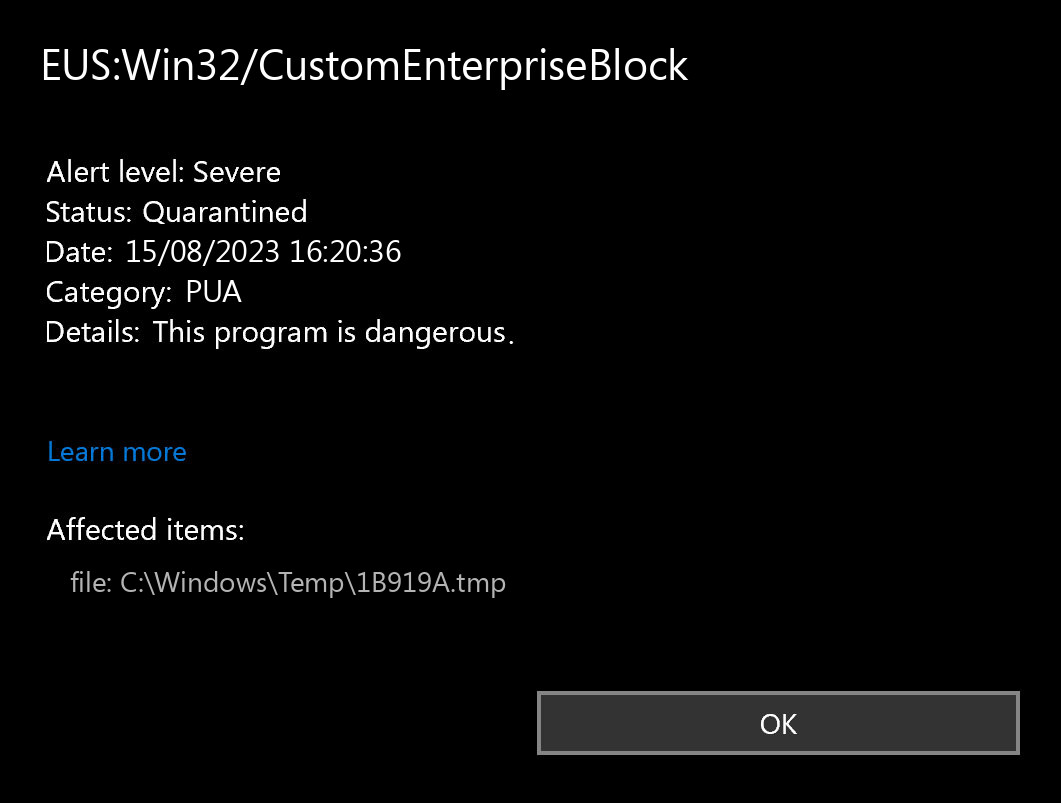
Microsoft Defender: “EUS:Win32/CustomEnterpriseBlock”
EUS:Win32/CustomEnterpriseBlock unwanted program is a case in point of PUA, which is pretty much common nowadays. Being free to use, it can give you “the extended functions” for the additional money. Some examples of this program type can have no real functions at all – only the shell with the bright interface. You can see it promoted as a system optimization tool, driver updater, or torrent downloading tracker. This or another way it does not bring you any type of real performance, exposing you to risk instead.
Unwanted Program Summary:
| Name | CustomEnterpriseBlock PUA |
| Detection | EUS:Win32/CustomEnterpriseBlock |
| Damage | CustomEnterpriseBlock is at least useless or can perform various malicious actions on your PC. |
| Fix Tool | See If Your System Has Been Affected by CustomEnterpriseBlock exploit |
Is EUS:Win32/CustomEnterpriseBlock dangerous?
I have already stated that EUS:Win32/CustomEnterpriseBlock PUA is not as safe as it claims to be. The “legit and effective” tool can abruptly uncover itself as a downloader trojan, spyware, backdoor, or coin miner virus. And you can never forecast what to anticipate even from different variants of CustomEnterpriseBlock unwanted program. That still does not imply that you have to panic – possibly, this nasty thing has not succeeded in doing negative things to your computer.
The particular damage to your system may be caused not only because of the malware injection. A large share of questionable programs, like the CustomEnterpriseBlock application, is just improperly developed. Perhaps, their actions are more useful than worthless if done on specific system setups, but not on each one. That’s how a basic system optimization program may create chaos with constant BSODs on your system. Any interruptions to the system registry are unsafe, and they are even more dangerous if completed with such programs.
How did I get this virus?
It is hard to line the origins of malware on your PC. Nowadays, things are mixed, and distribution ways chosen by adware 5 years ago can be used by spyware nowadays. However, if we abstract from the exact spreading tactic and think about why it works, the reply will be pretty uncomplicated – low level of cybersecurity understanding. Individuals click on advertisements on odd sites, click the pop-ups they receive in their web browsers, and call the “Microsoft tech support” assuming that the strange banner that says about malware is true. It is necessary to understand what is legit – to stay away from misunderstandings when trying to determine a virus.
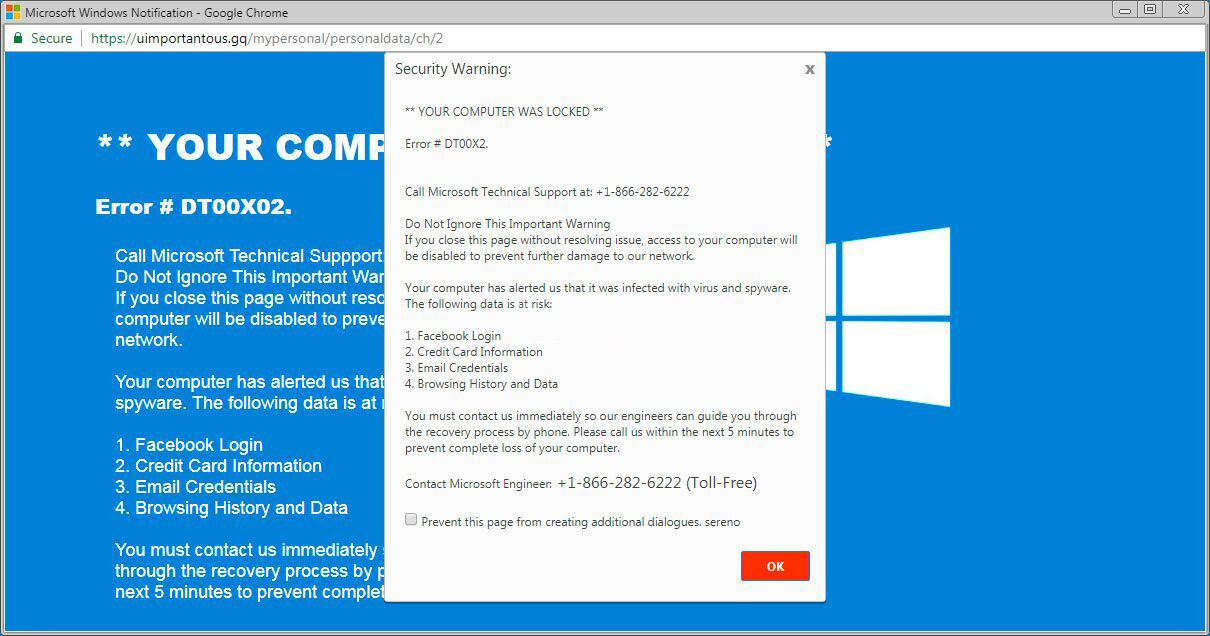
The example of Microsoft Tech support scam banner
Nowadays, there are two of the most widespread methods of malware distribution – lure emails and also injection into a hacked program. While the first one is not so easy to avoid – you should know a lot to recognize a counterfeit – the second one is simple to solve: just don’t use cracked apps. Torrent trackers and various other providers of “free” applications (which are paid, but with a disabled license checking) are a giveaway point of malware. And EUS:Win32/CustomEnterpriseBlock is simply one of them.



Leave a Comment