
Recently, Coinghw.com website surfaced, promoting itself as a place to keep cryptocurrency and other assets safely. I managed to gather credible proof that unmistakably indicates it is, actually, a fraudulent site.
Despite the promises of the most user-friendly, trustworthy, and customer-centric service, Coinghw.com does not follow any of them. All this is just a gilded wrap around a blatant scam, which takes your funds and never gives them back. Any stories about bonuses, endorsement from celebrities etc are non-existent as well.
Coinghw Scam Overview
Originally, Coinghw poses as a cryptocurrency trading & cryptowallet platform with exceptionally low commission fees. Another bright selling point for this platform is backing from celebrities that have relation to the crypto world. Vitalii Buterin (Ethereum creator), Elon Musk, Jeff Bezos, Bill Gates, Warren Buffet – the site says about being supported by them. To make these claims look more realistic, con actors employ deepfake videos with those celebs advertise the fake crypto service as if it was the best thing in the world. For obvious reasons, Elon Musk is the most common choise for that. But, as I mentioned above, all this is just a blatant wrap around a transparent scam.

Coinghw Scam
First and foremost, Coinghw copies the layout of many similar pages. There are quite a few examples, like Kunocex, Play21arena or Oxbeast. They are entirely undistinguishable in terms of visual elements, with slight discrepancies in the site header. Other details, and sometimes even crypto wallet addresses, are matching. Presumably, all these fraudulent websites are managed by the same group of swindrels.
Cryptocurrency Scam Summary
| Website | Coinghw.com |
| Hosting | AS13335 Cloudflare, Inc. United States, San Francisco |
| IP Address | 104.21.16.1 |
| Threat Type | Scam/Fraud |
| Scam Type | Fraudulent offers of cryptocurrency services |
How the Coinghw Scam Works?
Coinghw is a part of a significant cryptocurrency scam scheme that started circulating actively in 2023. Scammers who stand behind it use various website designs, which still share the similar overall layout. Another mutual element are the ways the scams like NAME are promoted, and the manner all this ends up to the victim of the scam. To reach peak efficiency, frauds apply sophisticated psychological tricks that make the user believe in the validity of the website. But let’s review them one by one.
Step 1: Promotion
To begin the fraud, criminals establish and fill accounts on well-liked social media platforms. They primarily focus on Facebook, Instagram, Twitter, and TikTok. Subsequently, the advertising campaign starts. Utilizing bots and sponsored promotions (when possible), fraud actors boost the visibility of their scam activities to potential victims. And as I said, crooks do not shy away using deepfake for creating clips with the mentioned celebrities that promote their scam to the public. To boost the folks even more, frauds claim the bonus for every user who registers the service immediately.
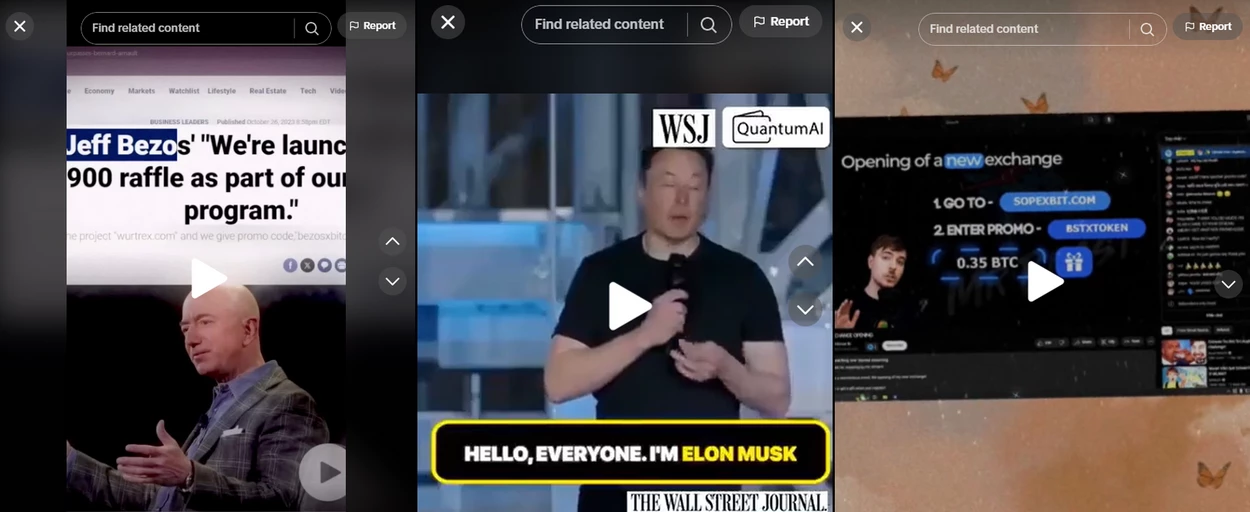
Promotions of cryptoscams like Coinghw in TikTok. Most of these videos are AI-generated deepfakes
Step 2: Gaining Traffic
After following the promos, users end up on a page filled with enticing offers. “Crypto starts with Coinghw”, “Your crypto savings are secured with Coinghw, “Start earning with Coinghw – they look rather authoritative. To heat up users and make them proceed to step 3, fraudsters say that getting the pledged bonus requires registration. And as nothing questionable happens at this point, unexperienced users happily move on – especially as the bonus appears to be right behind the corner.
At this point, it is possible to skip the scam without any losses. Before you sign up using your personal information, crooks will not be able to earn even a penny from your presence on the website.
Step 3: Data Gathering
This is where the main fraud action begins. As I just mentioned, deceivers bait folks for registration with bonuses. And all the personal info needed for it – email, username, cryptocurrency wallet address – is valuable for user identification. Exclusively by gathering this data and selling it further into the Darknet, swindlers can earn quite a penny. Nonetheless, their plans go much further.
As it turns out, the claimed bonus is not available to use right away. To make it at least usable for crypto purchases, you need to top up the account with the equivalent sum. And this is what initiates the final step of the scam.
Step 4: Requesting funds
Eventually, any crypto purchases require you to have funds on your account. In the case of Coinghw, users are also forced to top up to claim the bonuses. And these top ups is what creates the majority of the cash flow to this scam site. By topping up the account, users hope to get the pledged gift (usually $500-1000 in USDT), and may start participating on this site hoping to use all the transferred funds and withdraw them.
This, however, is where the victim notices the issues. When comparing the real cryptocurrency wallet vs what the website says, you can notice that no transactions are done whatsoever. And then, when you’d try to pull out the capital from your account, the scam is finally uncovered to the user.
Step 5: Escaping from Funds Withdrawal
There’s no need to explain that fraudsters have 0 intentions to give your money back. Though to make the denial look more realistic, they’ve elaborated a whole bunch of reasons to decline the wireout request. Usually, they repeat what Know Your Client requirements say, but in this case they are here only to make the withdrawal impossible.
By requesting your personal data, frauds just stall hoping for you to understand that you’ve been scammed and stop contacting them. If you don’t – well, there are a dozen other checks you should go through before getting your money back. And every check will uncover more and more information, which – you guessed it right – will be then sold on the Darknet. Never reveal your real info to strangers!
Signs of Scam
I gathered several facts that point at the scammy nature of the Coinghw.com. Actually, there are a lot of scams that fall under the same points, so they are pretty much universal.
- False Celebrity Sponsorship. Coinghw often resorts to fake endorsements from celebrities such as Elon Musk, Jeff Bezos, Mr. Beast, and Mark Zuckerberg. This fraudulent tactic extends to claiming partnerships with reputable companies like Coinbase, Binance, or MetaMask, despite lacking any genuine affiliations.
- Cryptocurrency-Only Payments. Coinghw.com exclusively accepts payments in cryptocurrencies, rejecting traditional bank transfers and other methods. This approach not only masks the company’s identity but also eliminates the possibility of seeking refunds.
- Dubious Company Information. Coinghw raises suspicion by withholding essential ownership, location, and registration details. Furthermore, the absence of legitimate contact information and the recent establishment of domain and social media pages intensify skepticism.
- Unsubstantiated Hype. Coinghw.com employs groundless hype tactics, fabricating events like securing contracts with Coinbase or receiving endorsements from Elon Musk. These manipulative techniques aim to instill false confidence and encourage further investments.
- Potential Pyramid Scheme. The scam relies on a structure resembling a Ponzi scheme, leveraging a referral system spread through social media. However, only initial participants benefit, often at the expense of subsequent investors.
- Implausible Claims. Promising returns of 50-100-200%, Coinghw preys on the desire for quick profits. Yet, the volatile nature of the cryptocurrency market makes such gains highly unlikely, definitively labeling Coinghw as a scam.
What Should I do as a Victim?
If you had to deal with Coinghw site and fell victim to that scam, there are still some steps to take. They will make further scam attempts harder, and also boost the knowledge about that scam among folks.
- Report the scam to authorities. Search for local authorities responsible for financial frauds, and also notify wallet providers and social networks via their tech support. It is essential to make the further operations of these scammers much harder.
- Tell your close friends. That step is similar to reporting to the authorities, and has similar effects. By posting info about scam crypto service, you decrease the pool of people they can fool.
- Get evidence. Screenshot or save all the information related to the website. URL, screenshot of a main page, login window, EULA, account top-up menu, wallet addresses – all these things may be useful for authorities to find the scammers.
- Check whether you can ask for a refund. As I’ve said above, crypto payments do not fall under refund policies in most banks. Nonetheless, in some circumstances, it is still possible. Never lose hope until you actually confirm it is gone.
- Make your mistake your lesson. Financial losses are always a reason for frustration, but let’s imagine it was a pay for scam revealing courses. Remember the key features of these crypto scam sites, the way they attract people and what they promise. In the future, you will easily recognize a trap of spending no money.
Scan your system for possible malware infections
Beware of cross scams! Scam actors can use your trust to make you download some stuff or interact with certain documents. It may be a trap that installs malware to your system. There are no moral barriers or limits for these scoundrels.
Throughout the timeline of the fraud, its actors may reach out to you with particular files. Alternatively, they may suggest you to set up “cryptocurrency wallet applications” or “browser extensions” to facilitate access to your cryptocurrency funds. As we previously figured out, these rascals have no plan of giving back your capital. So, what do these emails and browser plugins represent? Correct – that is another element of the scam designed to entice you into deliberately running malicious software onto your computer.
Both add-ons and attachments attached to email messages can serve as a carrier for various malicious code. In this scenario, I anticipate the presence of spyware and stealers among other types of threats. While it is not mandatory for scammers to distribute malware, the chance is always significant. As previously mentioned, their conscience is of little concern, and their reputation is already severely tarnished. They have nothing to lose and strive to maximize profits.
Frequently asked questions
- Contact your bank or card provider and ask about chargeback options.
- Save screenshots, receipts, tracking numbers, and emails as evidence.
- Change reused passwords and enable two-factor authentication on important accounts.
- Watch for follow-up phishing emails pretending to offer refunds or delivery updates.

