
Recently, Coinexnet.com site popped up, promoting itself as a place where you can securely keep cryptocurrency and other assets. I managed to gather credible supporting information that clearly reveals it is, actually, a scam platform.
Despite what Coinexnet site states, they won’t refund your money. Regardless of the figures displayed in the “member area”, there is no ability to take out even a single penny. All commitments regarding crypto bonuses are empty as well.
Coinexnet Scam Overview
The primary service that Coinexnet attempts to provide is a protected and convenient crypto wallet service. The site promises exchange facilities, tools for controlling wallets, transfers, dashboards, and similar stuff. In fact, they endeavor to emulate the functionality of a crypto marketplace, akin to Binance or Coinbase. However, it in fact only serves as a cover needed to deceive the cautious.
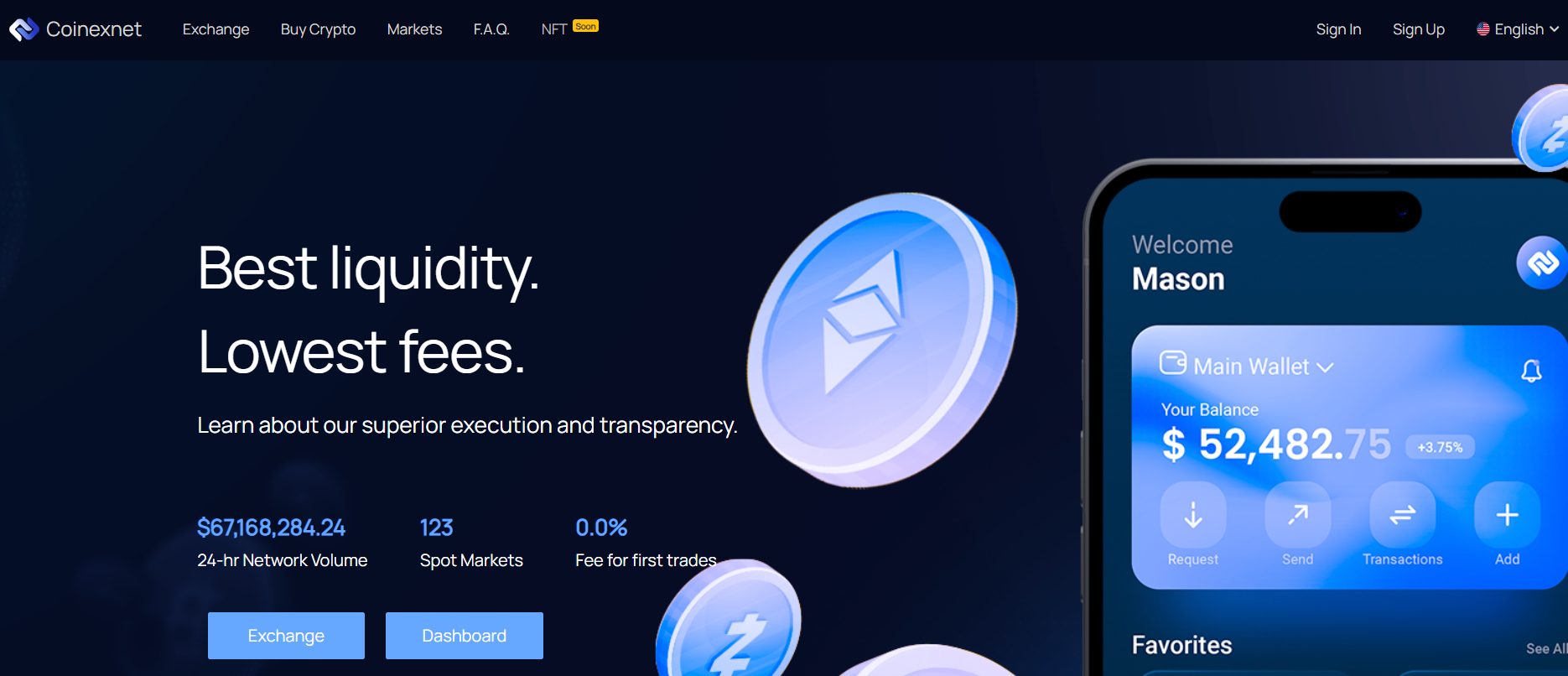
Coinexnet Scam
Initially, Coinexnet reproduces the layout of multiple similar websites. There are quite a few examples, like Coinevt, Nevacy or Moxtesla. They are totally indistinguishable in terms of visual elements, with small discrepancies in the webpage header. Other particulars, and at times even crypto wallet addresses, are the same. Presumably, all these scam sites are managed by the same team of scammers.
Cryptocurrency Scam Summary
| Website | Coinexnet.com |
| Hosting | AS13335 Cloudflare, Inc. United States, San Francisco |
| IP Address | 104.21.26.4 |
| Threat Type | Scam/Fraud |
| Scam Type | Fraudulent offers of cryptocurrency services |
How the Coinexnet Scam Works?
Coinexnet is yet another online platform within a vast network of interconnected crypto deceptive sites. The managers employ diverse brand identities and sites, like Coinexnet.com, to ensnare victims. Nevertheless, these fraudulent sites share identical designs, terms of service, and About information. This unveils their origins as parts of the same fraudulent network, which advocates the similar type of deception under various disguises. The fraudsters merely copy the equal fraudulent site under diverse names to fool users into believing they are enrolling a new venture. However, in reality, it’s the same system of fraudsters orchestrating the deceptive promises and undertakings to take deposited money. The operators cleverly make use of psychological tactics and captivating offers to carry out their unscrupulous plots.
Step 1: Spreading
To initiate the deceptive scheme, criminals set up and fill accounts on popular social media platforms. They mainly focus on Facebook, Instagram, Twitter, and TikTok. Subsequently, the advertising campaign starts. Utilizing bots and sponsored advertisements (when achievable), scam actors increase the visibility of their fraudulent activities to possible victims. This approach allows them to cast a broad net and engage with their focused audience. The public usually consists of cryptocurrency enthusiastic individuals searching for opportunities to generate profits.
Users obtain an encouragement to register, drawn by the commitment of getting crypto prizes valued at hundreds of dollars, all for free. To increase the appeal of the offer, false claims of cooperation with a celebrity are added. As you may guess, these assertions are entirely baseless.
Step 2: Gaining Traffic
Individuals who show interest visit Coinexnet.com via links included in promotions or bot-generated posts. The website uses captivating visuals, design features that appear genuine, and assertions of possessing a valid license, all intended to project an initial impression of trustworthiness.
Step 3: Data Gathering
To redeem their prizes, users are required to actively create an profile on Coinexnet and receive prompts to submit sensitive and personal data during the enrollment procedure. This comprises linking their cryptocurrency wallets, providing email addresses, specifying phone numbers, furnishing identification papers, and the like.
Step 4: Requesting funds
Once signed up, users observe significant amounts of cryptocurrency, valued at hundreds of dollars, within their Coinexnet wallets. Nonetheless, as it usually happens with such bonuses, you are unable to withdraw them ahead of topping up your account. Typically, a payment of $100 is asked to withdraw the sign-up bonus. This stipulation serves as the snare that eventually leads to the money loss.
Step 5: Disappear
The instant the payment is made, the scammers halt all communication. They proceed to block users, delete accounts, and vanish with both the deposited funds and essential private details. The fictitious rewards remain perpetually uncredited, as they lack actual existence. They operate purely as a deceptive maneuver. This technique forms the foundation for the scammers’ capacity to mislead victims and misappropriate hard-earned money through their deceptive internet-based crypto scheme.
Signs of Scam
I gathered several facts that point at the scammy nature of the Coinexnet.com. Actually, there are a lot of scams that fall under the same points, so they are pretty much universal.
- Absent company details. Coinexnet does not provide any documentation about its ownership, location or registration. No legitimate contact details are given either. Moreover, it appears that the domain and all social network pages were registered quite recently.
- Fake sponsorship from a celebrity. Scams like Coinexnet like to pick a celebrity as a sponsor of this entire campaign. For obvious reasons, fraudsters generally choose Elon Musk, Jeff Bezos, Mr. Beast, Mark Zuckerberg, and similar celebrities. They do not disdain claiming partnership with a company as well. Even though Coinbase, Binance or MetaMask never heard of Coinexnet, they do not care – this creates a halo of credibility.
- Potential Ponzi Scheme. The scam relies on a Ponzi-like referral system to spread reach through social media. In fact, only the first members will receive the payoff, at the cost of the money brought by other members.
- Hype without facts. Frauds can cheer up their victims from time to time, using claims about non-existent events. “We got contracts with Coinbase”, “Elon Musk mentioned us as the most prolific crypto project” – you could likely hear something like that. This is made to make people believe in their money return. This can be the sauce to make people top-up their accounts once again.
- Crypto-only incoming payments. Whether the user tries to top-up the account, hackers will only accept payments in crypto – no bank transfers or other payment methods. Such an approach completely hides the identity of the company and deprives you of the ability to ask for a refund.
- Claims are too good to be true. Let’s be sane and sober: even in crypto space, there are not many places where you can earn 50-100-200%. Being able to participate in all of them is nearly impossible, as well as it is impossible to insure or hedge all the risks. Even by that reason alone I can tell that the Coinexnet is a definite scam.
What Should I do as a Victim?
If you had to deal with Coinexnet site and fell victim to that scam, there are still some steps to take. They will make further scam attempts harder, and also boost the knowledge about that scam among folks.
- Report to Authorities. Your initial action should involve reporting the scam to local authorities responsible for addressing financial fraud. Additionally, reach out to wallet providers and engage with the technical support teams of social networks. This collective effort raises the bar for the scammers’ operations.
- Inform Your Inner Circle. Extend your impact by sharing information about the scam with your close friends. Similar to notifying authorities, this dissemination of details curbs the scammers’ potential to deceive.
- Document the Trail. Assemble a comprehensive record by capturing screenshots and archiving all relevant website-related data. This encompasses the website URL, screenshots of the main page, login interface, end-user license agreement (EULA), account top-up menu, and wallet addresses. These materials offer invaluable leads for authorities in their pursuit of the scammers.
- Explore Refund Possibilities. While cryptocurrency payments may not typically align with traditional bank refund policies, it’s worthwhile to explore potential refund avenues under specific circumstances. Maintain a positive outlook until you secure confirmation of the loss.
- Transform Loss into Insight. Shift your focus from the financial loss to gaining wisdom. Consider your loss as an investment in comprehending the tactics employed by crypto scam sites. Familiarize yourself with their distinctive traits, the methods they employ to entice individuals, and the extravagant pledges they make. This knowledge equips you to recognize and avoid future traps, minimizing the risk of enduring further financial setbacks.
Scan your system for possible malware infections
Beware of cross scams! Scam actors can use your trust to make you download some stuff or interact with certain documents. It may be a trap that installs malware to your system. There are no moral barriers or limits for these scoundrels.
Throughout the duration of the fraud, scoundrels may contact you with specific documents. Alternatively, they may propose you to install “cryptocurrency wallet applications” or “browser extensions” to streamline access to your crypto assets. As we already determined, these scoundrels have no intent of returning your capital. So, what can these email messages and browser add-ons represent? You guessed – that is another side of the scam designed to entice you into deliberately installing destructive programs onto your system.
Both add-ons and attachments included to email messages can act as a shell for various malicious code. In this situation, I foresee the presence of spyware and stealers among all types of malicious programs. While it is not obligatory for scammers to distribute malware, the probability is always significant. As previously mentioned, their morality is of negligible importance, and their dignity is already seriously marred. They have no principles to give up and aim to boost gains.
Frequently asked questions
- Contact your bank or card provider and ask about chargeback options.
- Save screenshots, receipts, tracking numbers, and emails as evidence.
- Change reused passwords and enable two-factor authentication on important accounts.
- Watch for follow-up phishing emails pretending to offer refunds or delivery updates.

