
Recently, Coinarken.com site appeared, promoting itself as a platform to keep cryptocurrency and other assets securely. I managed to gather reliable proof that clearly confirms it is, actually, a deceptive platform.
Despite what Coinarken site says, they won’t pay off your money. Even though the figures displayed in the “member area”, there is absolutely no ability to take out even a coin. All commitments regarding crypto rewards are baseless as well.
Coinarken Scam Overview
The main offering that Coinarken strives to provide is a protected and convenient cryptocurrency wallet service. The website promises crypto exchange services, tools for handling wallets, transfers, dashboards, and similar stuff. In truth, they aim to emulate the functionality of a crypto trading platform, like Binance or Coinbase. However, it in fact only serves as a cover needed to lull the vigilance.
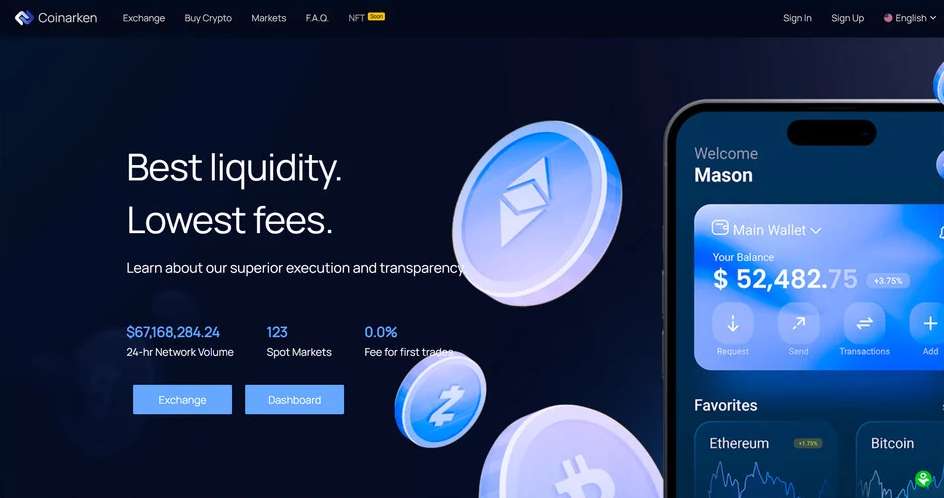
Coinarken Scam
Initially, Coinarken imitates the layout of multiple similar pages. There are quite a few examples, like Rakexbit, Biosunex or Biarux. They are entirely identical in terms of visual elements, with minor discrepancies in the webpage header. Other particulars, and at times even crypto wallet addresses, are matching. Most likely, all these scam websites are managed by a single group of scammers.
Cryptocurrency Scam Summary
| Website | Coinarken.com |
| Hosting | AS42745 Safe Value Limited Russia, Moscow |
| IP Address | 193.233.15.41 |
| Threat Type | Scam/Fraud |
| Scam Type | Fraudulent offers of cryptocurrency services |
How the Coinarken Scam Works?
Coinarken is yet another online platform within a vast network of linked crypto fraudulent sites. The managers employ diverse brand titles and websites, like Coinarken.com, to capture victims. Nevertheless, these deceptive websites share matching website designs, terms of service, and About Us content. This reveals their beginnings as components of the same criminal network, which advocates the identical form of fraud under different covers. The scammers simply duplicate the same fraudulent website under different names to deceive users into believing they are joining a fresh platform. However, in reality, it’s the same system of fraudsters orchestrating the fraudulent commitments and attempts to take deposited money. The managers skillfully employ psychological tactics and captivating invitations to implement their deceitful schemes.
Step 1: Spreading
To initiate the fraud, criminals set up and fill accounts on well-liked social media platforms. They generally target Facebook, Instagram, Twitter, and TikTok. Subsequently, the advertising campaign commences. Employing bots and sponsored ads (when achievable), scam actors boost the visibility of their scam activities to potential victims. This approach allows them to cast an extensive net and interact with their aimed spectators. The latter usually consists of cryptocurrency fans searching for prospects to earn profits.
Step 2: Gaining Traffic
Individuals who express interest check out Coinarken.com via links featured in ads or bot-generated posts. The site uses captivating visuals, design elements that appear authentic, and claims of possessing a legitimate license, all designed to convey an initial impression of reliability.
Step 3: Data Gathering
To redeem their rewards, users must proactively sign up on Coinarken and receive instructions to submit sensitive and private data during the sign-up procedure. This includes linking their cryptocurrency wallets, providing email addresses, supplying phone numbers, furnishing identification papers, and more.
Step 4: Requesting funds
Once enrolled, users notice substantial amounts of cryptocurrency, valued at hundreds of dollars, within their Coinarken wallets. Nevertheless, as is common with such bonuses, you are unable to withdraw them ahead of making a deposit. Usually, a funds transfer of $100 is asked to get the sign-up bonus. This condition serves as the trap that ultimately culminates to the money loss.
Step 5: Disappear
The point in time the payment is made, the fraudsters cease all contact. They move forward to bar users, erase accounts, and vanish with both the transferred money and vital personal data. The fabricated rewards remain perpetually uncredited, as they lack actual existence. They operate purely as a deceptive strategy. This technique forms the foundation for the scammers’ capability to trick victims and misappropriate hard-earned earnings through their duplicative online crypto fraud.
Signs of Scam
I gathered several facts that point at the scammy nature of the Coinarken.com. Actually, there are a lot of scams that fall under the same points, so they are pretty much universal.
- Cryptocurrency-Only Transactions. Coinarken.com insists on cryptocurrency payments exclusively, excluding conventional methods like bank transfers. This strategy ensures anonymity for the scam and eliminates any possibility of seeking refunds.
- Dubious Company Credentials. Coinarken arouses suspicion by failing to provide critical information about ownership, location, and legal registration. The lack of valid contact details and the recent creation of domain and social media profiles cast doubt on its legitimacy.
- Baseless Hype Generation. Coinarken resorts to fabricating non-existent achievements, such as contracts with Coinbase or endorsements from Elon Musk, to manipulate emotions and enhance the perception of potential returns, enticing victims to invest more.
- Fictitious Celebrity Association. Coinarken employs a deceptive tactic by falsely associating itself with well-known figures like Elon Musk, Jeff Bezos, Mr. Beast, and Mark Zuckerberg. Additionally, the scam falsely claims partnerships with established entities like Coinbase, Binance, or MetaMask to bolster its false credibility.
- Potential Ponzi-Like Model. The scam operates on a pyramid-style referral system disseminated through social media, benefiting only initial participants and relying on later investments to sustain the illusion.
- Unrealistic Profit Promises. Promising improbable returns of 50-100-200%, Coinarken capitalizes on the desire for high profits. However, the tumultuous nature of the cryptocurrency market renders such gains implausible, solidifying Coinarken.com as a definite scam.
What Should I do as a Victim?
If you had to deal with Coinarken site and fell victim to that scam, there are still some steps to take. They will make further scam attempts harder, and also boost the knowledge about that scam among folks.
- Secure Your Actions. Begin by promptly reporting the scam to appropriate local authorities tasked with handling financial fraud. Notify wallet providers and engage with social networks’ technical support teams. By taking these measures, you contribute to making the scammers’ operations significantly more difficult.
- Expand Awareness. Extend your efforts by sharing the scam information with your close friends. This action has a parallel effect to reporting to the authorities, as disseminating details about fraudulent crypto services reduces the potential victims they can deceive.
- Gather Evidence. Preserve comprehensive evidence by capturing screenshots and saving all pertinent data linked to the deceptive website. Collect the URL, screenshots of the main page, login interface, end-user license agreement (EULA), account top-up menu, and wallet addresses. These materials could prove invaluable for authorities in their pursuit of the scammers.
- Explore Refund Possibilities. While cryptocurrency payments generally fall outside the scope of refund policies within most banks, it’s worth investigating the potential for a refund in specific circumstances. Maintain optimism until you definitively confirm the loss.
- Convert Mistake into Wisdom. Transform your financial setback into a valuable learning experience. Treat your loss as an investment in understanding the tactics of crypto scam sites. Familiarize yourself with their key characteristics, how they lure individuals, and the grandiose promises they make. Armed with this knowledge, you’ll be well-equipped to recognize and avoid falling into future traps without incurring further losses.
Scan your system for possible malware infections
Beware of cross scams! Scam actors can use your trust to make you download some stuff or interact with certain documents. It may be a trap that installs malware to your system. There are no moral barriers or limits for these scoundrels.
Throughout the course of the scam, its actors may contact you with specific documents. Alternatively, they may propose you to set up “cryptocurrency wallet applications” or “browser extensions” to simplify access to your cryptocurrency funds. As we already figured out, these scoundrels have no intent of returning your money. So, what do these email messages and browser plugins represent? You guessed – that is another component of the scam designed to throw you into deliberately installing harmful software onto your device.
Both plugins and attachments added to emails can serve as a shell for various malware. In this scenario, I expect the presence of spyware and stealers among all forms of threats. While it is not obligatory for scammers to distribute malware, the chance is always existent. As noted, their morality is of little concern, and their reputation is already seriously marred. They have nothing to give up and strive to maximize profits.
Frequently asked questions
- Contact your bank or card provider and ask about chargeback options.
- Save screenshots, receipts, tracking numbers, and emails as evidence.
- Change reused passwords and enable two-factor authentication on important accounts.
- Watch for follow-up phishing emails pretending to offer refunds or delivery updates.

