
Cisco Unified Communications Manager administrators should treat CVE-2026-20230 as a near-term patch item, even though the vulnerable service is disabled by default. Cisco disclosed the flaw on June 3, 2026, for Unified CM and Unified CM Session Management Edition, describing an unauthenticated server-side request forgery issue in specific HTTP request handling when the WebDialer service is enabled.[1]
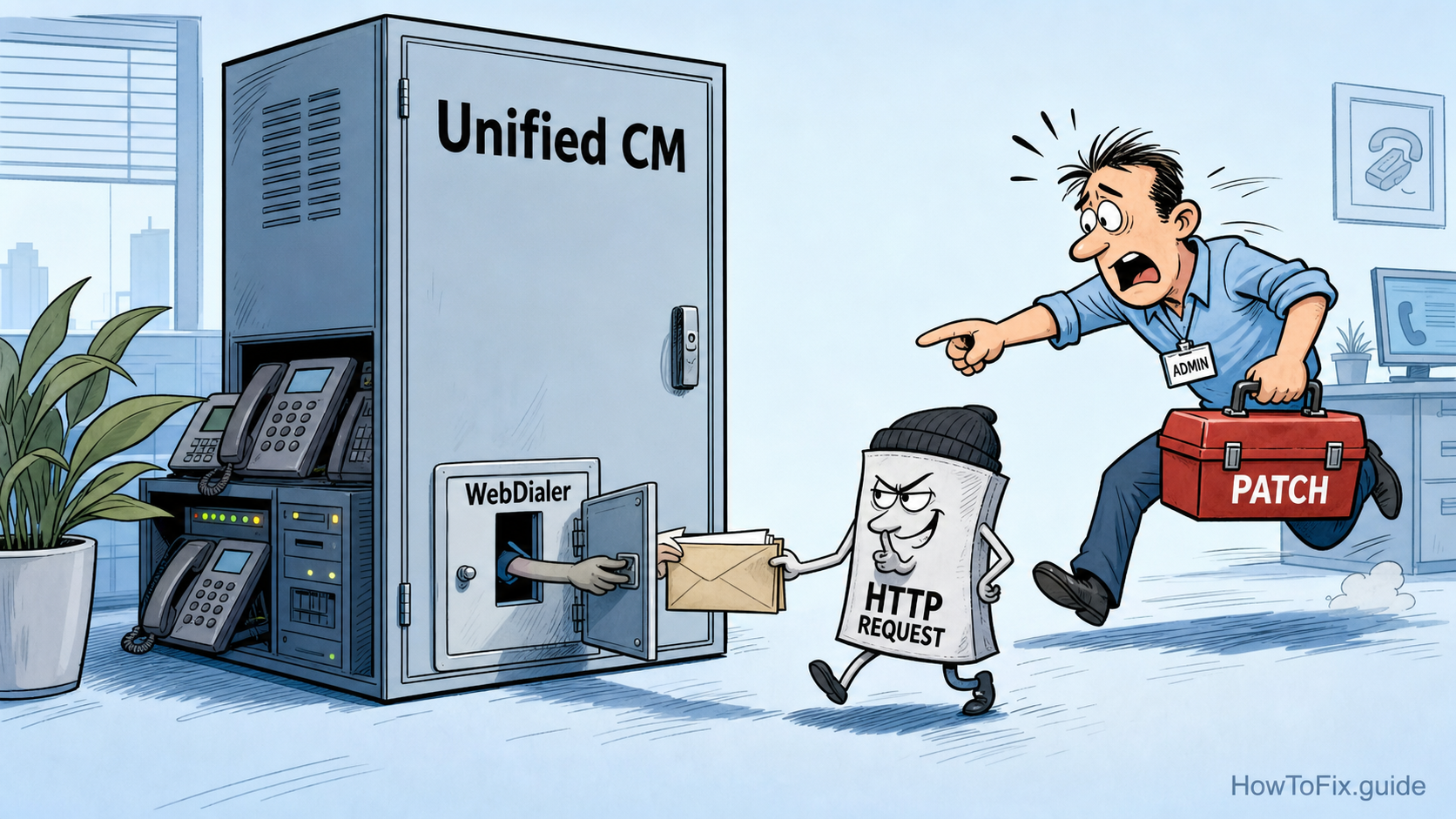
The practical risk is narrower than a default-on internet bug, but still serious for exposed voice infrastructure. Cisco says a crafted HTTP request could let an attacker write files to arbitrary paths on the affected device. The company gave the advisory a Critical security impact rating because successful exploitation could lead to root-level privilege escalation, despite the CVSS base score being 8.6 rather than 9.0 or higher.[1]
The exposure condition matters: WebDialer must be enabled. Cisco notes that WebDialer is disabled by default, so environments that never started the service are not in the same position as systems where administrators enabled click-to-call functionality. That nuance should not become a reason to ignore the advisory. Public proof-of-concept exploit code is already available, and Cisco PSIRT said it was not aware of malicious use at publication time.[1] The Hacker News and BleepingComputer both flagged the public PoC angle in their June 4 coverage.[3][4]
For howtofix.guide readers, the closest comparison is other edge or infrastructure flaws where a non-default condition still leaves real risk once a feature is turned on. Recent examples include Cisco’s own SD-WAN CVE-2026-20182 authentication bypass, the older Cisco phone adapter vulnerability that was left without a fix, and the Palo Alto GlobalProtect VPN bypass. In each case, the first useful question is not only “is the product installed?” but “is the affected service reachable in our deployment?”
What Cisco Unified CM admins should check now
Cisco’s fixed-release table lists 14SU6 as the first fixed release for Unified CM and Unified CM SME 14. For release 15, Cisco lists 15SU5, expected in September 2026, or an interim COP patch. Cisco also stresses that COP patches are version-specific, so teams should read the patch notes instead of assuming one package covers every deployment.[1] NVD has the CVE record published, but at the time of this run it did not add much operational detail beyond the Cisco-backed identifier.[2]
The fast triage path is straightforward. Log in to Cisco Unified CM Administration, switch to Cisco Unified Serviceability, open Tools → Control Center – Feature Services, and check the CTI Services section for Cisco WebDialer Web Service. If the status is Started, WebDialer is enabled and the system should be prioritized for the Cisco update path. If it is Not Running, document that result, but still plan the normal maintenance update because feature state can change later.[1]
Administrators should also review whether Unified CM management and application interfaces are exposed beyond trusted networks. Because the flaw is reached through HTTP requests, access controls, segmentation, and monitoring around unusual web requests to Unified CM remain useful compensating controls while fixed software is being scheduled. They are not a replacement for Cisco’s fixed releases, especially now that public exploit code exists.
Bottom line: if Unified CM or Unified CM SME is in your environment, check WebDialer state today, confirm the installed release, and map the update path to 14SU6, 15SU5, or the relevant COP patch. The best outcome is discovering that WebDialer was never enabled; the second-best is finding that out before public PoC code turns into a real intrusion attempt.
References
- Cisco Security Advisory: Cisco Unified Communications Manager Server-Side Request Forgery Vulnerability.
- National Vulnerability Database: CVE-2026-20230 Detail.
- The Hacker News: Cisco Patches CVE-2026-20230 in Unified CM as Exploit Code Goes Public.
- BleepingComputer: Cisco warns of critical Unified CM flaw with PoC exploit code.


Leave a Comment