
Google’s June 2026 Android security update fixes CVE-2025-48595, a high-severity Framework flaw that Google says may already be under limited, targeted exploitation.[1] CISA added the bug to its Known Exploited Vulnerabilities catalog on June 2, 2026 and set a June 5 remediation deadline for covered U.S. federal systems.[2]
The vulnerability is worth treating as more than routine mobile patch Tuesday noise. Android’s bulletin lists CVE-2025-48595 as an elevation-of-privilege issue in the Framework component, marked High severity, affecting Android 14, Android 15, Android 16, and Android 16 QPR2 branches.[1] NVD describes the bug as an integer overflow that can lead to code execution and local privilege escalation without extra execution privileges or user interaction, with a CVSS 3.1 score of 8.4.[3]
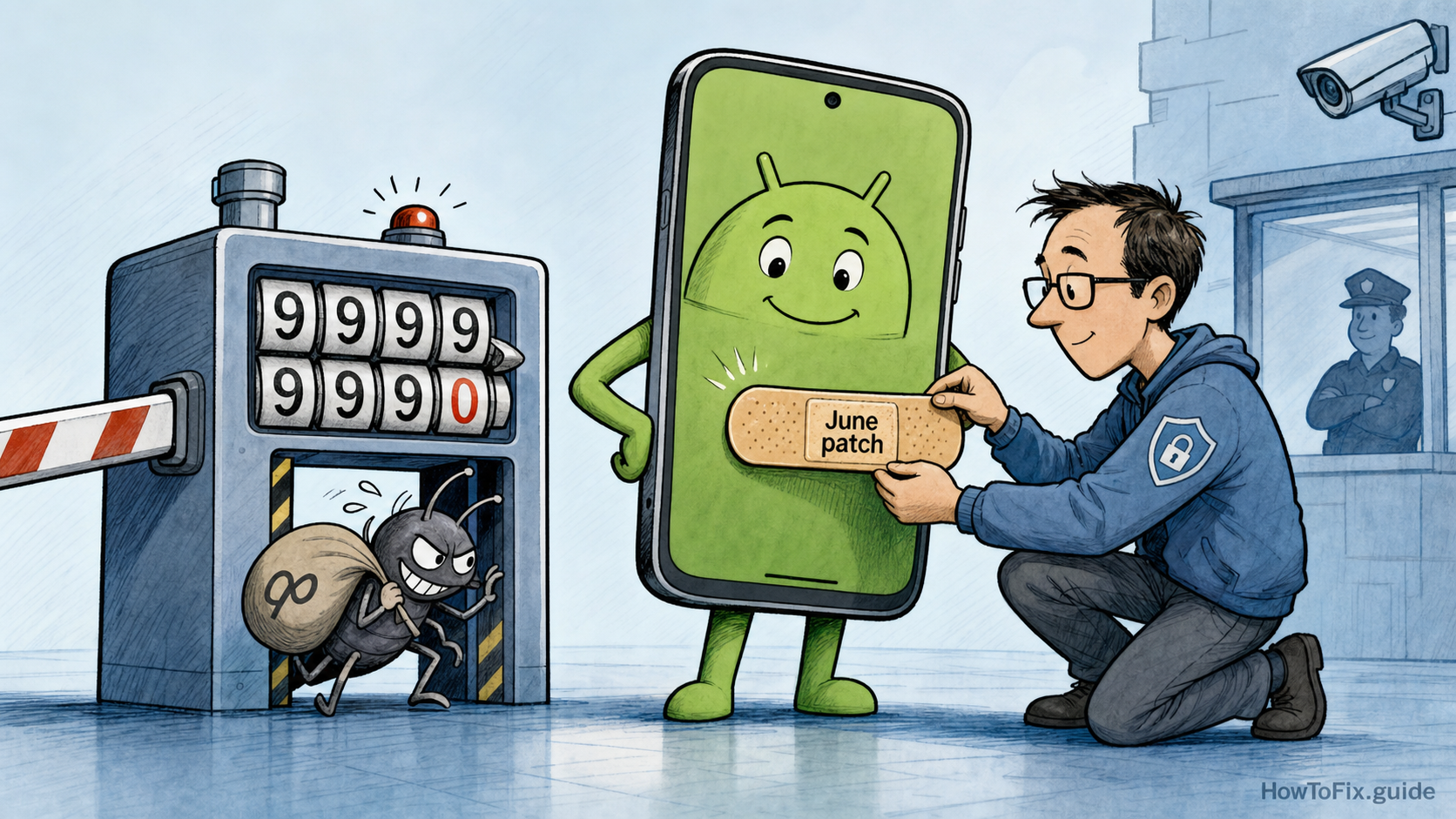
That local attack vector matters. It does not mean every vulnerable phone can be compromised remotely just by receiving a message. It does mean an attacker who already has a foothold through a malicious app, spyware chain, sideloaded package, or another exploit can potentially use the Framework flaw to move from app-level access toward broader device privileges. That is the same practical reason earlier mobile flaws, such as the Android Mali GPU vulnerability used by spyware, were urgent even when the exploit path was not a simple browser-style remote takeover.
The June bulletin also reminds users that Google Play Protect is enabled by default on devices with Google Mobile Services and is especially relevant for people who install apps outside Google Play.[1] That control helps, but it is not a replacement for a platform patch. Targeted mobile exploitation often combines several pieces: a delivery method, a first-stage exploit or malicious app, then a privilege-escalation step. CVE-2025-48595 appears to fit that last, high-value role.
What to check now
Android users should install the June 2026 security update as soon as it is available from their device maker or carrier. On Pixel and other promptly supported devices, check Settings -> Security & privacy -> System & updates and confirm the Android security patch level is at least 2026-06-01. Managed-device teams should inventory Android 14, 15, and 16 devices, then prioritize executives, journalists, administrators, developers, and users who sideload apps or travel with sensitive accounts.
For enterprise fleets, the triage should be practical: check MDM compliance for the June patch level, watch for devices stuck on older vendor firmware, review recent sideloading exceptions, and verify that high-risk users have Play Protect enabled. If a device shows signs of spyware-like behavior or suspicious admin/profile changes, do not rely on patching alone; preserve logs where possible, rotate account sessions, and consider a clean device rebuild. For broader context on how zero-day chains can quickly move from narrow targeting to wider abuse, see our recent coverage of Google’s zero-day 2FA bypass warning.
The update also fixes a large set of other Android vulnerabilities. The Hacker News counted 124 flaws in the June 2026 Android release, with CVE-2025-48595 standing out because of the exploitation note.[4] Older Android monthly bulletins, including our earlier note on June Android fixes for RCE and UNISOC issues, show the same recurring lesson: the monthly patch level is not just housekeeping, it is the easiest visible signal that a phone has received fixes for flaws attackers may already be testing.
References
- Android Open Source Project. Android Security Bulletin – June 2026.
- CISA. Known Exploited Vulnerabilities Catalog: CVE-2025-48595.
- NVD. CVE-2025-48595 Detail.
- The Hacker News. Google June 2026 Android Update Patches 124 Flaws, One Actively Exploited.


Leave a Comment