
Capetown-athletic.co.za is a scam website that offers to purchase items at unusually discounted prices. It may appear as a discounter, or as a marketplace for warehouse liquidation items, but it is in fact just a story to make you think this site is legitimate. Upon ordering from this site, you will most likely get nothing at all, or, at best, poor-quality or counterfeit items.
In this article, I will show the red flags regarding the Capetown-athletic.co.za site, the way this scam operates, and teach how to detect similar scams. This will help you to avoid similar shopping frauds in future.
Capetown-athletic.co.za Site – Scam Overview
As I said, Capetown-athletic.co.za may initially look like a legit discounter or the merchant of stock liquidation items. But a brief analysis shows a disturbing amount of red flags that indicate clearly about this site’s dishonesty. Unfair advertising methods, extremely low prices, absence of customer support and customer reviews – this site accomplishes the scam bingo right away.
| Website | Capetown-athletic.co.za |
| Hosting | AS13335 Cloudflare, Inc. Canada, Ottawa |
| IP Address | 23.227.38.32 |
| Threat Type | Scam/Fraud |
| Scam Type | Fraudulent/Scam online shop |

Capetown-athletic.co.za Scam
By purchasing items on sites like Capetown-athletic.co.za, it is unlikely that you will obtain the goods you’ve ordered. More often, it results in one of 3 situations typical for scam sites.
Counterfeit goods. Not the worst option, as you get at least something. But as it usually happens to fake items of popular brands, the grade will be inferior, to say the least. Eventually, the site may indicate about that somewhere deep in the item description or “about us” page, but users rarely check them thoroughly. This is a notably often case when ordering from sites that promote baubles, small electronics and stuff the like.
Wrong item. To make the purchase look legit, but spend even less money on the actual item, rascals may send a random item they have instead of your order. An old t-shirt instead of a branded one, a dented aluminum platter instead of a set of dishes – scammers may turn rather inventive in that case.
Absolutely nothing. This is the most usual case when ordering goods from sites like Capetown-athletic.co.za. Fraudsters take your money, promise the delivery, and then simply vanish. As scam sites do not aim to exist for a long time, scammers are not wasting time creating even a slight sight of legitimacy.
Capetown-athletic.co.za scam – How does it work?
As any scam, Capetown-athletic.co.za follows a simple and well-proven scheme of operations. It usually consists of 3 stages, with certain deviations from time to time.
Step 1 – Attract the Masses. Frauds post huge amounts of marketing on online platforms, particularly preferring Facebook, YouTube, Instagram and TikTok. Paid ads say exactly the same things as their sites do: 90% discounts, free delivery around the world, hurry up to get the deal.

Ads of fraudulent shops posted on different platforms
As users consider ads on the mentioned platforms benign, they do not suspect anything at this point. Ads become especially convincing during major events that boost people’s interest in shopping, like Halloween, Black Friday, Christmas, etc. Sometimes, they disguise themselves as resellers of the liquidated stock of bankrupt retail companies.
Step 2 – Take the Money. Once customers are on the website, fraudsters do their best to make the individuals buy something. Mind-boggling deals, additional discounts, free delivery, bright and blinking “Order Now” buttons that are just everywhere – they use every single method possible. And this works out – uninformed users stick to the offers and proceed to paying for the order.
Payments are done in a quirky manner. Instead of more classic options for online shopping, like Visa/MasterCard payments or PayPal, tricksters offer using direct bank transfers, Venmo or CashApp. Thing is, the latter do not provide any refunds, regardless of the circumstances. Even when you can prove that the transaction went to deceivers, “no refunds” is a part of their policy which you agree on upon registration.
Step 3 – Vanish. Once tricksters get enough money, or – what is more likely – there are enough grievances and user feedback regarding the site being a scam, they simply vanish. Usually, this happens at around the 2nd or 3rd week of the site activity. Once enough individuals know about the dishonest activity, the profits will dry up, leaving crooks with no reason to move on. Reporting the scam to the hosting speeds up the domain takedown.
Why is Capetown-athletic.co.za a Scam?
Well, we just talked about the way the hoax site operates. Now, let’s see how to understand whether the site is deceptive without risking your money. Fortunately, scammers do not bother themselves with creating well-rounded disguises, so the same red flags repeat from one site to another.
1. Fake or absent reviews
Fraud websites aim to exist for 1-2 weeks, so there’s no purpose (and way) to make any reputation with reviews. Obviously, even benign shopping sites will lack client testimonials when they have just started, as there were not many buyers yet. For that reason, this sign is not stand-alone and must be confirmed with other signs or indicators.

Definitely not generic comments generated by AI
However, when you face unrealistic reviews that have nothing to do with what the site sells, that’s definitely not a good sign. Any vague or absurdity reviews that may describe any item sold on the website should be taken with a grain of salt. And well, on scam websites you will get an entire saltcellar. Do not hesitate searching for reviews on Google – this may save your money.
2. Unbelievably high discounts/low prices
No merchants will sell goods at loss for themselves. 70%, 80%, 90% reductions are not viable even during sales events such as the aforementioned Thanksgiving day. In some cases, deceptive websites set the prices low without saying anything about discounts, but they will most likely be ludicrous, like $30 for a bed or $10 for a branded leather bag. Goods may be sold for cheap, but every discount has its sane limits.
3. No customer support.
This is what distinguishes fraudulent websites from the legit ones, even newly established. When a site is about to scam the clients, there’s no need to bother about answering their questions. Check out the “About us” or “Info” page – the site will most likely have no contact info whatsoever.
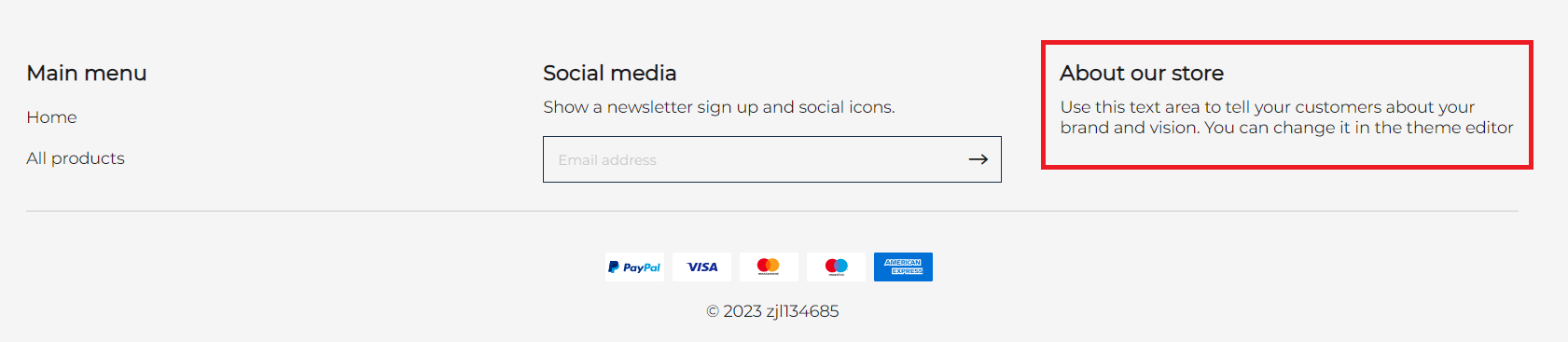
Typically for fraudulent websites, the “About us” column is completely empty
When they offer a contact email, or even a phone number to reach them out, there is a great possibility that these contacts will be unresponsive to your request. This, or you will receive some generic text regardless of your question.
As frauds tend to reuse numbers and emails as “support” contacts, you can search them on Google. When they appear on a completely different website, be sure you are facing a blatant scam.
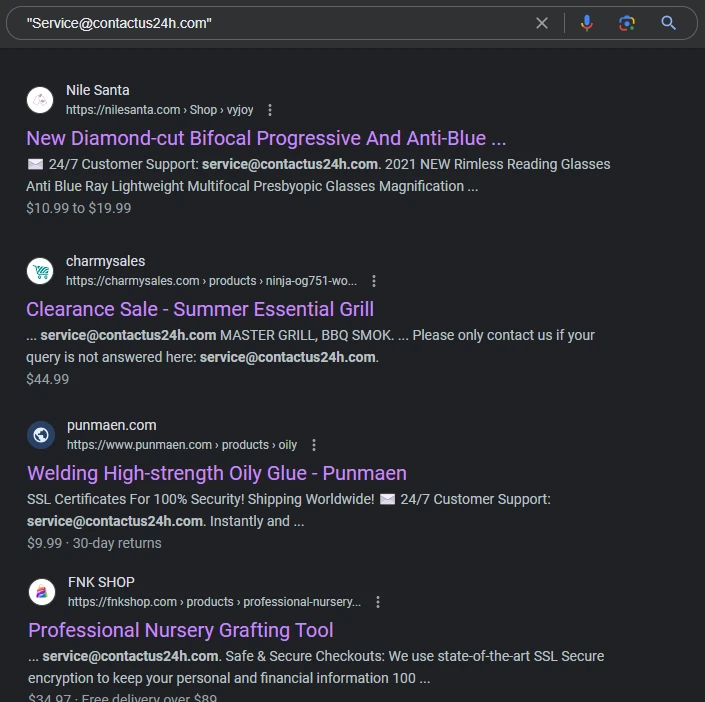
A chain of scam websites that use the same “support email”
4. Payments via payment systems that does not support refunds
This scam indicator is not a guarantee, as there are a lot of trustworthy shops and services using direct bank transfers, CashApp, Venmo or similar payment systems. Each of the latter has the same pitfall I’ve already mentioned above: they do not suppose any refunds. And this is what attracts scammers – once you’ve sent the money, nothing will help you to get the money back.
Some websites may also ask for payments in cryptocurrency, which is even less controllable than aforementioned payment methods. While cryptocurrency payments expand their presence slowly, they still remain a beloved bay for different scammers.
5. Items’ images are sourced from another page
As fraudsters are unlikely to have any real items on hand, they cannot create unique pics. Thus their option is to hijack these images elsewhere. When crooks sell the same items on different websites, you can find same images on similarly-designed fraudulent pages. By reverse image searching on Google, you can prove whether the image is unique or not.
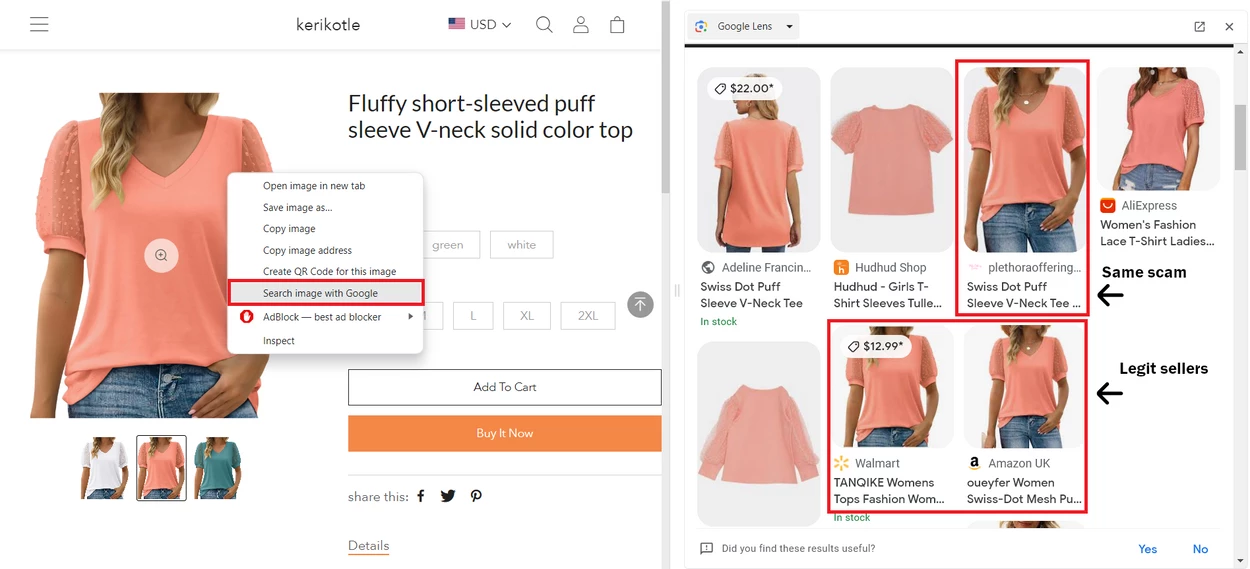
Image duplicates on another scam site, as well as on Amazon and Walmart sites
6. Design repeats the one of a different page
This is the continuation of the stolen images I’ve just described. As rascals may use the same topic again and again, they reuse the same site design under the new web-address, and voila – a new scam is ready to rock-n-roll! In some cases, image search advice I’ve mentioned above may lead you to the identical copy of the page you’ve started on. It allows you to unveil such frauds particularly easy, but scoundrels who run them never aim at cautious users.
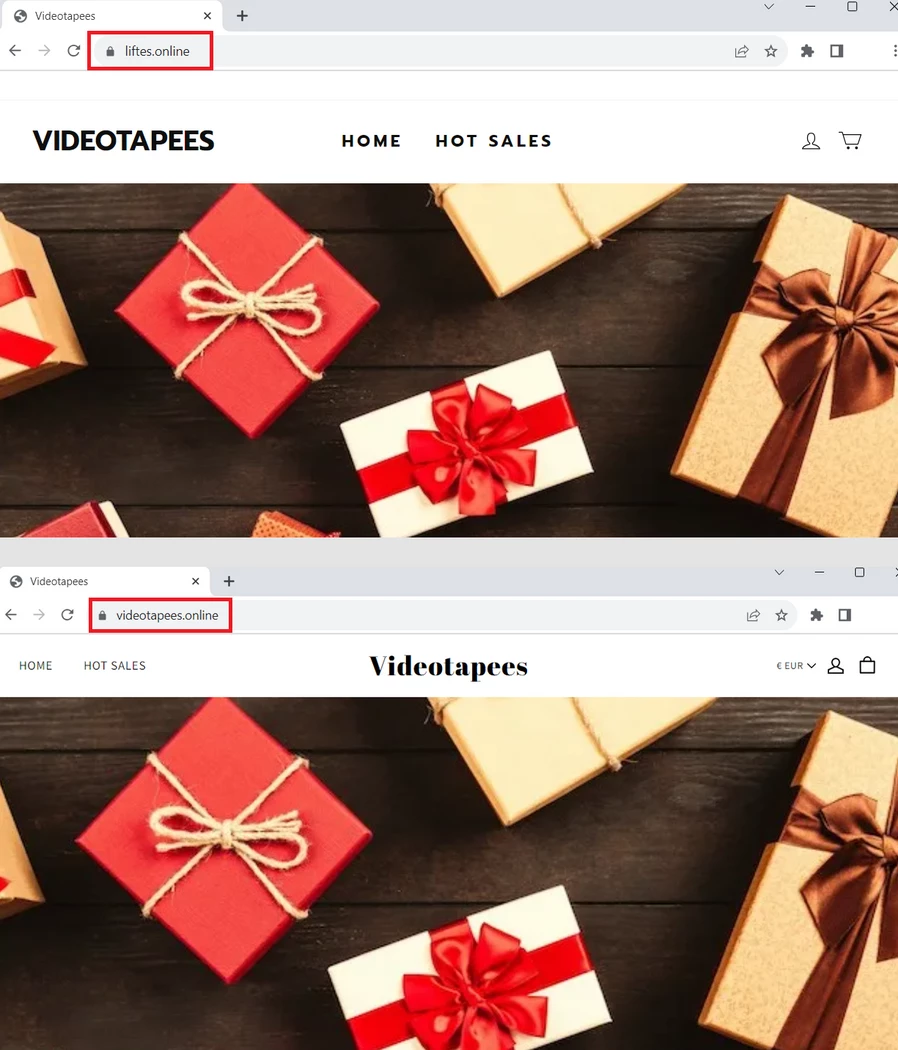
Example of scam sites that duplicate each others’ design
Frequently Asked Questions about the Capetown-athletic.co.za Scam
- Contact your bank or card provider and ask about chargeback options.
- Save screenshots, receipts, tracking numbers, and emails as evidence.
- Change reused passwords and enable two-factor authentication on important accounts.
- Watch for follow-up phishing emails pretending to offer refunds or delivery updates.

