
AggregatorHost.exe is commonly seen on modern Windows systems and is often located in C:\Windows\System32. Many users notice it in Task Manager and worry because the name is vague. Older pages labeled it as a coin miner, but that is not a reliable conclusion. The useful approach is to verify path, signature, behavior, and how it started.
What is AggregatorHost.exe?
AggregatorHost.exe appears to be associated with Windows components and has been discussed by users in connection with Windows updates, Defender/security components, and System32 activity. Microsoft documentation is not especially clear for this filename, so the safest guide is evidence-based rather than absolute.
If it is the Microsoft-signed System32 file and it behaves quietly, it is usually not a threat. If a copy with the same name runs from a user folder, it deserves investigation.
Safe vs suspicious signs
| Usually legitimate | Suspicious |
Located in C:\Windows\System32. |
Runs from AppData, Temp, Downloads, Startup, or ProgramData with a random folder name. |
| Signed by Microsoft or tied to Windows servicing/security context. | Unsigned file, unknown publisher, or invalid signature. |
| Appears after Windows updates and uses low resources. | Constant high CPU/GPU, suspicious network activity, or persistence after deletion. |
| No other compromise symptoms. | Browser hijacking, disabled security, fake alerts, or unknown startup tasks. |
How to verify it
- Open Task Manager, right-click AggregatorHost.exe, and choose Open file location.
- Check whether the file is in System32.
- Open file properties and review the digital signature.
- Check whether the process appeared after Windows Update or security updates.
- If the path is wrong, scan the file and inspect startup entries.
Why it may appear suddenly
Windows updates can introduce or activate components that users did not notice before. A process appearing after an update is not automatically suspicious. What matters is whether it uses a trusted Windows path, has a valid signature, and behaves normally.
When high CPU is a problem
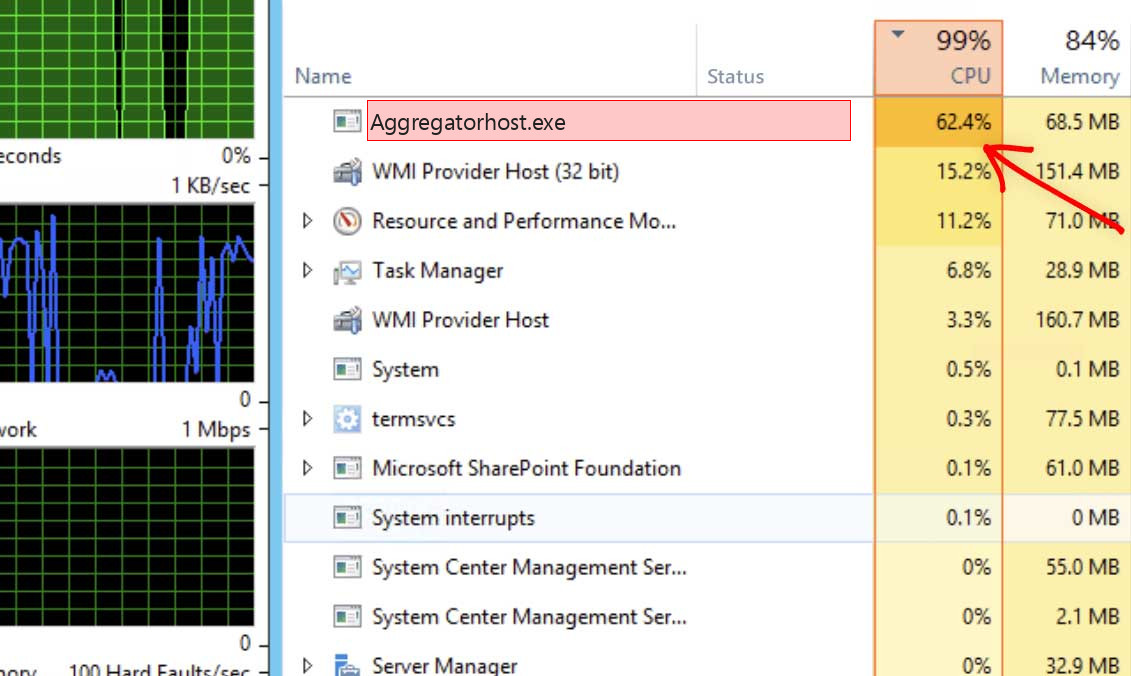
AggregatorHost.exe should not behave like a miner. If CPU or GPU usage is constantly high, collect the path, signature, command line, and parent process. Check Event Viewer and recent update history. If the file is legitimate but high CPU persists, Windows servicing or security components may be stuck and should be repaired through updates, SFC, or DISM.
When to scan for malware
Scan if the file is outside System32, unsigned, or linked to a suspicious task/service. Also scan if it appears with redirects, fake browser notifications, unknown extensions, or disabled Windows Security. A fake copy can exploit the vague name to look harmless.
Practical example
If AggregatorHost.exe is in System32 and appears after Patch Tuesday with low resource use, leave it alone. If it appears in AppData after installing a fake updater and starts through a random scheduled task, remove the launcher and scan the system.
After repair
After fixing Windows servicing or removing a suspicious copy, reboot and confirm the path and CPU behavior again. Keep notes about the file path and signature so the same process is not misidentified later.
Decision tree for AggregatorHost.exe
If AggregatorHost.exe is in System32, signed by Microsoft, and quiet, leave it alone. If it appears during or after Windows updates, that timing also supports a Windows-related explanation. If it is unsigned, located in a user folder, or launched by an unknown task, treat it as a fake copy.
Because the filename is poorly documented and generic, this page avoids pretending there is one universal answer. Evidence matters more than certainty from the name.
Repair path for the legitimate Windows file
- Install pending Windows updates and reboot.
- Check Reliability Monitor for crashes around the same time.
- Run
sfc /scannowif Windows components look damaged. - Run DISM repair commands if SFC reports problems it cannot fix.
- Do not delete the System32 file.
Common false alarms
A newly noticed process after Windows updates is not automatically malicious. Many users discover processes only after opening Task Manager during a slowdown. If the process has the correct path and signature, investigate the broader performance issue before blaming the filename.
What to record before removal
If you find a suspicious copy, record path, signature, creation date, and startup source. Search for other files created in the same folder at the same time. Remove the launcher and scan the system after reboot to make sure the fake copy does not return.
When performance symptoms point elsewhere
If AggregatorHost.exe is quiet but the system is still slow, look at disk, memory, Defender scans, Windows Update, and browser processes. It is easy to blame a vague process name while another component is doing the work. Use Task Manager sorting and Resource Monitor to confirm the actual resource consumer before removing anything.
If the file was a fake copy, change passwords from a clean device if browser or account activity looked suspicious.
Do not keep broad antivirus exclusions for the folder where the fake copy was found.
Document the correct System32 path after verification so future checks are faster.
This keeps the decision based on evidence rather than fear of an unfamiliar process name.
FAQ
Is AggregatorHost.exe malware?
The System32 copy is usually not malware. A fake copy in a user folder can be malicious.
Why does it have a vague name?
Some Windows components have generic names. That is why path/signature verification matters.
Should I delete it?
No, not if it is the legitimate Windows file. Investigate suspicious copies instead.



Leave a Comment